
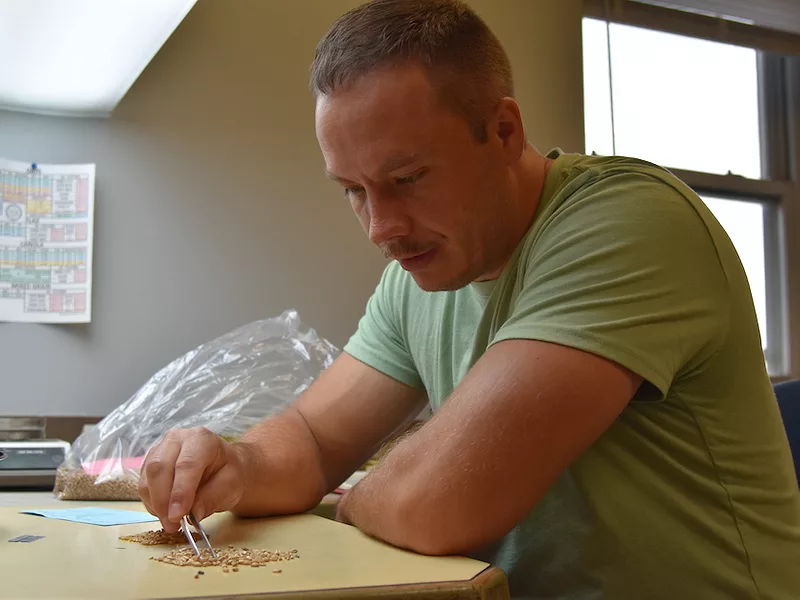
Robert Moore dumped a pan of wheat kernels into an old blue machine and flipped a switch. Noisily, the contraption began to shake, spilling seeds into a series of sieves. When he turned it off, a group of broken kernels had been neatly separated from the rest of the grain.
Moore, the manager of the Wisconsin Department of Agriculture, Trade and Consumer Protection Grain Inspection Service, was running a sample of spring wheat through a dockage tester, which helps inspectors check for broken seeds, weeds and foreign materials. Next, he walked over to a scale where he weighed one pan of the grain. He then settled into a chair, grabbed tweezers and carefully picked at a kernel, studying it intently for mold and damage.
This wheat had come from one of six elevators nestled along the banks of Lake Superior that store grain from farms in North Dakota, South Dakota and Minnesota. Most such shipments eventually head to Europe or northern Africa — so long as they pass the inspection process.
"The health and safety of bread that’s baked in Italy really starts here with our team looking at the volume, quality and safety of that grain of wheat,” Wisconsin Agriculture Secretary Randy Romanski told Agri-Pulse.
Moore and the other grain inspectors working out of the port that rests between Duluth, Minnesota, and Superior, Wisconsin, are employed by the state of Wisconsin, despite performing duties typically reserved for staff of the U.S. Department of Agriculture. The inspection program was set up under an agreement between the state and USDA and is funded by user fees assessed to shippers who send their grain through the port.
For a time, that funding source worked. In the 1980s, the Wisconsin Department of Agriculture employed more than 100 inspectors, according to Jeremy McPherson, who serves as the director of the agency’s bureau of trade practices. But now, only 14 inspectors remain Randy Romanski (Noah Wicks photo) — the minimum needed by the department to meet its service obligations.
It's a challenge driven by declining grain shipments in the Great Lakes and other port systems across the U.S. where state departments of agriculture oversee inspection services. State officials are now seeking federal dollars to help keep their grain inspection programs afloat as they weigh dipping into their own funds to fulfill agreements they made with the USDA.
Declining grain flows fuel drop in inspection revenue
Grain shipments through Duluth and Superior dwindled over the years as shippers began sending grain to larger Panamax vessels at ports along the coasts, rather than the smaller “salties" that transit the St. Lawrence Seaway. In 1980 more than 8 million metric tons of grain passed through the port. But last year, that number was 720,201, according to data from the Duluth Seaway Port Authority.
Kate Ferguson, the Duluth Seaway Port Authority’s director of trade and business development, said 30 years ago, the port handled a number of different grain varieties, like wheat, soybeans and sunflowers. But shifting global trade flows have since reshuffled routes for several of these commodities. Growing Chinese demand for soybeans inspired shippers to send more by rail to West Coast ports. Fewer Midwestern farmers are now growing wheat, which is the dominant crop shipped through Duluth and Superior.
Last year, 561,320 short tons of spring wheat were routed through the port alongside 118,833 short tons of durum wheat, 46,287 short tons of oats and 67,435 short tons of beet pulp pellets, according to data from the Duluth Seaway Port Authority. Small volumes of soybeans, flax and canola traveled through the port in the past, but not in recent years.
Alongside the long-term decline in grain shipments at the port of Duluth-Superior came a drop in program revenue derived from user fees. The program generated more expenses than revenue in five of the last seven fiscal years, leaving Wisconsin's state government with little choice but to use its own dollars to fill in the gap, according to data provided to Agri-Pulse.
Over the last 10 years, Wisconsin has put more than $2 million into sustaining the grain inspection program, according to a briefing paper. If state officials were to cut more staff, the program may fail to meet service requirements.
“We’ve converted state funds to do this work because we believe in the work,” Romanski said. But he added: "It’s not sustainable for the state to continue to subsidize a USDA and international service.”
Most of the inspectors' work is done in a small brick building in Superior just a few blocks from the harbor. Inside, the floor is covered with orange carpet that seems straight out of the 1970s.
Atop a desk in the facility’s main room sits a stack of black-and-white photos that capture moments from the grain inspection program’s long history. Moore flipped through them, stopping to examine one of a grading demonstration that was once performed for audiences at the Wisconsin State Fair. He pointed to a metal grain divider that sat onstage, which was nearly identical to the one still in use by the department — one sign of program administrators' frugality under the program's lean budget.
It’s easy to be “in the know” about what’s happening in Washington, D.C. Sign up for a FREE month of Agri-Pulse news! Simply click here
“What you’re seeing is equipment that has stood the test of time,” Romanski said a little while later, watching as Moore poured wheat kernels down a weathered grain divider made of copper and brass. “The facility is a little old. The lights may not turn on. But the work gets done.”
State agencies seek fresh funding to sustain inspection services
Romanski has been advocating for a baseline level of program funding from the federal government outside of user fees to ensure a more stable budget. It’s a request he said he's made to USDA officials, and while he said they understand Wisconsin's funding challenge, he has yet to see additional dollars.
USDA did not respond to a request for comment by the deadline for this article.
"Current funding structures are not sustainable, and the service fee-based structure sacrifices efficiency and competitive pricing of U.S. grain products,” Ted McKinney, CEO of the National Association of State Departments of Agriculture, said in a statement.
He said NASDA supports a “new base funding structure from USDA to conduct the inspection programs to create stability and certainty for exporters as states already have the facilities and infrastructure to provide needed inspection services.”
Wisconsin and three other states — Alabama, Virginia and Washington — are currently authorized by USDA to perform mandatory grain inspections at export ports, according to the Congressional Research Service. Six others — Louisiana, Maryland, Missouri, Montana, North Carolina and Utah — can do voluntary inspections at these ports and mandatory inspections at nonexport ones.
Wisconsin isn’t alone when it comes to facing funding challenges, Romanski said. He said Washington and Virginia officials have supported his request. Washington’s agriculture department has “faced some difficulties” funding its inspection services in the past due to tonnage reductions, though agency spokesperson Daniel Schafer told Agri-Pulse that 2025 has been a “very good year for the program."
On the Great Lakes, current funding challenges also echo history to some degree. Minnesota handled grain inspections for Duluth up until 2005, while Wisconsin focused solely on those passing through Superior, McPherson said. When declining grain shipments threatened program funding, Minnesota decided to shift control back to USDA’s Federal Grain Inspection Service, which conducted inspections for six years before passing the responsibility to Wisconsin’s Agriculture Department in 2011.
 Thom Petersen (Noah Wicks photo)
“From what I remember, it was a budget situation,” Minnesota Agriculture Commissioner Thom Petersen said of the state’s decision to stop its program. “Kind of similar to the challenges now that are going on.”
Romanski and other supporters of baseline funding for state programs also see Congress’s reevaluation of the U.S. Grain Standards Act as a way to address their concerns. The bill, which establishes marketing standards for grains and oilseeds, is up for reauthorization in September. The House Agriculture Committee advanced its version on Tuesday without the requested funding, though the Senate Agriculture Committee has yet to take up its own draft.
When pressed about whether Wisconsin could continue to operate the program without additional funding, Romanski said for now, the state intends to honor the commitment it made to USDA when it first signed the agreement. He added that he doesn’t know whether USDA or any other entities have the capacity to step in and replace Wisconsin when it comes to conducting grain inspections at Duluth and Superior.
“If there’s a need, we have to make the ask,” Romanski said of his department’s request for additional funding, adding that "this is too valuable of a service."
To see a gallery of photos from Agri-Pulse's visit to Wisconsin's grain inspection facility, click here.
For more news, go to agri-pulse.com.

