

As California’s summer camping season peaks and state park reservations remain scarce, lawmakers are advancing a bill that could open the door for farmers and ranchers to earn extra income by hosting campers on their land with fewer regulatory hurdles.
Assembly Bill 518, authored by Assemblymember Chris Ward, D–San Diego, would allow counties to opt in to a framework for permitting low-impact camping areas on private property. The measure is aimed at expanding outdoor access across the state, but its strongest implications may be for working agricultural lands, where some landowners are already seeking ways to diversify revenue amid rising input costs, water uncertainty and an escalating regulatory environment.
“Farmers, ranchers and rural landowners across the state are struggling with the increased cost of land ownership in California,” Ward told a Senate committee last week. “Currently, landowners looking to set up campsites on their property to share with the public often face a self-imposed bureaucratic barrier and lengthy permitting system at the state level, which can cost more than $100,000 and in some cases even significantly more than that.”
A farm diversification tool
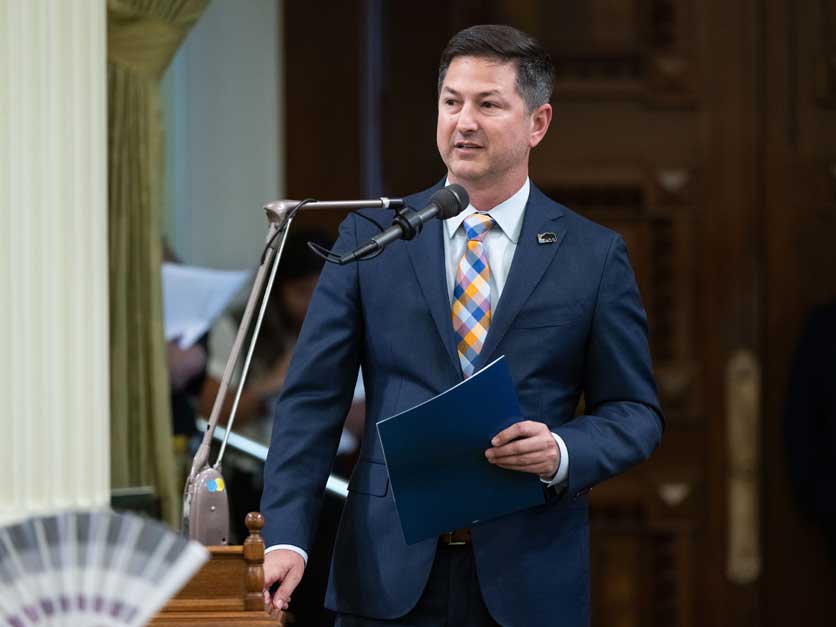 Asm. Chris Ward, D-San Diego (photo: Ward's office)
Under AB 518, landowners in counties that adopt the program could host up to nine temporary campsites for tents, yurts or RVs on parcels of at least two acres. Campers could stay no more than 14 consecutive nights and no more than 28 nights total in a year. The campsites would be exempt from the state’s Special Occupancy Parks Act, which governs formal campground permitting through the California Department of Housing and Community Development.
Ward said his bill gives counties a pathway to support responsible landowners, noting that 50 of California’s 58 counties already allow some form of this use informally or under general land-use discretion.
The bill sets basic standards for sanitation, noise control and safety, requiring quiet hours between 10 p.m. and 6 a.m., a 200-foot buffer from offsite residences and compliance with fire, health and tax codes. Counties would be responsible for maintaining a registry of operators and enforcing complaints.
To some in the agricultural sector, the measure presents a low-risk way to help offset financial pressures without needing to develop or permanently convert land.
“Agritourism gives these farmers the opportunity to explore new sources of income while educating the public on commodities grown in the region,” testified Steven Fenaroli, who directs policy advocacy at the California Farm Bureau.
The bill has also gained the support of Hipcamp, a tech company known for its app connecting travelers to campsites on private land.
“Today, whether you have 200 RV parking spots or two tents on a working farm, [the parks act] imposes the same commercial grade standards for infrastructure: 18-foot paved roads, flood lighting, septic systems with gendered bathrooms,” said Micha Rosenoer, who leads government relations at Hipcamp. “These requirements are often incompatible with ranching or farming operations and conservation efforts.”
Rural recreation advocates and farmers see opportunity
Proponents point out that demand for camping in California has soared in recent years, while the state’s public camping capacity has remained largely flat.
“Outdoor recreation hit a record high in 2022, with more than 19 million Californians going outside, and it provides an estimated $74 billion for the state's outdoor recreation economy,” said Ward. “However, nearly half of the campers report difficulty finding and booking available campsites.”
It’s easy to be “in the know” about what’s happening in Washington, D.C. Sign up for a FREE month of Agri-Pulse news! Simply click here
During an Assembly hearing on the bill, Lexie Gritlefeld, director of the California Outdoor Recreation Partnership — which is “basically an outdoor chamber of commerce” — said the bill helps connect the unmet demand with rural communities that can benefit.
“AB 518 comes at a time of highest importance,” said Gritlefeld, calling it a commonsense bill.
Campground industry warns of unfair competition
While the measure has found favor with rural landowners and recreation advocates, it has drawn sharp opposition from the state’s traditional campground industry. Operators argue the bill creates an uneven regulatory playing field by exempting the camping areas from state standards that formal campgrounds must still meet.
Dyana Kelley, president and CEO of the California Outdoor Hospitality Association, countered Ward’s claims by pointing out that camping was down 30% across the association’s privately owned campgrounds.
“This bill is bad for California campers, it's bad for local government, and it allows the circumvention of current regulatory process for the benefit of one corporation,” said Kelley.
Lobbying on behalf of the association, Andrew Govenar raised concerns with classifying RVs under low-impact camping, arguing that would encourage those RV owners to empty their sewage at campgrounds equipped with dump stations. Solano and Siskiyou county supervisors opposed the bill as well, outlining issues with code enforcement and fire risks, arguments that convinced several of their region’s legislators to oppose or lay off the bill.
Assembly Republican Leader James Gallagher, R–Yuba City, worried about zoning conflicts and preserving ag land use, among other concerns.
“Our rural and our agricultural areas need to remain rural and agricultural,” Gallagher said during Assembly floor debate, while speculating that the bill could increase complaints over pesticide spraying and dust from farming activities and create venues for squatters and homeless encampments.
Ward maintained that the bill’s limited scope, opt-in structure and caps on guest numbers strike a fair balance between rural flexibility and regulatory responsibility and that the legislation is ultimately about giving counties and landowners options.
For more news, go to Agri-Pulse.com.

