
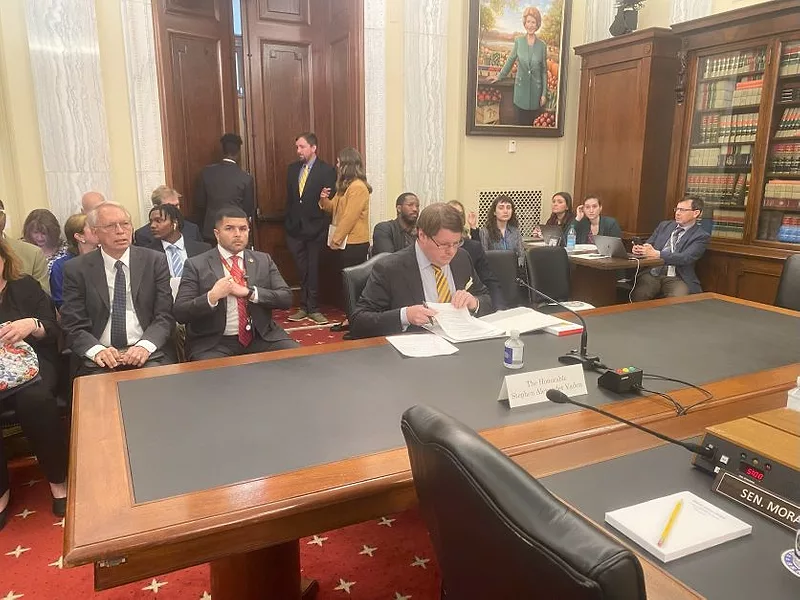
Agriculture Deputy Secretary Stephen Vaden staunchly defended USDA’s reorganization plan at the Senate Agriculture Committee Wednesday, saying it would make the department more efficient and allow more employees to live in areas where they can afford to buy a home.
When it was announced last week, senators on both sides of the aisle were unhappy they had not been informed of the plan beforehand, or at least asked for advice on its contents. Vaden said that was out of respect to employees, who were the first to learn of the plan from comments delivered by Ag Secretary Brooke Rollins.
He also indicated that the department did not want the news to be leaked by Congress.
Vaden is leading implementation of the plan, which foresees moving more than half of the 4,600 employees in the national capital region to regional hubs in Raleigh, North Carolina; Kansas City, Missouri; Indianapolis; Fort Collins, Colorado, and Salt Lake City. At the hearing, he said it would be unrealistic to believe all employees would be willing to move, but that he thinks “more than a majority” would accept relocation, in part because the D.C. area’s job market “isn't what it once was.”
He also said the plan does not favor reductions in force. Rollin's memorandum "puts a thumb on the scale against future RIFs," which can only be approved by him.
He said the release of the plan kicked off a 30-day period where the department can consult with lawmakers and stakeholders. The plan is “essentially the green flag, not the checkered flag,” he said.
Vaden said the department would be saving about $4 billion from the deferred resignation program and building closures, including the Ag South Building in Washington – $1.9 billion from the DRPs and $2.2 billion in deferred maintenance on the buildings, which also include Braddock Place in suburban Alexandria, Virginia, and the Beltsville Agricultural Research Center in suburban Maryland.
The $4 billion is the “baseline” of savings before considering the lower cost of living for employees and lower lease rates, he said.
Both Democratic and Republican senators said they supported, or were not necessarily opposed to, moving USDA employees out of the D.C. area, but wanted to know how it would make the agency more efficient and responsive to farmers.
Ag Committee Ranking Member Amy Klobuchar, D-Minn., who continued to call the plan “half-baked,” honed in on the department’s research capabilities. “Do you think that these actions are actually going to make us more competitive when it comes to ag, more competitive when we are dealing with research issues across the world? And how will you ensure that critical research projects will not suffer?”
The cost of living was a paramount consideration in developing the plan, Vaden said.
“According to the Federal Reserve, the median price of a home in the Northeast region is more than $800,000,” Vaden said. In the Midwest, “where we're sending many of our employees, it’s less than half that.”
It’s easy to be “in the know” about what’s happening in Washington, D.C. Sign up for a FREE month of Agri-Pulse news! Simply click here
Vaden also said that 90 of 94 Agricultural Research Service laboratories would stay open. He did not identify the four locations slated for closure. He also said that although the Food and Nutrition Service’s headquarters building in Virginia would be shut down, that doesn’t mean all FNS employees would be farmed out to the hubs.
Some employees in each of USDA’s eight mission areas, including food and nutrition, would remain in Washington in either the Whitten Building or the Yates Building. When it comes to FNS, he added, in response to a question from Sen. Tommy Tuberville, R-Ala., “As we shift more people into the field who are focused on the states and focused on the regions of the country that you serve, that means more people or individuals in Alabama and every other state to reach out to” for technical assistance or other issues.
Vaden said USDA plans to shut down buildings that are underutilized, citing the USE IT Act, a law that passed the Senate 97-1 as part of the Water Resources Development Act reauthorization and was signed into law earlier this year by then-President Joe Biden. The law mandates federal buildings demonstrate 60% occupancy.
The South Building’s usage rate is well below that figure, he said, citing a peak of 36.9% usage.
Much of the hearing focused on the locations of the hubs, which Vaden said were chosen not just because of their lower cost of living, but for their proximity to other USDA offices.
Sen. Deb Fischer, R-Neb., said she was disappointed in the roll-out of the plan and “the lack of engagement with Congress prior to the announcement.” She said she "would have liked to see a process that allowed for Nebraska to demonstrate its strong value proposition" and said, “Congress will need to be a partner to provide resources and perhaps additional authorities.”
“USDA will be proactive and engaged with this committee and also with the Appropriations Committee,” said Vaden, stressing that the secretarial memorandum issued by Rollins July 24 was “not the final step” in the process.
Sen. Adam Schiff, D-Calif., questioned whether the Trump administration’s treatment of California is politically motivated because a majority of Californians did not support Trump for president. Schiff cited in particular the lack of a regional hub not just in California but in any of the top five agricultural states.
Vaden said politics didn’t enter into the decision, but that California didn’t make the cut because of the cost of living.
The regional hubs present an “exciting opportunity” for employees to grow and expand their families due to the lower cost of living, Vaden said.
For more news, go to Agri-Pulse.com.

