
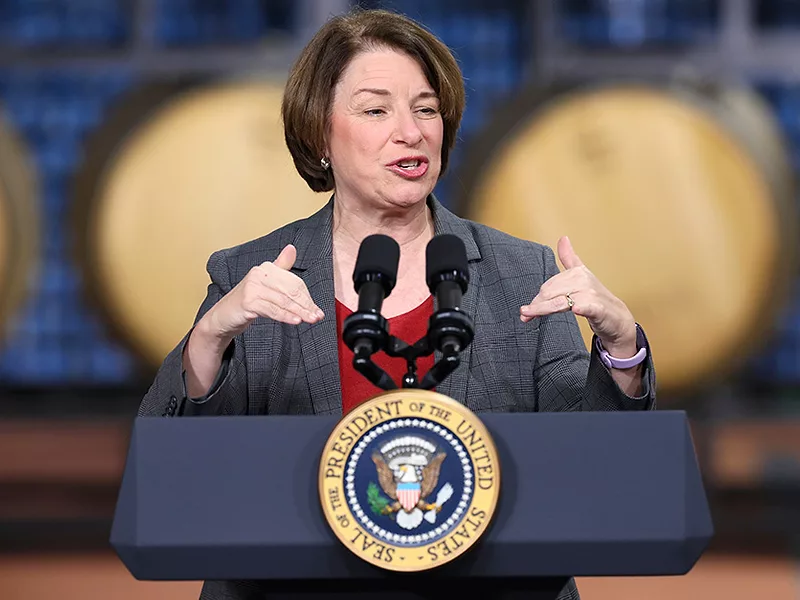
Senate Agriculture Committee Chair John Boozman, R-Ark., and the committee's top Democrat, Amy Klobuchar of Minnesota, are calling for a hearing on USDA’s reorganization plan, which Klobuchar said was "completely unacceptable" and would “decimate research work at the USDA.”
“The U.S. Department of Agriculture plays a critical role in supporting America’s farmers, ranchers and rural communities," Boozman said in a statement. "The best way to serve our agriculture community is by working together, so it’s disappointing USDA didn’t share its plans in advance of this announcement. I will be thoroughly examining the details of the proposal and look forward to hearing more about the reorganization from [Ag] Secretary [Brooke] Rollins.”
Klobuchar gave a short statement to reporters after the announcement went out from USDA, which includes plans to close the South Building in Washington, D.C., and the Beltsville Agricultural Research Center in Maryland, and consolidate some departmental operations in five regional hubs.
“Obviously it's completely unacceptable, and it's going to decimate research work at the USDA,” she said. “I asked for a hearing next week on this, and hopefully we will have one.” Boozman also said he wants to hold a hearing as soon as possible.
Klobuchar said she got only a brief advance notice of the announcement for something that’s going to “destroy the whole USDA.”
"We were given a 15-minute embargoed press release,” she said. "They have literally come up with this half-baked proposal to divide the USDA into five parts with no consultation."
Sen. Deb Fischer, R-Neb., said she "was surprised" by the announcement. "I hadn’t heard anything about it. So look forward to hearing from the secretary what the details are.”
Sen. Joni Ernst, R-Iowa, said she had not seen the proposal yet, "but what we want to make sure is that they're delivering for our farmers and ranchers efficiently. So, I'm always happy to talk it over with Secretary Rollins, but look forward to seeing it.”
Sen. Jerry Moran, R-Kan., said he didn’t know much about the plan, but commented on the relocation aspect. “What I know about it is that Kansas City was on the list, and we've been through this previously, where a couple of research agencies at USDA were moved to Kansas City, and we hope that what that means is that there's continued expansion of the workforce in agriculture in Kansas, maybe Kansas City.”
Sen. Roger Marshall, R-Kan., said, “I think it'll be great for American agriculture,” pointing in particular to the presence of the Economic Research Service in Kansas City, Missouri.
The ERS was relocated from Washington during the first Trump administration, leading to the loss of personnel and a reduction in work output from ERS.
“I think this has been a priority for Secretary Rollins, to get USDA workers out closer to producers,” Marshall said. “So we have this office in Kansas City – research. They do a lot of data collection, so I'm all for it. We've got some incredible graduate programs around there for agriculture – Iowa State, Nebraska, of course, Kansas State University. Missouri has a great ag program as well.”
However, Rep. Angie Craig, D-Minn., ranking member of the House Agriculture Committee, noted that “when the first Trump administration relocated USDA’s Economic Research Service and National Institute of Food and Agriculture outside of the Washington, D.C., area, about 75 percent of employees impacted declined the move, resulting in a massive brain drain and significant loss of productivity at both agencies."
“That the administration did not consult with Congress on a planned reorganization of this magnitude is unacceptable," Craig said in a statement. "I call on Chairman Thompson to hold a hearing on this issue as soon as possible to get answers. We need to hear from affected stakeholders and know what data and analysis USDA decisionmakers used to plan this reorganization.”
Sen. Todd Young, R-Ind., said the selection of Indianapolis as one of five new USDA regional hub locations is "exciting news for Hoosiers. It’s great to see these USDA services move outside of Washington and into places like Indiana that feed our nation.”
In addition to Kansas City and Indianapolis, the other three regional hubs are Fort Collins, Colorado; Raleigh, North Carolina; and Salt Lake City, Utah.
Sen. John Hoeven, R-N.D., said he wants to speak with Deputy Secretary Stephen Vaden, who has been tasked with carrying out the plan.
Hoeven said he wants to “go through it in some detail and kind of see what their thoughts are,” indicating perhaps “some adjustments or modifications” could be made.
Sen. Tim Kaine, D-Va., said he was not surprised by the administration's desire to move people out of the D.C. area., but called it "a little bit of a fig leaf for 'we just want to shrink government.'"
Se. Ted Budd, R-N.C., said he had not seen all the details of the plan, but that he supported the notion of moving people from the National Capital Region. "Getting things out where the people actually are makes the mission of the agencies even stronger."
It’s easy to be “in the know” about what’s happening in Washington, D.C. Sign up for a FREE month of Agri-Pulse news! Simply click here
Former Ag Secretary Dan Glickman, who served under President Bill Clinton, said it’s important Congress be involved in the decision-making process.
“My observation of moving boxes around in government is, are you accomplishing what you want in terms of your objectives? So, in the case of the department, are we helping food safety? Are we helping our research establishment? Are we serving farmers better? So I'd want to know how all these moves impact the quality of their services, because they're going to be disruptive no matter what happens.”
“The Department of Agriculture is probably closer to Congress than any other department in government, so I hope at least the Congress looks at this,” he said.
Glickman withheld any broader judgment about the wisdom of the plan, saying, “Not all of it may be bad, some of it may be okay, some of it may not be good – but they need to have Congress's buy-in, as well.”
Bruce Knight, a former Natural Resources Conservation Service chief during the George W. Bush Administration, said the idea of "pressing reset and downsizing the D.C. presence while maintaining the farmer focus" is "healthy and needed and positive."
"This should be given a chance to work," Knight said.
However, Robert Bonnie, who was undersecretary for farm production and conservation during the Biden administration under Ag Secretary Tom Vilsack, said the plan would have overwhelmingly negative effects.
"Having spent a significant portion of the Biden administration trying to unwind a poorly executed reorganization [of FPAC], I think this latest proposal is hugely problematic, and I think it will weaken the ability of USDA to serve farmers and ranchers," he said.
Bonnie said he's particularly concerned about the elimination of nine regional Forest Service offices, which the plan says will be phased out over the next year.
"A lot of the those regional Forest Service offices are critical to fire response, so I think they're weakening fire response," he said.
He said moving senior leadership out of Washington to regional offices also will weaken the voice of U.S. agriculture in policymaking, because groups that conduct fly-ins to meet with lawmakers and senior officials will no longer be able to see the people they need to.
"They do fly-ins all the time, and they come and they'll meet with leadership, but then they'll go meet with the different agencies, and they're all gathered in one place." he said. "What are they going to do now? They haven't thought through any of these issues."
Gbenga Ajilore, who previously served as a senior adviser in the office of the undersecretary for rural development, said the messaging in the plan about making USDA a customer-focused agency conflicts with the fact that more than 15,000 people from across the country have so far taken buyouts.
"They're moving people out of D.C. and moving them into, pretty much big cities ... at the same time that they're removing staff from these field offices that may end up being closed," he said. "I just don't see how that's going to work."
Kevin Shea, former administrator of the Animal and Plant Health Inspection Service, told Agri-Pulse, "I think this is just kind of part of the vengeance tour against D.C.-area people."
"So many people have lives here, they have spouses here with jobs here," Shea said. "It's going to be very difficult for them, and I don't know what they gain by having those people work in other places around the country."
"Many of the things that people do in the D.C. area for APHIS and other parts of USDA involves providing information to the political appointees and to members of Congress and to the industry organizations that often are D.C.-based," he continued. "So it's not as if the people here deal with farmers day-to-day like people in Farm Service Agency might do or Rural Development might do. They're dealing with people at the headquarters level. So I think it's a little disingenuous to say they'll be able to better serve the people they typically serve by going away."
Noah Wicks and Oliver Ward contributed to this story.
For more news, go to Agri-Pulse.com.


