
The shortage of affordable housing in the United States is starting to get nationwide attention. For Californians, access to housing has been a crisis for some time, and the state’s agricultural workforce has been uniquely affected by a lack of housing availability.
State-level legislation signed into law June 30 promises to boost housing production through reforms limiting the reach of the California Environmental Quality Act, a stringent law that many housing activists point to as one principal cause of California’s housing problems.
The new law can limit CEQA reviews for housing and infrastructure, including farmworker housing. To understand its potential impact, we will explore just how bad the farmworker housing situation is in California and how the latest CEQA reforms could potentially improve the situation.
An Agri-Pulse analysis
California’s high housing costs are due in large part to a lack of housing supply from decades of underdevelopment. This lack of supply is felt acutely by California’s labor-intensive agricultural sector, where a dearth of farmworker housing is one more challenge for the industry. In fact, the housing crisis is most severe in some of the state’s most agriculturally important areas.
California is home to seven of the top 10 metropolitan areas with the highest home price-to-income ratio in the country, and four of the California metro areas on the list (Santa Maria-Santa Barbara, Santa Cruz-Watsonville, Salinas and San Luis Obispo-Paso Robles) are home to significant agricultural industries. The Santa Maria-Santa Barbara metro has a home price-to-income ratio of 12.7, the highest in the country.
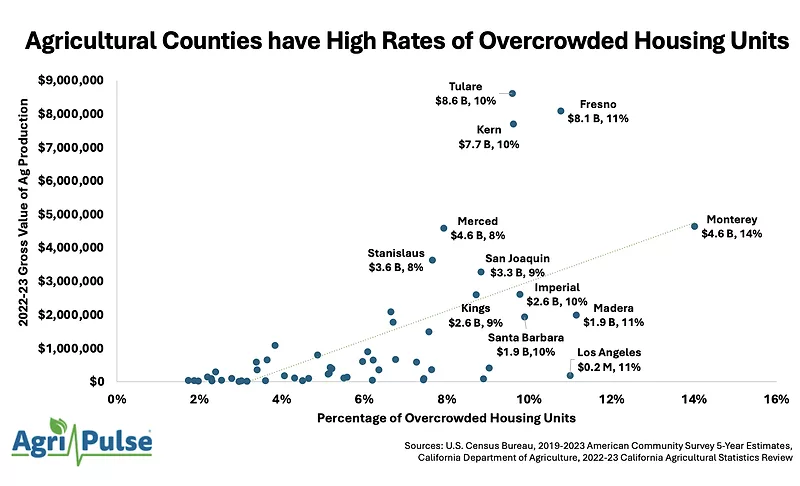
Digging into state-level data on housing affordability, of the 10 California counties with the highest gross agricultural production values in 2023, all but one were ranked in the top 13 highest in “overcrowding” in the state. Overcrowding, as measured and defined by the U.S. Census Bureau, means that there is more than one person per room in a household dwelling, excluding bathrooms and kitchens. For example, a two-bedroom apartment with a living room would be defined as overcrowded if four people were living in it.
Monterey County has the highest level of overcrowding for any county in the state and the highest in the nation for counties with over 5,000 housing units. Fourteen percent of houses in Monterey in the 2019-2023 American Community Survey were found to be overcrowded, and nearly 5% were defined as severely overcrowded with more than 1.5 people per room. The 93905 ZIP code in north Salinas, the heart of the nation's “Salad Bowl" where many agricultural workers live, saw overcrowding rates of 40%, the highest rate of any ZIP code in California with more than 300 housing units.
The expansion in the state of H-2A, a nonimmigrant visa program that allows for temporary agricultural workers, has brought the need for more farmworker housing to the forefront, as employers are required to provide housing as part of the program. From 2013 to 2023, H-2A-certified positions expanded in California by over 23,000 (516%).
Monterey County has been a leader in both expanding farmworker housing and increased usage of H-2A workers. According to Norm Groot, the executive director of the Monterey County Farm Bureau, the county has added over 5,000 beds in newly purpose-built farmworker housing in the past seven years, which provides housing for both domestic workers and the over 3,500 H-2A positions added from 2018 to 2023.
The new purpose-built farmworker housing is typically apartment style, with recreation and laundry facilities on-site. Most of the recent additions have been exclusively for single or coupled farmworkers, leaving out the significant portion of domestic farmworkers living with children.
California Environmental Quality Act
CEQA was signed into law by then-Gov. Ronald Reagan in 1970, the same year the National Environmental Policy Act was enacted. While both CEQA and NEPA require environmental reviews, they differ substantially in scope. CEQA, due to a court decision in 1972, requires environmental review for every single project with discretionary action by state or local governments, including approval, permit, oversight or funding.
It’s easy to be “in the know” about what’s happening in Washington, D.C. Sign up for a FREE month of Agri-Pulse news! Simply click here
While federal projects can proceed even if negative environmental effects are found, CEQA allows both private and government entities to sue to stop development. In 2020 alone, CEQA lawsuits targeted 48,000 approved housing units, which accounted for slightly under half of the total houses built. Litigation can tie projects up for years and add substantial costs to projects even if they eventually get built. A study from 2015 found that only 13% of CEQA lawsuits were brought by established environmental advocacy organizations.
2025 CEQA reforms and the way ahead for housing in farming communities
The recently passed CEQA reforms are significant and were lauded by Governor Gavin Newsom as “the most consequential housing reform that we’ve seen in modern history in the state of California.” Overall, this is true, with the bills (AB 130 and SB 131) providing a CEQA exemption to swaths of urban, infill housing. In the eyes of pro-housing groups, any new housing benefits all Californians, as increasing housing supply will lower (or stem) housing prices across the board.
The bill’s proponents have highlighted the fact that the package will “streamline CEQA review to speed up delivery of housing and infrastructure projects — including … farmworker housing.” On the farmworker housing side, this bill may not have as broad of a reach as press releases claim. Rather, the way Groot described the laws, as well as previous efforts to resolve the farmworker housing issue in California, was, “Sounds great on paper, but there are so many strings attached that it’s not practical to use.”
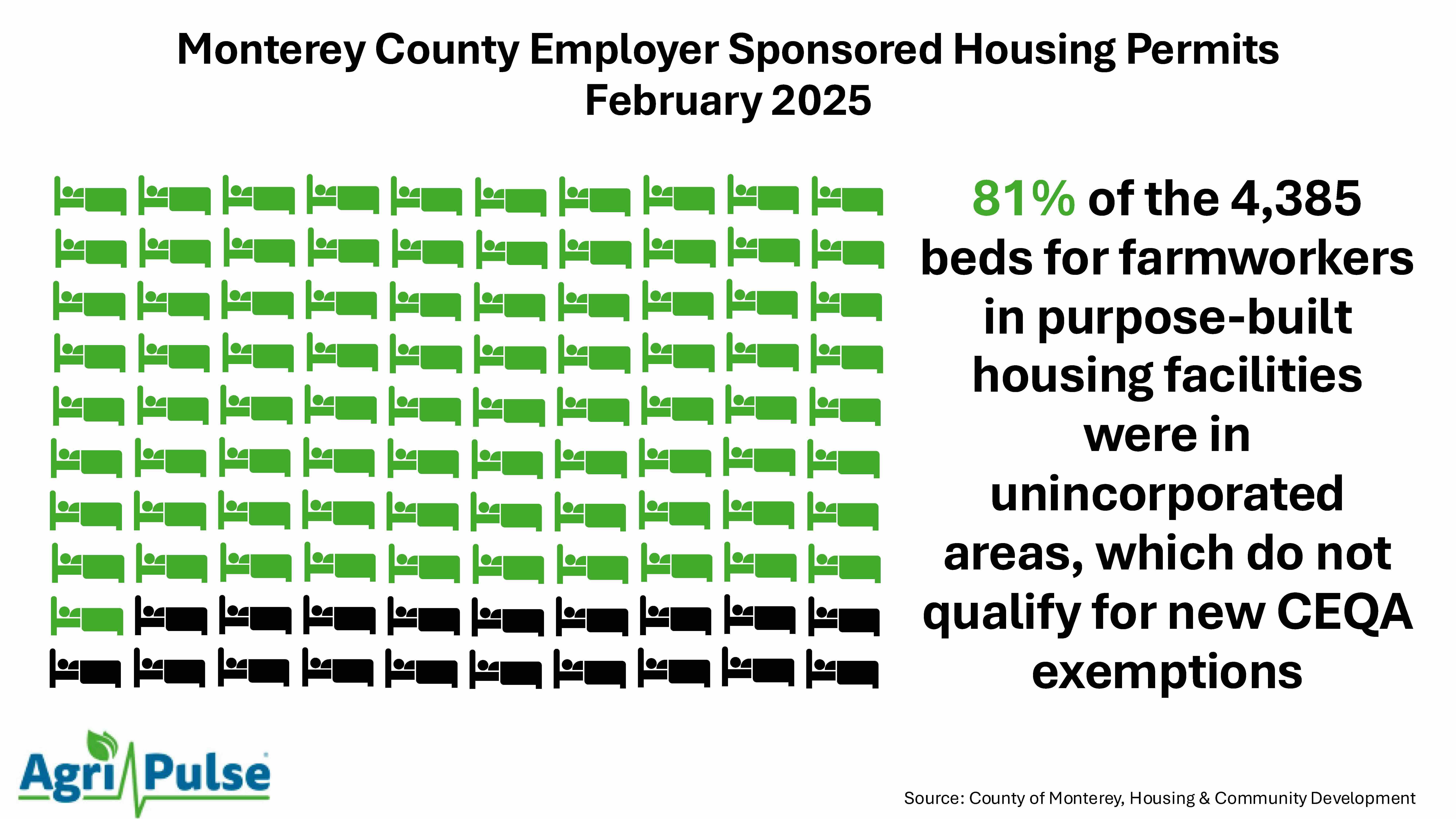
The new CEQA reforms under AB130 are limited to development within the boundaries of an incorporated municipality or “urban area” as defined by the Census Bureau. This inherently excludes significant portions of farmworker housing. For example, as of February 2025 in Monterey County, slightly under a third of roughly 14,000 beds for agricultural workers in permitted employer supplied housing were in unincorporated areas. This included 81% of the more than 4,000 beds in purpose-built employer sponsored housing for farmworkers, the type of farmworker housing theoretically benefiting from the CEQA reforms. Most permitted employer-sponsored housing within city limits were hotels or motels.
The new CEQA reforms also narrowly define what types of farmworker housing qualify for exemption. Specifically, under SB 131, agricultural employee housing projects are only exempt if they are one of the following:
- Funded by the Joe Serna Jr. Farmworker Housing Grant Program.
- Funded by the Office of Migrant Services within the Department of Housing and Community Development.
- Funded by a local government.
- Owned or operated and funded by a public or nonprofit entity, or that receives state, federal or local public funding.
Thus, housing projects in rural/unincorporated areas built wholly by private funding do not qualify for the new CEQA exemptions.
Housing challenges ahead
California policymakers have sold the recent CEQA reforms as a major step to improve farmworker housing in the state. While analysts believe that it will help alleviate the statewide housing crisis, the impact to rural farming communities may be blunted.
Although California’s agricultural communities may be able to change certain development trends by targeting plots in urban or incorporated areas to build new developments, they are still fighting an uphill battle to maximize the impact of the CEQA reforms to address the housing issues that the industry faces.
Betty Resnick is an agricultural economist based in Monterey, California.
For more news, go to Agri-Pulse.com.
