
California agriculture officials and farm leaders say they are drawing valuable lessons from Brazil’s decades-long investment in biological solutions, public-private research collaboration and streamlined regulatory systems — takeaways that could influence how the state approaches climate-smart agriculture and product registration in the years ahead.
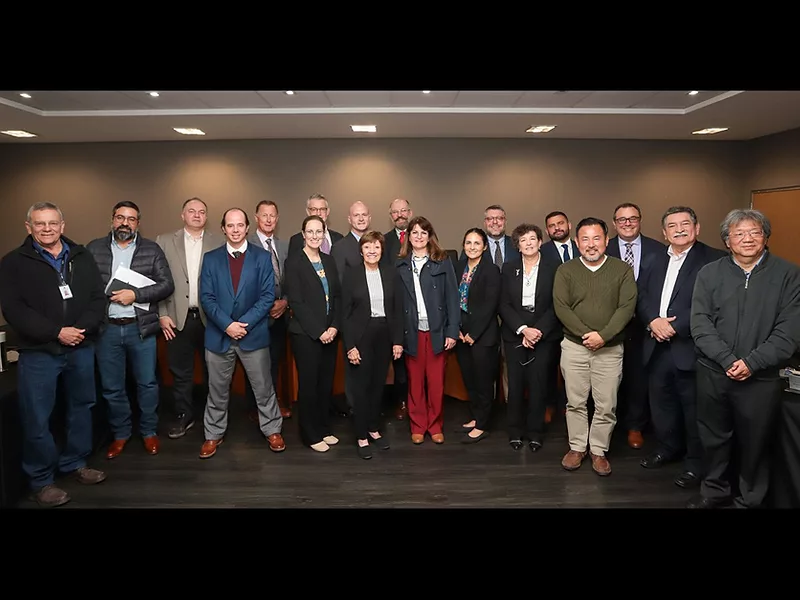
The California Department of Food and Agriculture led a delegation to Brazil last week, marking the ninth such international trip on climate policy organized by CDFA Secretary Karen Ross. She was joined by California Department of Pesticide Regulation Director Karen Morrison and industry leaders like California Farm Bureau President Shannon Douglass.
While the trip was framed around climate policy, much of the focus centered on Brazil’s progress in deploying biological pest management and fertilizer alternatives. Participants were particularly impressed with how Brazil’s agricultural system has built a robust research and deployment pipeline while aligning public policies to support commercial development.
“They’ve made a very powerful, very positive impression on what’s doable by everybody working together,” said Ross in an interview. “We were all blown away by the [advancements] they’ve been able to make, considering they started this a couple decades ago.”
Trade clash overshadows trip
While the visit focused on biologicals and sustainability and was not an official USDA trade mission, the sudden trade shift under the Trump administration has cast a fresh spotlight on U.S.–Brazil relations and their implications for California’s global agricultural partnerships.
The administration’s 50% tariff policy announced last week, which is set to take effect Aug. 6, will impact a wide range of Brazilian products, including beef, coffee and tallow. The tariffs are expected to touch up to a third of Brazilian exports to the U.S., raising costs and uncertainty for importers and exporters alike.
 CDFA Sec. Karen Ross at the Agri-Pulse Food & Ag Issues Summit (photo: Fred Greaves/Agri-Pulse)
The delegates found it hard to avoid the backdrop of the intensifying trade friction.
“It was hard to go somewhere when there’s trade talks happening and have that not come up in it,” said California Farm Bureau President Shannon Douglass, who joined the trip. “But that wasn’t a strong focus of it.”
Still, she added, “it just highlighted the value of international collaboration.”
Brazil’s biological revolution
The CDFA-led delegation focused primarily on Brazil’s leadership in biological pest management and climate-smart agricultural practices. The trip, Ross said, came at a critical time, as Brazil prepares to host the United Nations Climate Change Conference in November. Ross and others emphasized how Brazil’s long-term investment in biologicals — bolstered by public research, private sector engagement and legislative reform — has allowed it to build an advanced system for deploying biological alternatives at scale.
Brazil’s move away from subsidies and toward funding agricultural research was particularly notable, according to Ross, as was its success in creating an efficient approval system for biological products.
It’s easy to be “in the know” about what’s happening in Washington, D.C. Sign up for a FREE month of Agri-Pulse news! Simply click here
“They’ve made a lot of advancements,” she said. “But they are a few years ahead of us on the deployment of that.”
She pointed to the country’s success with no-till practices and microbial solutions as examples of strategies that could be adopted in California. One highlight that drew California’s attention to Brazil was the biologicals company Koppert, which began in the Netherlands but grew in the U.S. over decades and has expanded to seize on the Brazil market, with divisions across South America.
“One of their new divisions is the drone service business, making sure that the deployment of the beneficial pests is as efficient and cost-effective as possible,” said Ross.
California’s regulatory backlog has long been a source of frustration for growers, and Ross said the DPR is now deploying new resources to reduce delays, including for biological products.
“They’re being very diligent and knocking those things out of the process,” she said.
While Ross cautioned it’s premature to expect immediate legislative changes, she emphasized the importance of early engagement with regulators and the need to validate microbial solutions for California’s unique climate.
Douglass said the regulatory angle was one of the most impactful aspects.
“Brazil, in wanting to figure out how to expedite more access to products, they really worked on changing their regulatory process to expedite the biological products, and that could be very helpful for us,” she said. “To see somewhere that recognized [the regulatory constraints] and did something about it was really impactful.”
Climate-smart focus reinforced by innovation
Many of the practical lessons centered on technology and innovation rather than direct climate policy. Ross emphasized the contrast with prior trips: Israel had focused on sensor technologies and robotics, while Australia and New Zealand emphasized methane reduction and ag equipment. In Brazil, the emphasis was squarely on biological tools and deployment, though the climate discussions also reflected initiatives to counter international concerns over deforestation in the Amazon.
Ross praised the breadth of collaboration on this — from universities to startups to large agribusinesses — and noted that even crop residue and processing byproducts are being repurposed as part of the country’s circular economy efforts.
“They are equally focused on their crop residue and their processing byproducts that can also be a part of this,” she said. “It’s not just knocking down trees exclusively.”
She said the country has passed new conservation laws requiring farmers to plant trees and has taken steps to align with European Union expectations around sustainability.
Douglass noted one surprising innovation: At a large avocado farm, Brazilian growers were using overhead sprinklers to cool trees during heat waves, mimicking — but in reverse — the frost protection systems used in California.
Douglass said the trip reaffirmed California’s leadership on climate-smart practices but offered new ideas for how to implement them faster.
A forward-looking agenda
In addition to Ross and Douglass, the delegation included leaders from several agricultural sectors and institutions: Jeana Cadby, director of environment and climate at Western Growers; Dan Sonke, head of sustainability at Blue Diamond Growers; Don Cameron, vice president and general manager at Terranova Ranch and the State Board of Food and Agriculture president; David Shabazian, also from the board and the former director of the California Department of Conservation; biological entrepreneur Pam Marrone; and Frank Muller, president of M Three Ranches.
In a statement to Agri-Pulse, Cadby of Western Growers said the visit highlighted an industry push to adopt precision agricultural practices.
"With a thriving startup scene and expanding rural connectivity, AI tools and data analytics are providing insights for improving yield as well as water and nutrient use efficiency," said Cadby. "With year-round pest pressures and a warmer climate supporting accelerated pest life cycles, the agriculture industry has encouraged increased transparency and strategic partnerships to tackle the most pressing pest challenges."
Ross credited the group’s expertise and engagement for making the trip especially productive.
“We just had a great group of people — very inquisitive, all fascinated with what we were learning together,” she said. “Every room we walked into, the companies and the CEOs would go, ‘Pam, she’s a legend.’ And she is.”
Looking ahead, Ross said she plans to join a USDA-organized trade mission to Mexico later this year, speak at a United Nations Food and Agriculture Organization session in Rome in early September and attend the COP30 climate summit in Belém, Brazil, in November. As for this Brazil trip, she sees it as a catalyst for future action.
“It was a very reinvigorating trip to see the world of possibilities,” said Ross. “Just some really great models to learn from.”
For more news, go to Agri-Pulse.com.

