
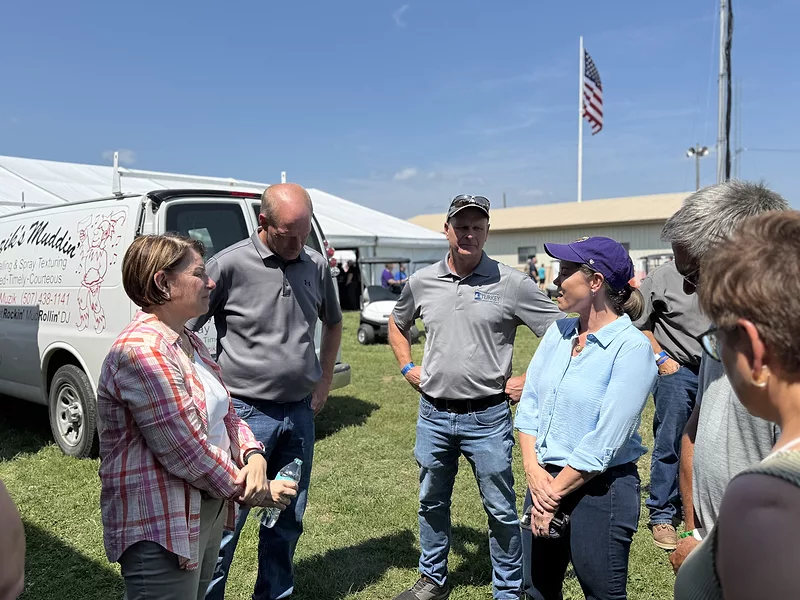
Minnesota lawmakers and American Farm Bureau Federation President Zippy Duvall have a number of priorities for the so-called “skinny” farm bill, including conservation and raising farm loan limits.
But there’s also some tension between Democrats and Republicans left over from the passage of the One Big Beautiful Bill, which cut the Supplemental Nutrition Assistance Program by $186 billion over 10 years.
“We're in the very early stage of talking about what we would like to see in the skinny farm bill,” Rep. Angie Craig, ranking member on the House Agriculture Committee, told Agri-Pulse Newsmakers at Minnesota Farmfest earlier this week.
Watch Newsmakers today at Agri-Pulse.com
However, she added, the size of the cuts in nutrition spending “makes it harder to get full Democratic support for a skinny farm bill down the road. I've made that clear.”
Rep. Brad Finstad, R-Minn., another Ag Committee member, said he wants to see changes in the USDA’s Conservation Reserve Program (CRP) to ensure that “the highest CRP contracts are going to the most vulnerable land, and maybe we take a little bit less of a CRP contract for the most productive, high-quality land in this country.” That way, he said, “we're not competing with our own federal government when it comes to land rent prices.”
The Senate Ag Committee’s top Democrat, Minnesota’s Amy Klobuchar, mentioned raising loan limits and trying to restore some funding for SNAP. She also was critical of the Trump administration’s tariff process.
In the short term, the tariffs “bring in some money, but in the long term for the ag community, it's really a nightmare because it dries up markets. … We know last time when this happened, we lost a huge part of our soybean market abroad, and now it's already been shrunk.”
Duvall said the clock is ticking on trade deals. Without trade deals that “level the playing field” for U.S. farm products, “it’s going to be very difficult for our farmers moving into the future and getting operating loans and being able to keep the farm sustainable,”
Minnesota Republican Rep. Michelle Fischbach defended the administration’s record on trade deals thus far. “Ag is at the forefront” of trade negotiations, she said.
Former USDA scientist jumps into race for New Jersey House seat
A former USDA climate scientist who chose to resign amid the agency's downsizing efforts has announced she will be making a run for New Jersey’s 7th Congressional District as a Democrat.
Megan O’Rourke, who until recently worked as the national science liaison for climate change at USDA’s National Institute of Food and Agriculture, is seeking to become the Democratic candidate in a race for the seat, which is currently held by Republican Rep. Tom Kean Jr.
Don’t miss a beat! It’s easy to sign up for a FREE month of Agri-Pulse news! For the latest on what’s happening in Washington, D.C. and around the country in agriculture, just click here.
Take note: Eight other Democrats are also competing for the chance to take on Kean in the general election, according to the Federal Election Commission. The Cook Political Report with Amy Walter currently rates the race as “Lean Republican."
Great American Farmers Market pictures
 Chobani had a prominent spot at USDA's market, the last day of which is today. The company was one of four sponsors named by USDA, including John Deere, Tractor Supply Company, and Visa
 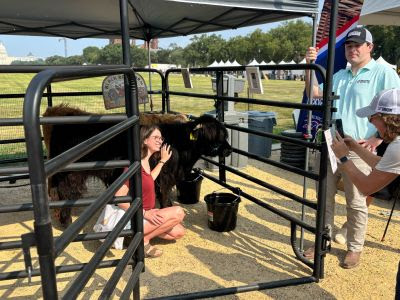 On display Thursday was a Highland cow (Agri-Pulse photos: Allie Herring)
The MAHA Commission report due out next week likely will continue to call for the removal of synthetic dyes from foods but also may recommend that the upcoming dietary guidelines promote saturated fats, meat and dairy.
That’s according to the Center for Science in the Public Interest, which hosted a webinar Thursday on what to expect from the report Aug. 12. An initial report identifying causes of chronic disease in children was released in May and was immediately criticized for its general lack of scholarship.
The report “could encourage states to pursue isolated additive bans,” CPSI Science Director Aviva Musicus said. Health Secretary Robert F. Kennedy Jr. has stated publicly he prefers states pass their own policies in lieu of federal regulations.
Another possible recommendation would be “eliminating quantitative limits on saturated fat and sodium,” and recommending Americans consume less ultraprocessed foods, Musicus said.
Kennedy has publicly said to expect the Dietary Guidelines for Americans to come out as soon as October, she said.
Landowners in Iowa get letter from Summit
Iowa landowners who have not signed voluntary easements with Summit Carbon Solutions will get a revised right-of-way proposal soon with terms “that better support landowners and their long-term interests,” Summit’s new CEO said in a letter sent out this week.
“Before long, I believe we’ll announce several updates to our business plan that will open new markets and create greater opportunities for the region,” Joe Griffin said in the letter.
He also sent a letter to landowners with signed agreements to thank them.
The five-state liquefied carbon dioxide plan has hit a snag in South Dakota due to a law that says eminent domain cannot be used for CO2 pipelines.
Attorney Brian Jorde, who has represented landowners in lawsuits against Summit, said “Summit’s ‘reboot’ was expected but after four years of stress, frustration and animosity, I don’t think a new CEO or upper management shift will do the trick.”
Summit spokesperson Sabrina Zenor told Agri-Pulse in a story that ran Wednesday that Summit has secured about 75% of its proposed route in Iowa.
Hemp takes step toward becoming animal feed ingredient
The hemp industry is one step closer toward access to a new market.
The Association of American Feed Control Officials has added hemp seed meal for laying hens as an ingredient in its official publication, which allows animal food ingredients to be recognized within a number of states.
Still, inclusion in the publication does not automatically grant state-level acceptance, and industry leaders say hemp feed’s regulatory path to market “remains riddled with bureaucratic obstacles," according to a press release from the Hemp Feed Coalition.
Andrew Bish, president of the coalition, said in the release that the approval “moves hemp closer to functioning as a real commodity."
Final word
“There is a lot to be said about the scientific inadequacies of the previous report. … As a piece of science, the initial MAHA report is not to be taken seriously. It was done rapidly. It was done with some assistance from AI. It covered … a far too complex set of topics than could ever possibly responsibly be addressed in the amount of time that they had. And that will be true with an additional 80 days. But as a piece of politics, it is absolutely to be taken seriously. This is an incredibly important report, and it will set the tune for what is to come the next several years.” — Peter Lurie, president and executive director, Center for Science in the Public Interest.
Noah Wicks contributed to today’s Daybreak.

