
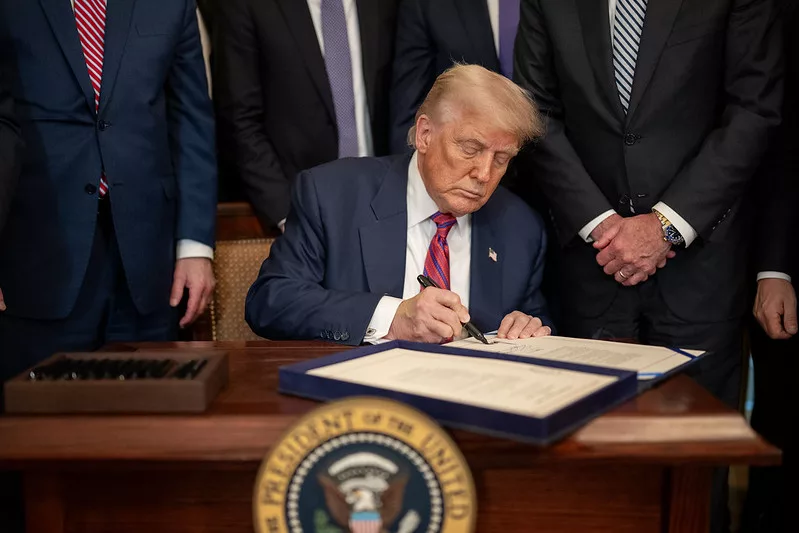
President Donald Trump signed an executive order on Monday to extend a deadline for higher tariffs on Chinese exports until November.
U.S. and Chinese officials agreed to end tit-for-tat tariff escalations in May, after duty rates from both sides reached triple digits. Under the terms of the arrangement, China reduced its retaliatory tariffs on U.S. products to 10%. The U.S. also slashed duties to a minimum rate of 30% -- made up of a 20% fentanyl tariff plus a 10% reciprocal tariff – for 90 days while further discussions played out.
That deadline was set to expire on Tuesday. The new deadline for higher duties will be Nov. 10, according to the order.
“The United States continues to have discussions with the PRC to address the lack of trade reciprocity in our economic relationship and our resulting national and economic security concerns,” the executive order reads, referring to the People’s Republic of China. “Through these discussions, the PRC continues to take significant steps toward remedying non-reciprocal trade arrangements and addressing the concerns of the United States.”
The extension comes after senior U.S. officials met with Chinese counterparts in Sweden, the third high-level meeting since May. Following that meeting, the Chinese side said that both sides had discussed extending the deadline, but Treasury Secretary Scott Bessent and U.S. Trade Representative Jamieson Greer told reporters that any final decision would come from the president.
Bessent also said that the two sides expected to meet again later in the year. Last week Trump suggested he could soon meet with Chinese President Xi Jinping.
“The relationship is very good with President Xi and myself,” Trump told reporters Monday.
The White House did not respond to a question from Agri-Pulse on whether there are plans for further meetings between senior officials or at the presidential level.
Trump’s executive order also lands days before a planned meeting with Russian President Vladimir Putin. Trump has threatened to apply tariffs on countries trading with Russia if it does not reach a settlement for peace with Ukraine. Last week the president announced a new 25% duty on India over its purchases of Russian oil with Trump arguing during a CNBC interview that India is “fueling the war machine.”
Don’t miss a beat! It’s easy to sign up for a FREE month of Agri-Pulse news! For the latest on what’s happening in Washington, D.C. and around the country in agriculture, just click here.
During that same interview, Trump previewed similar duties on other Russian trading partners.
“You’re going to see so much secondary sanctions,” Trump said.
Notably, China became the largest purchaser of Russian oil after Putin’s invasion of Ukraine and Europe’s pivot to alternate sources.
Asked whether the administration is planning new tariffs on Beijing as part of its effort to sanction China, Vice President JD Vance told Fox News on Sunday that the president “hasn't made any firm decisions.”
During Trump’s first term, Trump inked a “phase one” deal with China that saw Beijing commit to boosting its purchases of U.S. products, including agriculture, from 2017 levels. China ultimately fell short of that goal. But Trump is again pushing for China to increase its purchases of U.S. ag commodities.
On Sunday, the president said he hopes China will “quadruple” its purchases of U.S. soybeans.
“China is worried about its shortage of soybeans,” the president wrote to his Truth Social page.
“Our great farmers produce the most robust soybeans,” he added. Increasing its soybean purchases would serve the added benefit of “substantially reducing China’s Trade Deficit with the USA,” Trump argued.
For more news, go to Agri-Pulse.com.

