
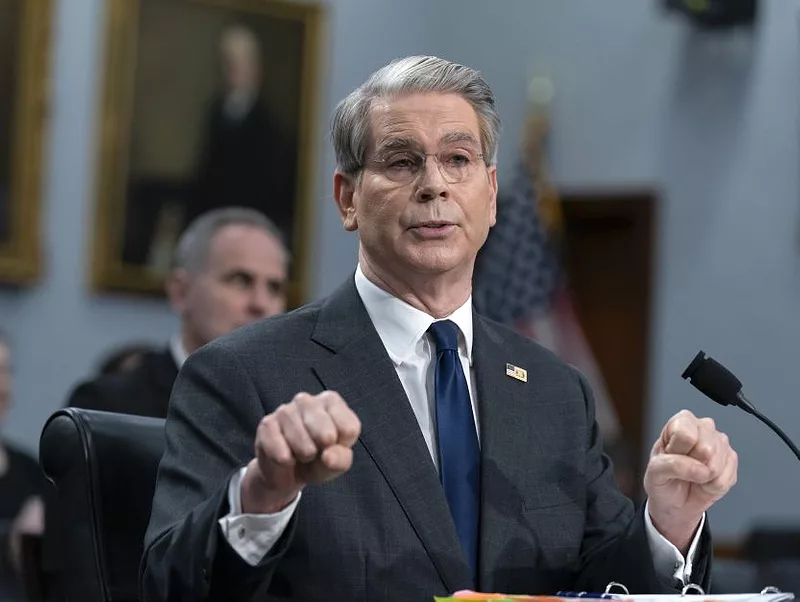
Bessent: U.S. could extend China tariff truce in exchange for rare earth delay
Treasury Secretary Scott Bessent says the U.S. could extend its tariff truce if China delays implementing expanded export controls on rare earth minerals.
“Is it possible that we could go to a longer roll in return for a delay? Perhaps,” Bessent told reporters at a press conference with U.S. Trade Representative Jamieson Greer. But he added this depends on upcoming negotiations.
Earlier Wednesday, Bessent told CNBC that the U.S. could set price floors in multiple industries to prevent China from undercutting U.S. producers.
He did not specify specific industries, but said, “when you are facing a nonmarket economy like China, then you have to exercise industrial policy.”
Take note: Later on Wednesday, AP reported Bessent saying the administration is working on more aid for Argentina. Bessent said his department is working with the private sector and outside entities for another $20 billion in financing alongside the $20 billion in currency swaps.
Economists: Used cooking oil import curbs would provide ‘minimal’ near-term relief
Two economists don’t think that restricting Chinese used cooking oil imports would give soybeans any near-term lifeline amid ongoing U.S.-China trade tensions.
President Donald Trump on Tuesday floated future trade measures to restrict cooking oil imports from China as possible retaliation for China not buying U.S. soybeans. Two economists tell Agri-Pulse that Chinese used cooking oil imports dropped significantly this year. As a result, trade restrictions wouldn’t raise soybean oil demand as a short-term replacement for clean fuel feedstock.
“If the U.S. banned cooking oil imports from China, it would have … minimal impact on U.S. markets,” said Stephen Nicholson, a grain and oilseed analyst at Rabobank.
Cut through the clutter! We deliver the news you need to stay informed about farm, food and rural issues. Sign up for a FREE month of Agri-Pulse here.
A second ag economist granted anonymity to speak candidly said the “near-term effect would be negligible.”
“The bigger driver of soy oil demand right now is structural (renewable diesel capacity and biofuel policy), so changes in Chinese UCO matter less than they did during the 2023–24 surge,” they said in an email.
Take note: House Ag Committee Democratic Rep. Jim McGovern of Massachusetts told Agri-Pulse he’s concerned further retaliation will trigger another response from China. Trump “can threaten withholding cooking oil … and then what? China's going to counter with something else? I mean, this is just stupid,” McGovern said.

U.S. District Judge Susan Illston (Northern District of California photo)
Unions cheer judge’s decision halting RIFs
Federal employee unions are pleased a federal judge issued a temporary restraining order blocking more reductions in force at federal agencies.
Senior U.S. District Judge Susan Illston of the Northern District of California issued the TRO from the bench Wednesday, finding the unions would likely prevail on the merits.
She also said the government cannot take any action to enforce RIF notices it already issued at agencies including the Department of Health and Human Services and Commerce Department, the unions said in a news release.
“What the judge is saying is that no further action can be taken to effectuate the RIFs at the agencies detailed in the lawsuit,” said Tim Kauffman, spokesperson for the American Federation of Government Employees. “No one has technically been fired yet because they just got the notices.”
Illston also ordered the agencies that issued the RIFs to provide more details about the them within two days.
DOE extends loan commitment to SAF company
The Trump administration is extending a $1.46 billion loan guarantee commitment to a company, Gevo, that’s looking to produce sustainable aviation fuel from corn ethanol.
The $1.46 billion loan guarantee could ultimately be reduced.
Gevo is looking at moving the loan guarantee from its Lake Preston, South Dakota, site to a smaller plant in North Dakota the company acquired earlier this year.
Gevo’s original plans for producing SAF at a 60-million-gallon-a year South Dakota facility have been hampered as the planned Summit carbon dioxide sequestration pipeline has stalled in the state. Carbon dioxide from the 30-million-gallon-a year North Dakota plant can be buried near the facility. Switching the loan commitment to the North Dakota plant also would shrink the size of DOE's loan guarantee.
The commitment extension to April 2026 gives Gevo and DOE time “to evaluate potential modifications to the project scope to address this administration’s energy policies and priorities,” the company says in a statement.
New study looks at effectiveness of paying farmers to use less water
Incentivizing Colorado River farmers to reduce water use may be more effective in the short term than funding reductions in other industries, a new study suggests.
An analysis of $1.08 billion spent by the Bureau of Reclamation on water-reduction efforts between 2004 and 2024 found that on average, agricultural-sector projects cost around $417.15 per acre-foot saved.
Local supply projects, on the other hand, averaged about $2,444 per acre-foot saved, according to the study from the University of California Riverside and the Utah Rivers Council.
But, but, but: While the researchers found that agricultural projects saved more water in the short term, funding for municipal and industrial projects and water reuse resulted in higher annual water savings.
Take note: Of the agricultural projects studied, those funding split-season deficit irrigation were the most common and had an average cost per acre-foot saved between about $70 and $210.
While less popular, land fallowing saved between approximately $128 and $258 on average per acre-foot, the researchers found.
Final Word:
“What a lot of folks don't understand is when the markets crash for corn and soybeans, it crashes all our markets for everything, because our contracts for vegetables are based off of the grain markets.” – Sarah Stelter, a Wisconsin soybean, corn and vegetable farmer, during a listening session hosted by Farmers for Free Trade.
Oliver Ward and Noah Wicks contributed to today’s Daybreak.


