
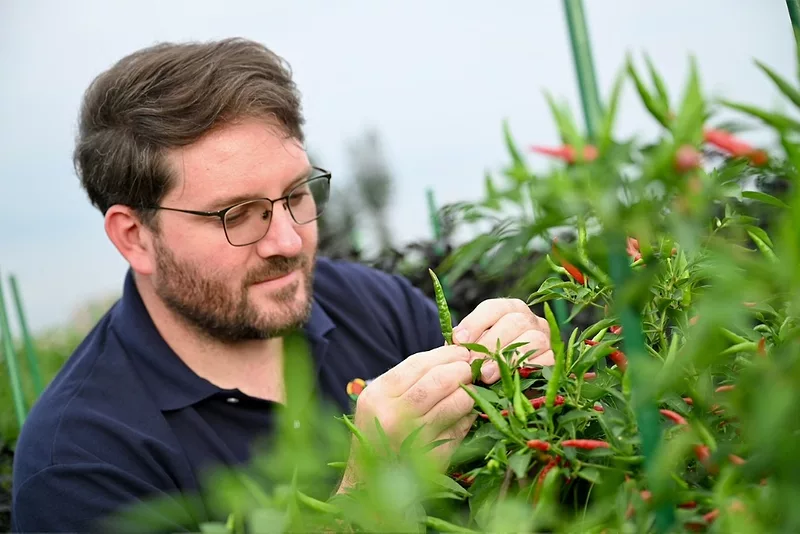
Derek Barchenger, an Oklahoma native and head of the Global Pepper Breeding Program at the World Vegetable Center, was named the 2025 recipient of the Norman E. Borlaug Award for Field Research and Application for his global leadership in pepper breeding.
He will be honored at the Borlaug International Dialogue in Des Moines, Iowa, in October for his leadership in developing pepper varieties that are more productive, resilient to climate stress and better suited to the needs of smallholder farmers who grow a majority of the world’s 41 million tons of peppers each year.
“Derek Barchenger’s journey, from an Oklahoma farm to leading global innovations in pepper breeding, is a testament to what’s possible when passion meets purpose,” said Mashal Husain, president of the World Food Prize Foundation. “His work empowers smallholder farmers, strengthens food systems and breathes new life into a crop that sustains cultures and economies alike.”
The award, endowed by The Rockefeller Foundation and facilitated by the World Food Prize Foundation, honors scientists under 40 who carry forward the legacy of Norman Borlaug, the father of the Green Revolution and a Nobel Peace Prize laureate.
Native to a small cow-calf ranch in southeast Oklahoma, Barchenger’s interest in plant breeding began while working and living with his grandfather.
Don’t miss a beat! It’s easy to sign up for a FREE month of Agri-Pulse news! For the latest on what’s happening in Washington, D.C. and around the country in agriculture, just click here.
“I don't even think I had taken biology and he was explaining to me Punnett squares and F1s, and how we make a Brangus on the farm,” Barchenger told Agri-Pulse. “So that's really how I got my foundation in plant breeding before any formal education.” A Punnett square is a diagram used to predict the outcomes of genotypes and phenotypes. F1 hybrid breeding is a plant breeding method.
During his undergraduate studies in horticulture at Oklahoma State University, Barchenger became fascinated by cultural crops that are both economically important and culturally significant to communities. This fascination led him to pursue a master’s degree at the University of Arkansas studying muscadine grapes, and then he went to New Mexico State University to study chili peppers under field expert Paul Bosland.
Barchenger first joined the WorldVeg team in 2016 when he was selected as a United States Borlaug Fellow in Global Food Security, and later a postdoctoral fellow in 2017. During that experience, he travelled to Bangladesh where he witnessed farmers struggling with the effects of a viral disease in chili crops that is now recognized as chili leaf curl virus.
Upon returning from Bangladesh and seeing the impacts of the disease firsthand, his research became focused on looking for host resistance and later scaling host resistant lines to that virus across Asia. He joined WorldVeg full-time after the completion of his doctorate studies as a senior scientist and head of the Global Pepper Breeding Program.
“That project really has a special place in my heart,” Barchenger said. “This disease was so severe, farmers were abandoning their crops and they were switching to other crops like maize. So to see that huge problem and develop something that can help them, it really meant a lot to me.”
Under Barchenger’s leadership, WorldVeg has grown from a Taiwan-based team of 10 to a global, multidisciplinary research group of over 20 scientists. Now, field staff with coordinated breeding programs are located in India and Benin, with additional testing sites located across the world.
WorldVeg has released 24 new pepper varieties since 2018 to better withstand climate extremes as well as pressures from pests and diseases. They also release 12 new pepper germplasm lines annually to consortiums in Africa and Asia which have created lines now used by more than 50 seed companies.
In 2024 alone, 20 tons of pepper seed with WorldVeg lines were sold, reaching an estimated 300,000 farmers.
“Derek Barchenger embodies the enduring spirit of Dr. Norman Borlaug—using science in service of humanity,” said Thomas Vilsack, CEO of the World Food Prize Foundation. “Through his groundbreaking work in pepper breeding, he has uplifted the livelihoods of hundreds of thousands of smallholder farmers and brought resilience to a vegetable that nourishes both people and cultures.”
Barchenger will receive a $10,000 award as the recipient of the award.
For more news, go to Agri-Pulse.com.

