
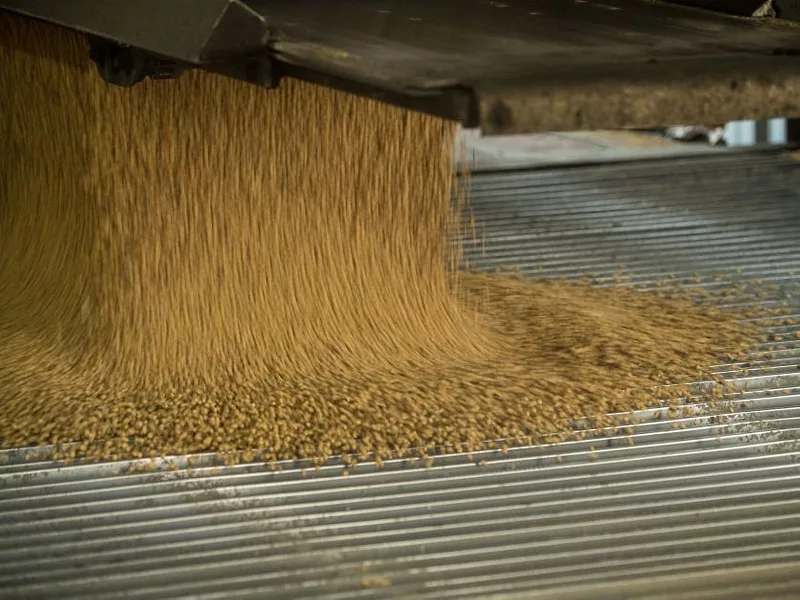
The American Soybean Association appealed to President Donald Trump on Tuesday to reach a trade agreement with China, warning that what has long been the biggest export market for U.S. soy doesn’t have a single order in for this fall’s harvest.
“Unfortunately for our soybean growers, China has contracted with Brazil to meet future months’ needs to avoid purchasing any soybeans from the United States,” the group says in a letter to the White House. The letter was accompanied by an 11-page white paper laying out the export situation facing soybean growers.
“Soybean farmers are under extreme financial stress. Prices continue to drop and at the same time our farmers are paying significantly more for inputs and equipment. U.S. soybean farmers cannot survive a prolonged trade dispute with our largest customer,” the letter says.
The letter and white paper note that the Chinese duty on U.S. soybeans is 20% higher than the tariff on South American soybeans, keeping the U.S. crop “prohibitively expensive.”
“China has not purchased any U.S. soybeans for the months ahead as we quickly approach harvest. The further into the autumn we get without reaching an agreement with China on soybeans, the worse the impacts will be on U.S. soybean farmers,” the letter says.
The white paper notes that at this time of the year China has normally ordered about 14% of its expected purchases of U.S. soybeans. Going into the 2022 harvest, China had ordered 27% of its purchases.
“China imported record volumes of Brazilian soybeans between April and July 2025, growing domestic stockpiles of soymeal to the point at which Chinese soybean processors are facing negative margins,” the white paper says. “In early August 2025, traders announced a first-time export sale of Argentine soymeal to China to be delivered this fall to reassure Chinese feed mill buyers anxious about hog feed availability amid the ongoing trade dispute.”
Overall, export sales of this fall’s soybean crop are down 81% from the five-year average.
The white paper noted that in the northern Plains, where the majority of soybeans are traditionally exported to China via Pacific Northwest ports, “there are currently zero orders for new crop soybeans on the books.”
Price of soybeans for November delivery fell 5%, or 51 cents a bushel, from July 18 to Aug. 6 both amid the lack of sales to China and expectations for increased production this fall. In the Dakotas and Nebraska, local cash prices are down sharply as well due to the lack of export orders.
Cut through the clutter! We deliver the news you need to stay informed about farm, food and rural issues. Sign up for a FREE month of Agri-Pulse here.
“Combines will start rolling through fields in the next month to harvest soy. At that point, the lack of export bookings will quickly become problematic as the main destination for the oilseed contains significant barriers. The problem will compound through the fall as more of the crop is harvested. By mid-October, almost half of the crop will be entering the supply chain,” the report says.
Mike Steenhoek, executive director of the Soy Transportation Coalition, likened the situation facing soybean growers to a bar owner who opened near a baseball stadium only to have the team owner move to another area.
In an email, Steenhoek said "a small business owner, a company, or an industry will invest substantially to position themselves to succeed in selling to a customer and when there is a threat that the customer may pull back or diminish, it is entirely reasonable for the small business owner, the company, or the industry to work to preserve it. U.S. soybean farmers have worked hard over the years to establish the Chinese market. It is reasonable to try to preserve and grow it."
Steenhoek said a significant amount of "economic development in rural America over the past 20-30 years is a result of U.S. soybean farmers effectively exporting to China."
On Wednesday, USDA released a statement in response to ASA's appeal to the White House.
The statement said Trump and Ag Secretary Brooke Rollins “are working to correct years of bad economic policies that prioritized other countries over the American people, especially our nation’s farmers and ranchers. This led to a disastrous $50 billion agricultural trade deficit that cannot be fixed overnight.
“USDA recognizes that farmers are hurting and the state of the agriculture economy continues to be the most challenging in recent decades. USDA stands shoulder to shoulder with today’s producers who feed and fuel our nation.”
The statement on to note the trade deals that Trump has announced with the “United Kingdom, European Union, South Korea, Pakistan, Japan, Indonesia, and the Philippines that break down longstanding barriers to agricultural trade and provide much needed certainty for American producers. We anticipate purchases of commodities will happen soon.”
For more news, go to Agri-Pulse.com.

