
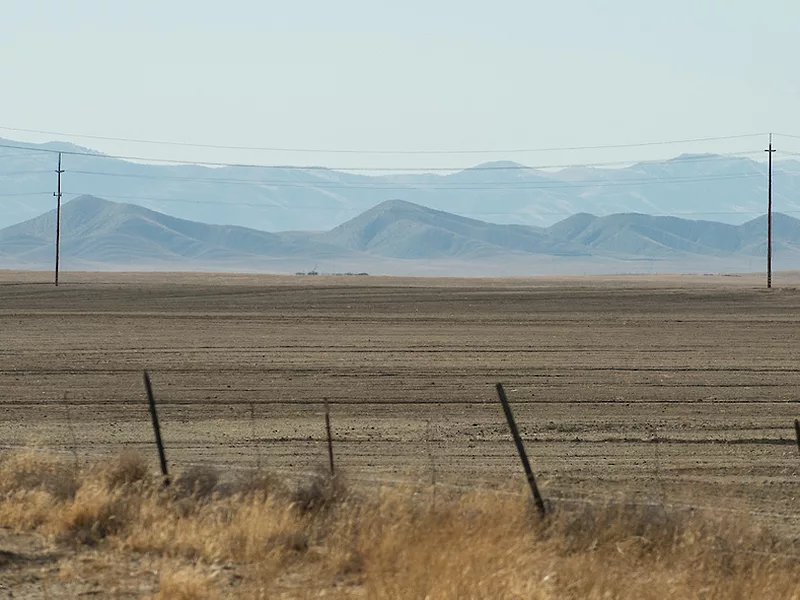
California’s farmland values are undergoing some of the steepest shifts in decades, with the Sustainable Groundwater Management Act at the center of changing dynamics. While commodity prices and global trade conditions weigh heavily on producers, water reliability is now the single most critical factor in determining whether agricultural land holds value or loses it.
At a State Board of Food and Agriculture meeting this month, appraisers and lenders described widespread declines in orchard and vineyard values, particularly in areas dependent on overdrafted aquifers. Their observations aligned closely with findings in the “2025 Trends Report” for the California Chapter of the American Society of Farm Managers and Rural Appraisers, which detailed how SGMA’s deadlines and state scrutiny over groundwater plans are redrawing the agricultural real estate map.
A market in retraction
Kyle Dalrymple, senior appraiser with Edwards, Lien & Toso and regional chair for the ASFMRA report, summarized conditions starkly: “The current state of the agricultural industry in California could be summed up in a single word—challenging.”
Dalrymple told the board land values had dropped up to 75%, depending on commodity and location. The steepest declines were tied to water insecurity.
“Most of the properties that are experiencing 50% or greater value declines are solely reliant on pumped groundwater from overdraft basins,” he said.
The “Trends Report” confirmed that assessment. “The ‘SGMA Effect’ (land with senior water rights having the highest values, while land with junior or no water rights seeing low values) has continued to impact values across the state, a trend that will continue into the foreseeable future,” according to the report.
Across the San Joaquin Valley, orchards in critically overdrafted areas have lost far more value than land with reliable surface water. The report documented land in the Modesto Irrigation District holding relatively steady, while nearby Merced properties reliant on declining groundwater have diverged sharply in price.
The latest state reviews reinforce those local divides. As of June, the California Department of Water Resources has determined that several valley basins — including the Kaweah, Kern County, Pleasant Valley, Tulare Lake and Tule subbasins — have inadequate plans, triggering potential intervention from the State Water Resources Control Board. The Tule Subbasin is already under probation, while the Chowchilla Subbasin narrowly avoided probation this summer and remains under DWR oversight. Those designations have direct implications for land values in each basin, with uncertainty depressing sales and widening gaps between surface-water-secure districts and groundwater-only properties.
 Leslie Crutcher, Yosemite Farm Credit (LinkedIn photo)
Even as these SGMA challenges intensify, USDA’s “2025 Land Values Summary” found that farmland overall continues to appreciate nationally. Average U.S. cropland rose 4.3% to $4,350 per acre, while pastureland gained 5% to $1,920. In California the average farm real estate value now stands at $13,700 per acre, up 2.2% from last year. The state also leads the nation in cropland cash rents, at $346 per acre, with irrigated cropland rents averaging $483 per acre. These baselines highlight the paradox: Even as California’s farmland remains among the nation’s most valuable, SGMA-driven uncertainty is eroding equity and collateral in overdrafted basins.
Stress on growers and lenders
For lenders, these changes have compounded financial strain. Leslie Crutcher, chief credit officer at Yosemite Farm Credit, said his portfolio reflected widespread stress among almond and dairy operations.
“They continue to face margin compression as market prices lag behind historical averages,” said Crutcher.
The almond sector, he explained, had been hit by a sudden plunge in prices after USDA released its objective estimate.
“We saw prices drop from just below the $3 mark to now — as I spoke to a couple processors — $2.15 to $2.20. I would say an 80-cent, 75-cent drop in price … . That just went away in the matter of maybe three days,” he said.
Those price collapses have direct consequences for equity and collateral.
Cut through the clutter! We deliver the news you need to stay informed about farm, food and rural issues. Sign up for a FREE month of Agri-Pulse here.
“Where we’re getting to at this point is the equities are starting to dry up a little bit because we’ve seen the drop in the real estate values,” he noted, explaining that it limits the ability of lenders to restructure loans and keep producers afloat.
The “Trends Report” described 2024 as the year when “the persisting challenges from 2022 and 2023 … resulted in financial stress for many operators that had to be dealt with in 2024.” It pointed to bankruptcies in the almond, tree fruit and wine sectors and warned that “financial pressures facing many growers are expected to continue in 2025, especially with lenders actively ordering updated appraisals to better understand their current loan to value.”
Winners, losers and the SGMA divide
Some sectors have fared better. Dalrymple said pistachios “have seen modest value declines, although solely attributable to impending SGMA restrictions.” Despite record crops, demand has held strong and grower returns remain “steadily robust.” Walnut orchards, after plunging by up to 65% in a year, began stabilizing recently with signs of renewed optimism.
Beef cattle, meanwhile, stood out as the only sector excelling, thanks to record-high prices driven by low herd sizes and cheap feed.
“The beef market is really the only excelling sector in the California ag market,” Dalrymple told the board.
Wine grapes remain deeply troubled. Dalrymple said, “thousands of acres have gone unharvested in the last couple of years because there’s no home for those grapes that don’t have winery contracts.” The “Trends Report” reinforced that assessment: “The harsh reality of the wine grape market is it has a demand problem… . Wine sales have been generally slumping across most channels and segments, especially those below $10 per bottle, which is mostly supplied by the Central Valley.”
The broader pattern, both speakers and the ASFMRA analysis concluded, comes back to water. In the Sacramento Valley, land with strong surface water rights has largely retained its value, even as nut and rice growers struggle with prices. In the San Joaquin Valley, however, the contrast between Tier 1 districts with secure supplies and White Land areas with no contracts is widening into a permanent divide.
“The ability to farm ground during the next drought will really determine who survives,” Crutcher warned, noting that irrigation costs could soar from $350 per acre-foot to $850 or more.
Looking ahead
With SGMA timelines tightening, DWR has ruled some San Joaquin Valley groundwater plans inadequate, while others remain under review. That uncertainty is freezing investment and reshaping buyer behavior.
“Buyers are sharpening their pencils in this higher interest rate environment and are patiently waiting for sellers to meet them at their valuations,” the “Trends Report” observed. “The reliability and cost of water continues to be a driving factor for buying decisions and value.”
Even with a wet 2023 and average 2024, long-term groundwater restrictions remain unavoidable. The report concluded that “a new normal is setting in that better reflects the higher operating costs and persistently soft commodity prices, coupled with water cost and reliability.”
For lenders like Crutcher, that means more consolidation ahead and more land coming out of production. For appraisers like Dalrymple, it means value spreads of 50% or more between neighboring properties will persist. And for growers, it means a difficult adjustment to farming under SGMA.
“We will see more of that land go out of production,” Crutcher predicted. “It just won’t be viable to try and farm it.”
For more news, go to Agri-Pulse.com.

