
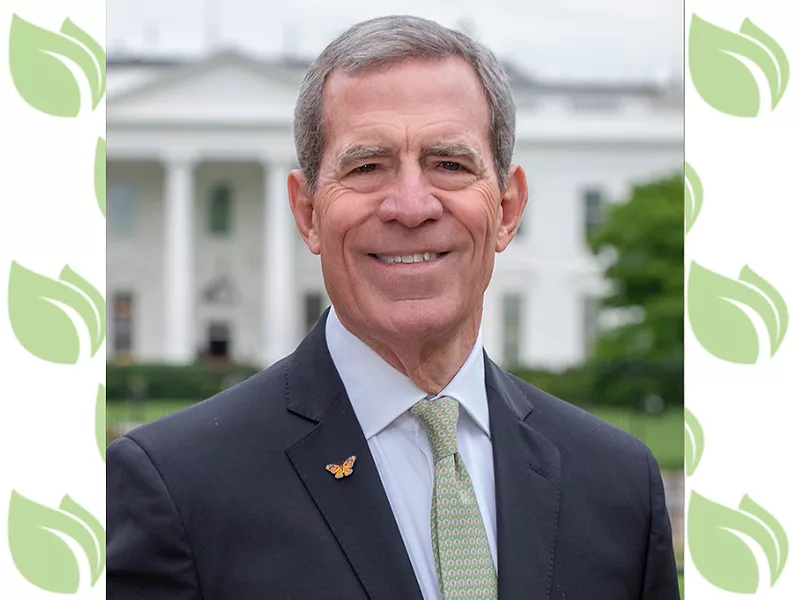
Too often, debates about our food system pit farmers against consumers. But America’s corn farmers and families across the country share the same goals: healthy food, a sustainable environment, and a reliable supply that doesn’t break household budgets. To get there, we need to ground policy in facts – not myths that oversimplify complex challenges.
An oft-repeated myth is that the powerful ag lobby has won agriculture subsidies allowing the sector to profit at the expense of the nutritional health of Americans. Specifically, it is frequently asserted that in the U.S., high fructose corn syrup (HFCS) is less expensive than caloric sweetener alternatives because of massive corn subsidies.
In reality, corn is inexpensive in the U.S. because American corn farmers lead the world in productivity and sustainability. While those criticizing U.S. agriculture often present European systems as superior, Department of Agriculture figures show American farmers produce 48% more corn per acre.
American corn farmers compete on a global market subject to a host of economic factors, so in the U.S., corn sells at world market prices. Meanwhile, another caloric sweetener, sugar, is generally sold in the U.S. far above world market prices.
Cut through the clutter! We deliver the news you need to stay informed about farm, food and rural issues. Sign up for a FREE month of Agri-Pulse here.
Domestic sugar price support policy recognizes that climatic reasons make sugar expensive to produce in the U.S. Through a complex system of import controls, non-recourse loans, and marketing allotments that typically costs the federal government nothing, the U.S. sugar program effectively holds U.S. sugar prices at or over twice world market prices. Despite that, the U.S. cannot produce enough sugar to meet domestic demand. For decades, the sugar price support program has prevented the U.S. from being completely reliant on sugar imports.
Moreover, the price of corn ranks far behind processing in the cost of producing HFCS. So, corn subsidies clearly do not account for the price advantage of HFCS relative to sugar in the U.S.
Of course, subsidies are part of American agricultural production, but they do not account for the price difference between HFCS and sugar. The primary forms of assistance are available to corn, sugar and other U.S. farmers – conservation assistance, which incentivizes farmer investment in environmentally beneficial practices, and crop insurance subsidies. In simple terms, the federal government subsidizes the administrative costs of crop insurance. Crop insurance payments are based on the actuarially determined crop insurance premiums farmers pay for their crop in their area.
Politically, this was done to provide farmers a risk management tool, permitting Capitol Hill to escape the mammoth disaster relief bills that were a prominent feature of earlier Congresses. Disaster assistance bills still occur, but crop failures are no longer the driver.
Price matters, of course, but it is not the only factor in deciding whether to use HFCS or sugar as a caloric sweetener. While every authoritative scientific body to address the subject says that HFCS, sugar, honey, and other caloric sweeteners are nutritionally equivalent, functional differences also play a role in ingredient decisions. Anyone trying to make a crisp sugar cookie should opt for sugar over HFCS. On the other hand, HFCS has functional advantages in beverages and some baked goods.
Even in Mexico, where sugar is an iconic national crop and sold at world market prices – preventing HFCS from having any significant price advantage – HFCS is used regularly in beverages because of its functional advantages.
Obesity is one of America’s most urgent health challenges – but blaming a single ingredient oversimplifies the problem and distracts from real solutions. Over the last 25 years, U.S. consumption of HFCS and sweetened beverages have both declined approximately 40% while the obesity rate has climbed from 30% to 40%. Sugar consumption has also declined.
Assertions that the obesity problem is because of one ingredient or one product are oversimplifications that allow the real drivers to go unrecognized and the problem to worsen. The real issue is overall caloric imbalance across the diet. The Corn Refiners Association does not advocate for increased consumption of HFCS because America has an obesity problem and caloric sweeteners are contributing to caloric overconsumption.
The new focus on many of the nation’s food and nutrition issues is long overdue. However, a healthier food system will not be built on myths or finger-pointing – it will be built on facts, innovation, and collaboration.
John Bode is the president and CEO of the Corn Refiners Association.