
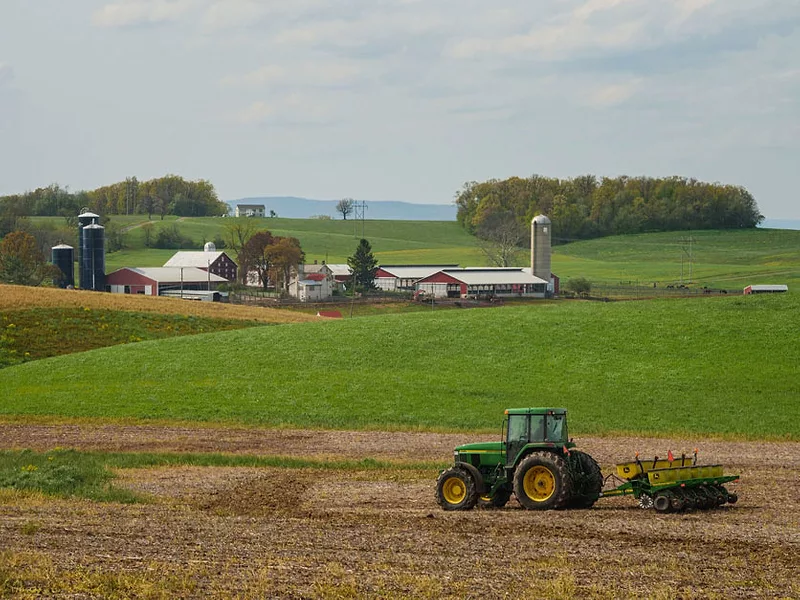
Deputy Agriculture Secretary Stephen Vaden says the Trump administration is looking at providing some kind of emergency assistance to producers to serve as a “bridge” until they get commodity program payments on their 2025 crops next fall.
Ag Secretary Brooke Rollins is “constantly talking to not only the president but other members of her cabinet about” the possible need for emergency farm aid, he said during the Farm Progress Show in Decatur, Illinois.
For more on Vaden’s comments read our weekly Agri-Pulse newsletter.
 Deputy Agriculture Secretary Stephen Vaden answers questions at he Farm Progress Show (Agri-Pulse photo)
USDA gets comments critical of reorganization
The department will be combing through comments on its reorganization proposal as it decides who should leave the national capital region and who should stay.
Rollins announced plans in July to shut down some facilities, including the Ag South Building and the Beltsville Agricultural Research Center, and transfer more than half of the Washington-area personnel to five regional hubs.
Two groups that submitted comments Tuesday were critical of aspects of the proposal. Solutions from the Land, a farmer and scientist-led nonprofit, said Rollins should rethink the closure of the Beltsville center.
Closing it “would represent a profound setback for American agriculture,” the group said. “BARC, with its 6,200 acres of research facilities and long-standing programs, is a cornerstone of U.S. agricultural science.” Its closure would “lead to the loss of world-class scientific talent [and] halt long-term, regionally relevant research plots and projects that are impossible to replicate elsewhere.”
The Food Research & Action Center (FRAC) said recipients of food and nutrition assistance would be harmed by the reorganization.
The proposal, “which would include relocating staff, consolidating regional offices, and the additional loss of institutional expertise, risks throwing the administration of [food and nutrition] programs into complete chaos and causing confusion among program participants,” FRAC said in a release.
Under the proposal, the Food and Nutrition Service headquarters building in Virginia would be closed.
By the way: Vaden said comments on the reorganization plan can be submitted until Sept. 1. He also vigorously defended moving jobs from Washington to regional hubs, where he said the cost of living would be significantly less.
Vaden says recent screwworm discovery no threat to US livestock
Vaden said the discovery of a traveler to the U.S. infected by New World screwworm (NWS) poses no threat to U.S., livestock.
Speaking to reporters at the Farm Progress Show, Vaden responded to a question about why the federal government did not immediately report the detection in early August. “There were people who traded on that,” DTNPF reporter Chris Clayton noted.
“If there are issues dealing with our markets, that's for the people that regulate markets to do,” Vaden said. “You're making an insider trading allegation. We at USDA are focused on the risk to cattle producers from the screwworm itself. This case does not represent that.”
USDA and the Department of Health and Human Services acknowledged the human case in the Maryland resident in a press release Tuesday. The Maryland Department of Health said the patient had recovered.
Take note: USDA’s release said the department “initiated targeted surveillance for NWS within a 20-mile radius of the affected area, encompassing portions of the District of Columbia, Maryland and Virginia. To date, all trap results have been negative for NWS.”
South of the border: USDA will be sending a team from the Animal and Plant Health Inspection Service to Mexico in two weeks to conduct a review of its New World screwworm protocols, Vaden said.
By the way: Vaden said USDA leaders are going to try to move the timeline for constructing a sterile fly facility in Texas “up as far as we can.”
Read more about FSA staffing challenges, weight-loss drugs’ impact on sugar sales, and flagging soybean exports in the Agri-Pulse newsletter.
House Dems: States still waiting on some BEAD guidance
Ten House Democrats say states are still waiting on the Commerce Department for clarification on how to rework their applications to comply with updated rules for the Broadband Equity Access and Deployment (BEAD) program.
Interested in more news on farm programs, trade and rural issues? Sign up for a four-week free trial to Agri-Pulse. You’ll receive our content - absolutely free - during the trial period.
In a letter to Commerce Department Secretary Howard Lutnick, the lawmakers say states are confused about how they can use “non-deployment” funds – dollars put aside for uses such as connecting schools, libraries and medical care facilities, or data collection and broadband mapping.
States are approaching a Sept. 4 deadline and are still awaiting guidance on this type of funding, the lawmakers say.
"Providing clear guidance about whether nondeployment activities are eligible uses of BEAD funding empowers states to make responsible, impactful decisions that advance the core objectives of the BEAD Program: digital equity, affordability, adoption, and access,” the lawmakers say.
Final word
“The cost of living in Indianapolis is literally half that of Washington, D.C., and so the same dollar that a USDA employee makes in Washington, D.C. goes so much further in Indianapolis, which means that employees who are located in Indianapolis in the future are more likely to stay with the agency long term, because they can have a better quality of life, which means that we get to keep their institutional knowledge for longer at USDA and not worry about attrition, which you see in high-cost-of-living places like Washington, D.C.” Deputy Agriculture Secretary Stephen Vaden at the Farm Progress Show in Decatur, Illinois.
Noah Wicks and Lydia Johnson contributed to today’s Daybreak.


