
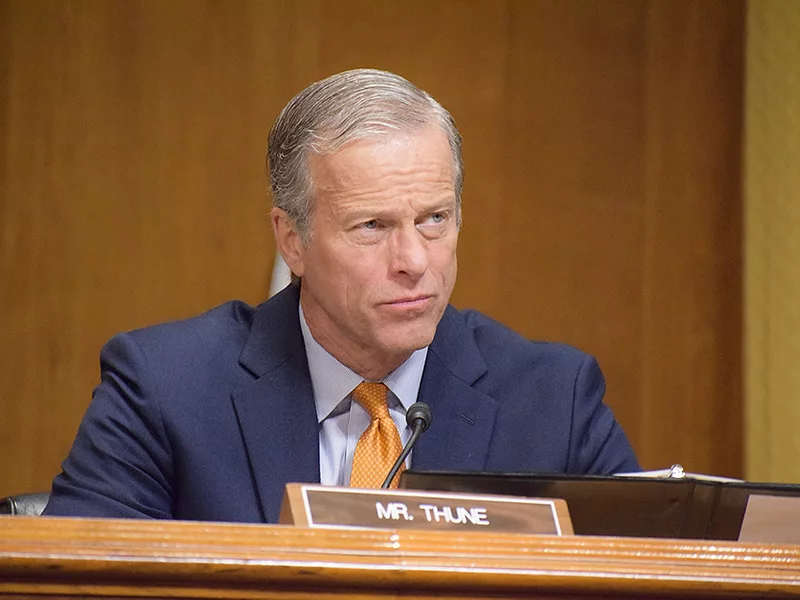
Senate Majority Leader John Thune says Congress will “keep the options open” for a new round of payments to compensate farmers for the slump in commodity markets.
Speaking at Dakotafest in his home state of South Dakota Wednesday, Thune said “we’ll see if there’s a demand” for payments like those made available to producers by the first Trump administration amid the trade war with China that started in 2018.
The American Soybean Association warned the White House earlier this week that growers “are under extreme financial stress” heading into the fall harvest. The group is urging Trump to reach a deal with China to lower tariffs.
More on Thune’s thinking: “With the margins our farmers are operating with right now, we’ve got big problems because they’re losing money — and they’re going to have good yields this year, which is great and hopefully that will offset and compensate for some of that,” Thune said. "But we can’t just continue to lose money on every sale in agriculture. So, we’ll see what the fall yields and we’ll decide where to go from there.”
Keep in mind: The One Big Beautiful Bill Act passed in July put significant new money into the Price Loss Coverage and Agriculture Risk Coverage, but farmers wouldn’t receive payments linked to this fall’s crop until October 2026.
For more of Thune’s remarks read Noah Wicks report at Agri-Pulse.com. South Dakota Republicans, Sens. John Thune and Mike Rounds, and Rep. Dusty Johnson talk ag policy at Dakotafest in Mitchell, S.D, Aug. 20 (Agri-Pulse photo).
Rollins canceled a planned appearance at Dakotafest on Wednesday; the department cited travel complications. But USDA responded Wednesday to ASA's public appeal to the White House over the ongoing trade tensions with China.
A long statement issued by the department and sent to Agri-Pulse doesn’t directly address China or ASA’s concerns but defends the president’s trade policy and notes that Congress has beefed up commodity programs.
USDA noted that Trump has announced trade deals with the United Kingdom, European Union, South Korea, Pakistan, Japan, Indonesia and the Philippines that should benefit agricultural trade. “We anticipate purchases of commodities will happen soon,” the statement says.
Cut through the clutter! We deliver the news you need to stay informed about farm, food and rural issues. Sign up for a FREE month of Agri-Pulse here.
The statement also says the Emergency Commodity Assistance Program funded by Congress in December has provided more than $2 billion directly to more than 365,000 soybean farmers. And since July 9, 132,000 soybean growers have collected another $1.07 billion in disaster payments.
In addition, the statement takes note of the proposed new biofuel usage mandates, and the extension passed by Congress of the 45Z tax credit. The department says “these actions cement the Trump Administration as the most pro-agriculture and pro-biofuels administration in the history of our country.”
Looking ahead: USDA is scheduled to release its quarterly Outlook for U.S. Agricultural Trade on Aug. 28.
RMA releases new coverage, premium increases in line with OBBB
USDA’s Risk Management Agency is rolling out enhanced crop insurance benefits that were included in the One Big Beautiful Bill Act.
 South Dakota Farmer Rodney Koch speaks about his use of federal conservation programs at a reception held by Invest In Our Land at Dakotafest (Agri-Pulse photo)
Among them: “Substantially increased premium support” for beginning farmers and ranchers in their first decade of farming; increased coverage for the Whole-Farm Revenue Protection program; and a jump in premium support from 65% to 80% for the Supplemental Coverage Option.
“The legislation delivers unprecedented improvements to premium support rates across coverage levels and unit structures, with particular emphasis on supporting enterprise and whole farm units,” an RMA news release says.
“RMA is committed to implementing these changes before upcoming sales closing dates so that producers can make fully informed decisions about their risk management strategies,” RMA Administrator Pat Swanson says.
The changes will be effective for all crops with sales closing dates on or after July 1.
EPA halts discharges from slaughterhouse in Puerto Rico
EPA has taken action to stop slaughterhouse waste from flowing into a creek in Puerto Rico. The agency says it worked with USDA to address the issue after the department notified EPA of the discharges.
“By acting quickly and working closely with our federal partner, we were able to stop the discharge almost immediately and protect a waterway that communities use for drinking water,” said EPA Regional Administrator Michael Martucci.
EPA inspected the facility and issued an order under the Clean Water Act about two weeks later that resulted in the facility “fixing the immediate issue and stopping the discharge,” EPA said.
Final word
"It's not hard to think that we might need a short-term extension to be able to get to conference in maybe the first quarter of next year to get this done" – Rep. Dusty Johnson, R-S.D., on prospects for a farm bill 2.0, which is needed to reauthorize programs left out of the One Big Beautiful Bill and to address other legislative priorities.
Speaking at Dakotafest, Johnson stressed that he believes the farm bill could still get done by this fall.
Philip Brasher and Noah Wicks contributed to today’s Daybreak.


