
As the annual FIRA USA robotics conference draws near, organizers and industry stakeholders are signaling a tighter but more dedicated investment climate ahead, along with shifting regulatory winds in California that may loosen long-standing barriers to autonomous agricultural technology.
The fourth edition of FIRA promises more robotics, more demonstrations and more scale. Co-Director Gwendoline Legrand revealed that the Woodland event will feature in excess of 30 robots and 20 field demos. Last year saw a 53% jump in farmer attendance compared to 2023, and the organizers anticipate even greater attendance this year, with growers from more than 40 states and 45 countries connecting with manufacturers, researchers and venture capitalists. California specialty crops — under growing pressure from costs, labor shortages and regulation — are widely viewed as the proving ground for many of the showcased technologies.
Innovation under pressure
Labor costs are a central concern. Western Growers Vice President of Innovation Walt Duflock pointed out that California growers spend more than $16.3 billion on 850 million hours of work each year. Harvesting accounts for more than two-thirds of that burden, while the rest goes to weeding, thinning, planting and other non-harvest activities. The shortage of workers, meanwhile, has led California farmers to increase use of H-2A guest workers three times over the last five years.
“If we can't automate some of this labor challenge, it just gets harder for California farmers to remain competitive in that global market,” said Duflock.
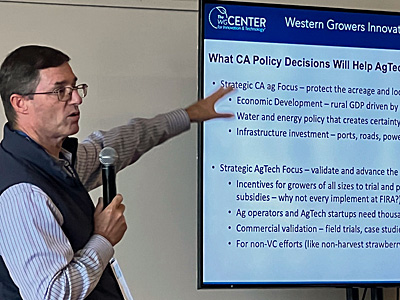 Walt Duflock, Western Growers (Agri-Pulse photo/Brad Hooker)
Regulatory costs have escalated dramatically over the last two decades. What cost $109 per acre in 2005 had risen to around $1,600 per acre by 2024, according to a study released in January by researchers at California Polytechnic State University, San Luis Obispo.
Duflock warned that these trends, combined with a sharp decline in agtech venture capital, threaten the pace of innovation. VC spending in agtech has shrunk from its “go-go era” four years ago to much lower levels over the past year, he explained. Duflock pointed out that startups took in $53 billion in 2020-21, but this dropped to just $16 billion last year and was down to $5 billion for the first half of this year.
Duflock recognized that some VCs “have soured on the field a little bit.” Yet he was optimistic the three-day FIRA event will “bring the tech to the table, sell it to the growers, tell their stories.” He called it the job of the conference partners, which, along with Western Growers, include University of California Agriculture and Natural Resources, the Governor's Office of Business and Economic Development and John Deere, among others.
Cut through the clutter! We deliver the news you need to stay informed about farm, food and rural issues. Sign up for a FREE month of Agri-Pulse here.
Startups that once raised large sums now face tougher Series A rounds, longer product development cycles and greater demands from investors. Duflock urged patience, discipline and collaboration between growers, technology providers and policymakers.
“The need for automation and precision agriculture isn’t going away,” he said.
Duflock said up to 3% of the non-harvest work is now automated, with a forecast for up to 20% within the next seven years. He hopes to get to 5% for harvest in that timeframe, though developing the robotic hands and tools to pick and pack delicate fruits and vegetables has been challenging.
The labor pressure, along with increasing water scarcity and rising land values, have put a spotlight on California’s tech sector.
“It makes California not just a major market and opportunity for agtech in the Western U.S., but a critical testing and demonstration ground,” said Gabe Youtsey, chief innovation officer at UC ANR. “Tech developed here has to deliver across hundreds of crop types, extreme climate conditions and a complex regulatory environment.”
Shifting regulations
A key regulatory hurdle has been a 1970s-era requirement under the California Department of Industrial Relation’s Division of Occupational Safety and Health, known as Cal/OSHA. All self-propelled tractors must have an operator stationed at the controls, effectively banning driverless tractors and similar machinery.
Under prior leadership, Cal/OSHA’s Occupational Safety and Health Standards Board rejected petitions to modernize the rules and resisted forming advisory committees that could explore the issue in depth with stakeholders.
Yet that has been changing. Last year Gov. Gavin Newsom appointed Joseph Alioto, a trial attorney, as the new board chair. One of Alioto’s early moves was to shift the tone and approach from resistance toward collaboration with agtech stakeholders, academics and equipment makers. Under his leadership, the board conducted informational workshops and established a stakeholder advisory committee, which met last month in Salinas to examine the safety and functionality of various autonomous agricultural machines. The committee will report its findings to the board later this year.
The more open atmosphere at the board has offered hope removing one of the greatest obstacles to the broader deployment of autonomous sprayers, weeders and tractors.
 Gwendoline Legrand, FIRA (Agri-Pulse photo/Brad Hooker)
The agtech solutions
FIRA will spotlight technologies like autonomous sprayers and tractors, electric weeders and solar-powered refill stations from companies like John Deere, New Holland and Bonsai Robotics. Panel discussions will explore regulatory barriers, scaling, AI in agriculture, and the return on investment for farmers.
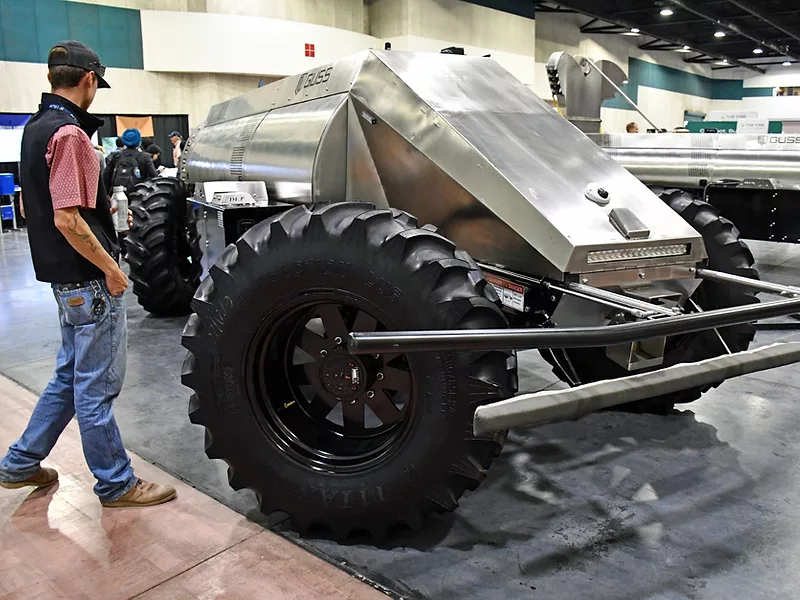
One promising venture came last month, when John Deere acquired GUSS Automation, which has been a staple at the first three FIRA conferences.
Now more than 200 GUSS autonomous sprayers are operating along the West Coast and in Australia. Sean Sundberg, business integration manager at John Deere, also announced the company will showcase its new precision spraying technology, Smart Apply, which can cut application costs up to 50%, and an autonomous utility tractor revealed at the Consumer Electronic Show earlier this year.
“We’re at a crossroads. … There’s a lot of pressure in terms of labor, there’s a lot of pressure in terms of regulation, a lot of pressure in terms of just overall material cost,” said Sundberg. “That’s the beauty of this event. We’re all focused on bringing real, impactful solutions that can help from a sustainability aspect of — not just being sustainable ag — but sustainable in terms of helping our growers’ bottom lines, top line revenue, bottom line margins as well.”
Bonsai Robotics will showcase new orchard automation tools after acquiring farm-ng, while other companies plan commercial rollouts of autonomous orchard sprayers, solar-powered refill stations and high-voltage electric weeders.
New Holland plans to bring its T4F tractor with precision fan sprayer and electric weeding technology.
“The benefits of these types of systems are increased accuracy, controlled droplet size, reduced off-target spray drift,” said Paul Welbig, director of precision technology at New Holland. “It helps reduce crop inputs by up to 10% and boosts productivity, allowing farmers to cover a lot more acres per day.”

