
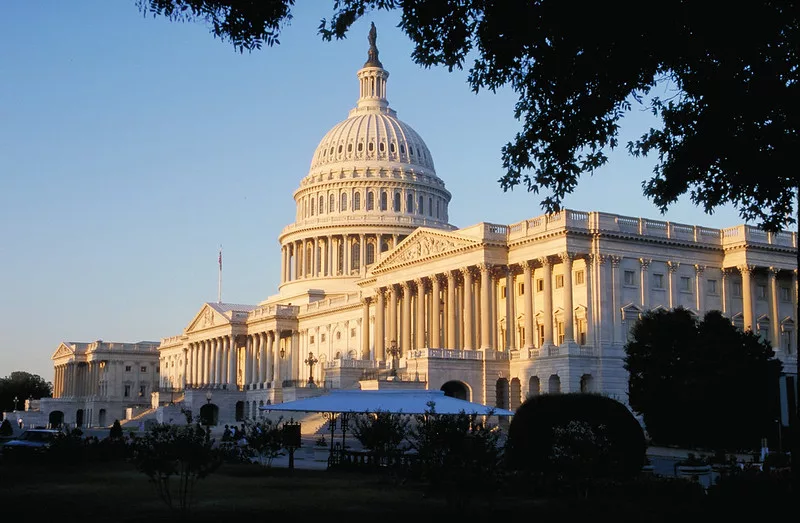
President Donald Trump’s trade policy has survived another challenge on Capitol Hill. But this time, Republican tariff critics say they’ve secured some concessions.
The House voted Tuesday to block any votes on challenges to Trump administration tariffs until at least March 2026. But the GOP leadership had to keep the vote open for more than 30 minutes while they cajoled several GOP holdouts. Nebraska Rep. Don Bacon and Reps. Jay Obernolte and Tom McClintock of California eventually switched their no votes to ensure the rule’s passage.
The language was included in the floor rule for a D.C. crime bill.
A staffer for McClintock’s office told Agri-Pulse he switched his vote after receiving assurances from House Speaker Mike Johnson that he would bring another rule to the floor this week to shorten the extension until Jan. 31.
Bacon said the language to address their concerns could be added to a rule vote scheduled for today.
GOP leadership also agreed to set up a GOP tariff working group. Bacon said he expects to sit on the panel, which will also look at Congress’ role in tariff policymaking.
Take note: Tuesday’s vote was the second in as many days in which House Republicans have narrowly blocked Democratic efforts to end the tariffs. On Monday, the House nixed a push to end the tariffs on Brazil in a 200-198 vote.
 Rep. Don Bacon, R-Neb. (Bacon office photo)
U.S. and Chinese officials left meetings in Madrid this week without advancing talks on the high cross-border tariffs on each other’s exports, dashing hopes from U.S. ag for trade relief.
We’re “deeply disappointed that ag didn’t seem to make the discussions,” Tim Lust, CEO of the National Sorghum Producers told Agri-Pulse. “We realize that the China-U.S. relationship’s complex, but sorghum farmers need markets.”
Read more on China’s lackluster ag purchases in this week’s newsletter.
Cut through the clutter! We deliver the news you need to stay informed about farm, food and rural issues. Sign up for a FREE month of Agri-Pulse here.
Corn industry group: Labeling laws could cost consumers
An analysis commissioned by the Corn Refiners Association suggests new state food labeling requirements in Texas and Louisiana could lead to significantly higher costs for consumers.
The report from Policy Navigation Group suggests out-of-pocket expenses for households in Texas could increase by $2,200 annually as a result of a new labeling law enacted in the state. Households in Louisiana may have to shell out $900 more a year.
“Consumers face the prospect of a sharp increase in food prices due to policy changes authorized by state legislators,” CRA CEO John Bode says in a release. "It is critical that the costs and benefits of food supply policy changes are purposefully assessed before increased costs are imposed on consumers."
Why it matters: Policies like these would have little chance of getting through Congress as it stands now. But pressure on the industry and the federal government will only build if the Make America Healthy Again movement continues to make progress at the state level.
Withdrawal of meat and poultry pollution proposal prompts lawsuit
The Trump administration’s decision not to limit water pollution from meat and poultry slaughterhouses is being challenged by environmental groups.
Ten organizations have filed a petition asking the 9th Circuit Court of Appeals in San Francisco to review the Aug. 28 decision by EPA to withdraw a 2024 proposed discharge rule.
A consent decree in previous litigation led to the original proposal last year.
The proposal “would have, for the first time, imposed limits on phosphorus pollution from 126 meat industry plants across the U.S.,” the environmental groups say in a news release. If implemented, it would have eliminated at least 8 million pounds of phosphorus and 9 million pounds of nitrogen and other pollutants, including fecal bacteria and grease.
The petition was filed by Environmental Integrity Project and Earthjustice on behalf of groups including the Rural Empowerment Association for Community Help, Food & Water Watch and the Center for Biological Diversity.
Small refinery exemption proposal has backers, detractors
Biofuels advocates are praising an EPA proposal to reallocate biofuel volumes exempted from the Renewable Fuel Standard.
In the proposal issued Tuesday, EPA said it would reallocate either 50% or 100% of volumes exempted in 2023 and 2024, as well as those expected to be covered by small refinery exemptions in 2025.
“EPA is issuing a solid proposal,” said Paul Winters, director of public affairs and communications at Clean Fuels Alliance America.
Summit seeks to advance carbon pipeline in Iowa
Summit Carbon Solutions is facing a raft of setbacks in its goal to build a nearly $10 billion carbon pipeline through prime U.S. farmland across multiple states. Now, the company is asking Iowa to change its conditional approval of the project.
In a new filing with the Iowa Utilities Commission, Summit wants the state to remove language requiring that South Dakota and North Dakota must approve the pipeline before construction can begin in Iowa.
The company instead wants the petition to say that building can’t start until Summit has “secured access to one or more sequestration sites and permits or agreements to allow it to reach such storage.” Summit also is seeking changes regarding the pipe size and route of the carbon-trapping-and-storage project.
The request follows two rejections of the project by South Dakota, most recently in April, amid fierce opposition from some landowners, including farmers, over concerns about safety and property rights. Summit’s aim is to capture and ultimately store in North Dakota carbon-dioxide emissions from plants making corn-based ethanol.
Backers of the pipeline say without it, top corn producing states like Iowa risk falling behind other regions that can more easily sequester carbon emissions on site due to more favorable geology.
Final word
“The lack of sufficient labor at times has prevented us from having the quality products we wish because we can’t get the work done. And it’s preventing us from growing our business and seizing opportunities that are coming our way. We urgently need a bipartisan legal ag workforce solution." -- Michael Frantz, president of California-based Frantz Wholesale Nursery, speaking at a House Ag Committee hearing on specialty crops.
Kim Chipman, Oliver Ward and Noah Wicks contributed to today’s Daybreak.
.webp?t=1762183428)


