
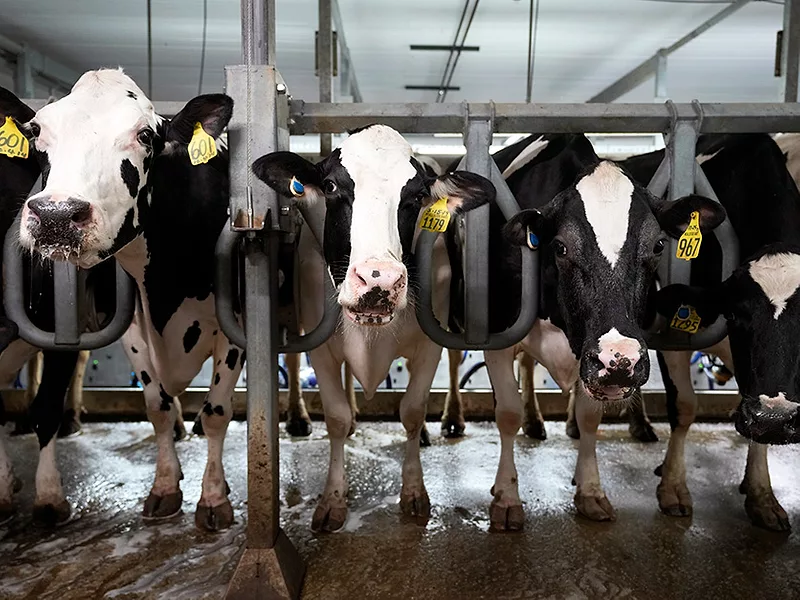
Air quality regulators overseeing the broad Los Angeles basin have approved a new rule requiring more stringent emission reductions at confined animal facilities.
The basin has spent more than a decade in serious nonattainment under the national air quality standard for fine particulate matter, known as PM2.5. The South Coast Air Quality Management District considers livestock operations part of the problem due to ammonia from effluent, a precursor to PM2.5.
The district has decided to revise the initial 2006 regulation to elevate the basin — along with its dairy, poultry and duck farms — to the same pollution threshold as the San Joaquin and Imperial valleys. The change also brings a dozen more dairies in San Bernardino and Riverside counties within the permitting requirements. The rule takes effect in 2027, with the facilities requiring permits by 2029.
At its September hearing, the district governing board approved the proposal, along with three other rule amendments to comply with clean air requirements. Since the basin had failed to meet the attainment standard in 2012, the Clean Air Act required the district to comply by 2025. A subsequent extension pushed the deadline to 2030, but that came with “some terms and consequences,” according to Michael Krause, assistant deputy executive officer in the district’s planning and rules division.
The district had to comb through its existing rules to find any provisions that are less stringent than those of other districts, the state or even other states. Along with livestock waste management, the search led them to rules on composting green waste, on residential wood burning and changing over char broilers at restaurants. The district faced a “sanctions clock” if it did not adopt more stringent measures for the rules before October, meaning California could lose federal highway funding or face more stringent federal air quality mandates, explained Krause.
“We do take the sanctions very seriously, we take these clocks very seriously, and we take the actions expected of us very seriously,” he said.
Under Rule 223, large confined animal facilities must obtain an air quality permit and implement a “menu” of options for mitigating ammonia emissions, with the additional benefit of curbing the release of volatile organic compounds. Until the update, the rule had applied to dairies with at least a thousand cows and poultry operations with 650,000 birds or more. The threshold has now dropped to 500 and 400,000, respectively. If an operation plans to shut down or downsize to be lower than the threshold, it can notify the district and avoid the actions.
The lower limit triggered seven more dairy farms in San Bernardino County and five in Riverside County to fall within the scope of the rule. Since the chicken and duck farms were already large, none were impacted. The district anticipates the modification will lead to 0.17 tons of ammonia reductions per day.
 John Lucas (Farmer Boys photo)
“This would have a minimal impact on some of those facilities because they would have to apply for a permit and an annual renewal,” said Krause. “But over time, it flattens out.”
The initial permit and plan fee is $3,500 and the annual renewal costs $550, though the three small businesses now under the rule would qualify for a 50% discount on the initial fee. The district’s socioeconomic impact assessment concluded that the 12 affected dairies would collectively pay up to about $12,000 to comply each year.
Despite Krause’s assurances, the dairy industry heavily opposed the rule change.
“I find it truly absurd that South Coast AQMD is willing to simply check the box on the most stringent measures,” said Kevin Abernathy, general manager of the Milk Producers Council.
He reasoned that “simply lowering the threshold would have zero public health benefits.” The council had been working to resolve the issue with U.S. EPA Region 9 Administrator Josh Cook — until he abruptly resigned from the position last month. Abernathy believes the Trump administration “has zero willingness to extend the undue burdens of increased cost on the few family farms left in Southern California,” which he described as a “180-degree difference” from the Biden administration.
Cut through the clutter! We deliver the news you need to stay informed about farm, food and rural issues. Sign up for a FREE month of Agri-Pulse here.
Such a regulation makes more sense in the San Joaquin Valley, where most of the state’s 1.6 million cows live, he argued.
“The days of half a million cows that used to be in Southern California are simply not there,” said Abernathy. “It’s homes and businesses where the dairies used to be.”
Kaitlyn Elkind, a consultant to the Milk Producers Council, took issue with the science behind the proposal. She argued the initial rule was designed for ozone precursors, not ammonia, and said the evidence was lacking to show it would meaningfully impact PM2.5, adding that the nonattainment areas are upwind of the 12 dairies and not affected by their emissions.
Elkind explained that, while the smaller dairies already voluntarily comply with the rule, they cannot shoulder the regulatory costs.
“The financial burden of the permits could force these dairies — which represent less than 20% of milking cows — out of operation,” she said, warning that if they close, the land may be developed for urban or industrial uses that increase emissions.
Composters were also upset with the strict new obligations for their sector. Arin Boughan, manager of the Inland Empire Regional Composting Authority, warned the rule updates would “harm the very infrastructure California needs to meet its climate and organics goals under SB 1383.”
 Manuel Perez (Perez office photo)
The 2016 law was the world’s first government mandate establishing a methane goal, with the aim of reducing emissions 40% by 2030. Deploying anaerobic digesters, the dairy industry is on track to surpass its SB 1383 obligation. But landfills have fallen behind on their targets for reducing organic waste 75% and diverting 20% of the food waste to composting and other purposes. The top concern has been the steep cost to comply, which would primarily fall on ratepayers.
Boughan told the board the new changes could limit composting capacity, requiring waste managers to truck organic material long distances out of the basin for disposal.
“This will raise emissions, add costs to our ratepayers, harm local air quality and reduce the quality of life — the exact opposite of our shared goals,” said Boughan.
Arborists and landscapers raised further alarms over the science behind the composting rule update. Restaurant owners, meanwhile, flagged the steep purchasing expenses with the crackdown on char broilers and cautioned that the state’s recent minimum wage hike, combined with inflation, has created a challenging environment for the quick-service eateries. Those issues alone have reduced worker hours and new hires and led to the loss of 18,000 jobs, according to the California Restaurant Association.
“California’s regulatory environment has become increasingly difficult to navigate, with each new mandate — however well intentioned — adding another layer of complexity and cost,” said John Lucas, vice president of brand and franchise development at Farmer Boys, who also spoke on behalf of the association.
The industry concerns drew the board’s attention, with several members urging district staff to find ways to ease the regulatory burden of the new rules, though the proposals passed nearly unanimously.
“We’ve got to get this passed,” said Riverside County Supervisor Manuel Perez. “But let’s work with the industries to get something that can be as fair as possible.”

