
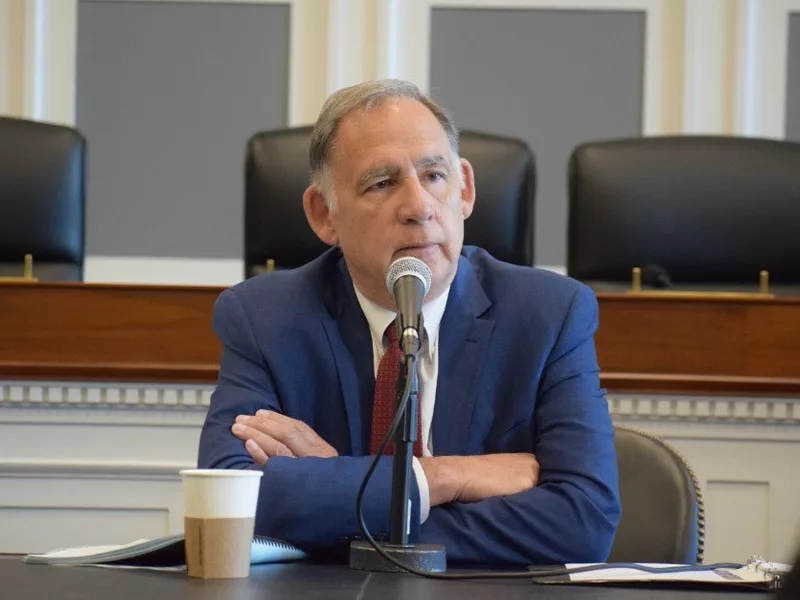
The Trump administration has quietly moved some $13 billion from a fund used to deliver tariff assistance to farmers in President Trump’s first term to the Agriculture Secretary’s office.
On Sept. 28, the Office of Management and Budget greenlit a $13 billion transfer from the Commodity Credit Corporation to the Office of Secretary Brooke Rollins.
Asked about the move, the top Senate Ag Committee appropriator Sen. John Hoeven, R-N.D., wouldn’t say if the money was linked to a forthcoming announcement on tariff assistance. But he told Agri-Pulse, “We've been working on this, so probably you're not too surprised.”
Take note: Hoeven said on Monday that the most likely path forward for tariff assistance would involve multiple steps. The administration, he said, would likely announce some unilateral measures while Congress worked on legislation.
“It won't be just a one-shot deal,” Hoeven said. “The CCC is already ready to go. That's done. That's squared away, so the administration doesn't need more help there.”
The CCC’s borrowing authority has been severely depleted, with some sources saying there could be as little as $4 billion remaining.
“That's why it's not going to be just one item,” Hoeven said. “We'll probably be doing more before the end of the year, which will require, actually, some legislative assistance as well.”
Cut through the clutter! We deliver the news you need to stay informed about farm, food and rural issues. Sign up for a FREE month of Agri-Pulse here.
Congress has been looking to lift restrictions on how much tariff revenue the administration can divert to farmers via a legal mechanism known as Section 32.
Ag Committee Chair John Boozman, R-Ark., stressed that other farm support programs relying on CCC funding would not be allowed to lapse if the administration taps CCC for tariff assistance.
“We're not going to let our commitments go by the wayside,” he said.
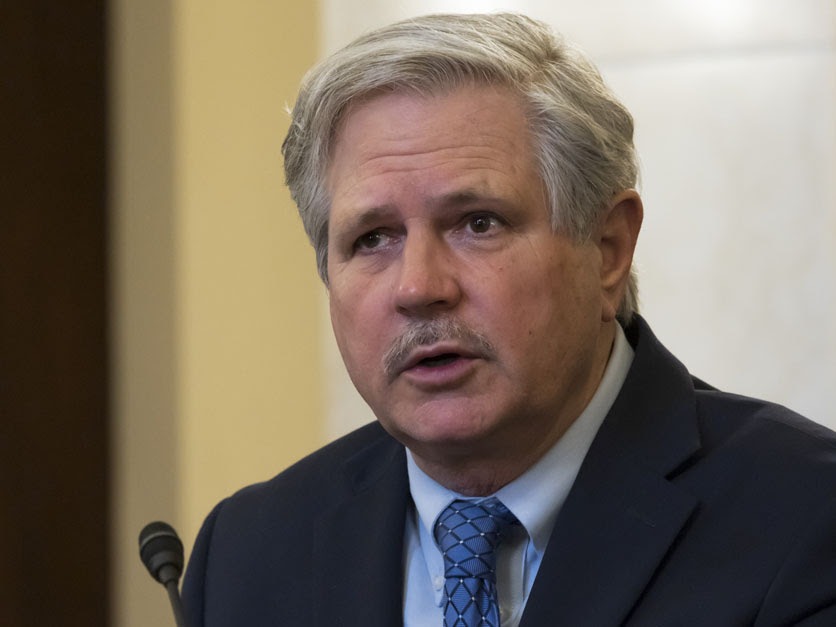 Sen. John Hoeven, R-N.D. (Agri-Pulse photo)
Trump says new tariffs on trucks are coming
President Trump says that foreign-made trucks will become the latest products to face new U.S. tariffs.
Trump said in a Truth Social post that starting Nov. 1, imported trucks will be subject to a 25% tariff. He directed the Commerce Department in April to probe whether truck imports are threatening national security.
Why it matters: The tariffs, Trump said, will apply to “all Medium and Heavy-Duty Trucks coming into the United States.” It is not clear whether they will also apply to Mexico and Canada, which account for more than 90% of U.S. medium and heavy truck imports.
Products covered by a North American trade pact have been exempt from some U.S. tariffs, although they still face sector-specific tariffs.
The announcement comes as Canadian Prime Minister Mark Carney comes to Washington for a meeting with the president today. The pair are expected to discuss the U.S.-Mexico-Canada Agreement and sector-specific U.S. tariffs affecting Canadian producers.
Farm groups to White House: ‘We need help’
More than 200 farm groups want help from the White House as export markets dry up.
Without specifically mentioning President Trump’s trade policy the groups noted that “crop prices are low, while input costs have increased substantially in recent years. According to the USDA, per-farm production expenses are up by almost 40% since 2020.”
“We know that building markets takes time, and while our producers do not want to be in the position of having to ask for more assistance, they do need a bridge to get to improved markets,” the groups said.
The letter says that the most significant benefits from the One Big Beautiful Bill Act don’t go into effect until October of next year. In addition, “Congress still needs to enact a full five-year Farm Bill to address other significant concerns in agriculture.”
The administration is reportedly considering a farm assistance package worth billions of dollars, but it’s not clear how it will be funded.
Appeals court upholds Massachusetts pig confinement law
A federal appeals court has upheld a Massachusetts law banning the sale of pork “derived from pigs who were confined in gestation crates”.
Question 3 was approved by Massachusetts voters in 2016 by about a three-to-one margin. A federal district court upheld the law last year.
The 1st Circuit Court of Appeals in Boston says the law does not discriminate against out-of-state farmers, since it has the same effect on Massachusetts pork producers as it does on those in other states.
The Supreme Court upheld a similar California law, Proposition 12, in 2023. The National Pork Producers Council and other farm groups have been supporting federal legislation preventing states from affecting farm practices outside their own states.
Plaintiffs in the case include non-Massachusetts pork producers.
New report sheds light on grain storage shortage
U.S. grain elevators are expected to be short 73 million bushels of upright grain storage this year amid what is shaping up to be a record harvest, according a new report from CoBank.
Farmers are expected to harvest 21.5 billion bushels of corn, soybeans and grain sorghum, a 10% increase from 2024. However, a strong corn harvest and a lack of Chinese demand for soybeans has cut into storage availability.
Soybean struggles: CoBank analysts Tanner Ehmke and Emmie Noyes said in the report that “with interest expense top of mind for elevators, soybeans will have the highest cost of carry versus corn, wheat or grain sorghum.” They added that stored soybeans degrade faster than stored corn.
“Soybean and grain sorghum export sales are lagging well behind prior years,” a CoBank press release on the report says. “Soybean sales are down 51% year-over-year while grain sorghum sales are starting the season down 58%.
“The weak shipping pace of soybeans and grain sorghum will allow more transportation and elevator capacity to be used to support corn and wheat shipments to the Pacific Northwest and the U.S. Gulf.”
USTR hearing on Chinese WTO commitments postponed
The U.S. Trade Representative has indefinitely postponed a hearing on China’s compliance with its World Trade Organization commitments.
The hearing had been scheduled for today. USTR collected comments until Sept. 24 on the issue; among those commenting were the National Pork Producers Council and USA Rice.
Cullman ascends to chair of international feed group
Constance Cullman has been named chair of the International Feed Industry Federation for 2026-2027.
Cullman, president and CEO of the American Feed Industry Association, was chosen unanimously during last week’s annual IFIF meeting in Rome. She succeeds Ruud Tijssens, who was chair from 2022 to 2025.
“I am deeply honored to be elected chair of IFIF for 2026–27,” Cullman said in a news release. “It is a privilege to work alongside our members to advance sustainable, science-based solutions for the global feed and food.”
Final word
"It’s beginning to look more and more like the 1980s to me." -- Sen. Chuck Grassley, R-Iowa, speaking on the Senate floor.
Philip Brasher, Oliver Ward and Noah Wicks contributed to today’s Daybreak


