
Government shuts down but potential RIFs loom
It was shutdown day at USDA, and the few workers at headquarters in Washington, D.C., were wrapping up office work in preparation for an indefinite leave of absence.
One employee who spoke to Agri-Pulse said he planned to catch up on home projects.
But there were no signs on Capitol Hill of a thaw between Democrats and Republicans, who remain at loggerheads over spending.
RIFs? The Trump administration has raised the prospect of firing federal workers during the shutdown, but there was no word Wednesday on when – or whether – those will take place.
One lawmaker, Rep. Adrian Smith, R-Neb., told Agri-Pulse’s Oliver Ward, “I think we will learn more here in the next 24 hours or so that there are a lot of positions that are funded but not authorized by Congress. And so I think there will be a very diligent and thoughtful process moving forward that will be able to achieve some efficiencies there and make sure that services are not sacrificed or compromised.”
“When we can … make progress at reducing the bureaucracy, a lot of people win,” Smith said.
Administration blames Dems: The Trump administration blames Democrats for the shutdown, even in communications that normally would not be partisan.
Pages on USDA’s website now say they will not be updated “due to the Radical Left Democrat shutdown.”
Emails that went out to federal employees Tuesday also blamed the Democrats.
Former NRCS Administrator Bruce Knight, now a consultant, said he’s worried about an extended shutdown because both sides “believe that the American public is going to rally behind their position.”
"If this runs, say, a month or two, then that sets back the ability for a farmer to get a decision on EQIP, be able to implement things over the next month," he said.
Administration signals soybeans at forefront of China talks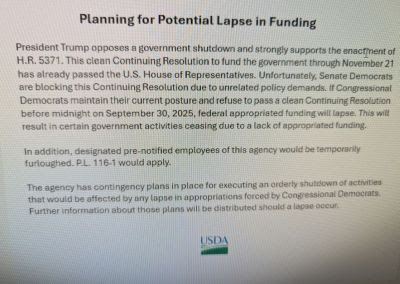
The president and his top diplomat in China are telling lawmakers and soybean farmers that protecting their interests remains a priority in ongoing trade discussions.
In a closed-door meeting between Senate Republicans and U.S. Ambassador to China David Perdue this week, Perdue reportedly told lawmakers that soybeans are the top issue in ongoing discussions.
Iowa Sen. Chuck Grassley said on the Senate floor Wednesday that in addition to emphasizing the importance of soybeans in negotiations, Perdue also mentioned the unfulfilled purchase commitments under the Phase One deal.
Later on Wednesday, President Trump highlighted the role of soybeans in negotiations. On social media, he said they would be “a major topic of discussion” when he meets Chinese President Xi Jinping later this year.
“I WILL NEVER LET OUR FARMERS DOWN!” he said. “MAKE SOYBEANS, AND OTHER ROW CROPS, GREAT AGAIN!”
Sen. John Hoeven, R-N.D., told Agri-Pulse that he is confident that soybean producers' concerns have reached the president.
“He understands the issue there,” he said, as well as “for other farm commodities.”
Boozman: Shutdown could help farm aid discussions
The government shutdown heads into day two today. But Senate Agriculture Committee Chairman John Boozman tells Agri-Pulse the shutdown could help get dollars to struggling farmers.
The funding lapse means "things slow down here, so it really allows us to focus on the things that are really important, even more so,” Boozman said in an interview with Congressional Editor Kim Chipman.
Cut through the clutter! We deliver the news you need to stay informed about farm, food and rural issues. Sign up for a FREE month of Agri-Pulse here.
As we’ve reported, lawmakers are looking to revise USDA’s Section 32 spending authority to pay for a sizable aid package funded through tariff revenue.
“The good news is that I think virtually everybody in Congress and certainly the administration is on board now,” Boozman said.
As for the timetable: It’s crucial to act as fast as possible – in the “next few weeks,” Boozman said. “The bankers are very concerned that farmers have the ability to show that they're going to have this income coming in,” he said.
Iowa lawmakers pitch moving Beltsville research to their state
Iowa’s congressional delegation wants Agriculture Secretary Brooke Rollins to make Iowa the new Beltsville.
With USDA proposing to move the historic Maryland-based agricultural research facility as part of its upcoming reorganization, Iowa lawmakers want Rollins to send the lab’s researchers to Ames.
In a letter, they said Iowa State University researchers already study several of the same subjects, including soybean genomics, hydrology and remote sensing, animal genomics, adaptive cropping systems, and bee research.
Surface Transportation Board member sues Trump Administration over attempted removal
Former Surface Transportation Board member Robert Primus is suing the Trump administration over its attempt to remove him from the board.
Primus, who received a termination email last August, filed a lawsuit Wednesday arguing that the administration provided no reasoning when attempting to remove him, which he alleges violates federal law. To satisfy statutory requirements, removals must be due to “inefficiency, neglect of duty, or malfeasance in office,” according to the lawsuit.
Biofuels to provide demand for corn, soybeans, KC Fed says
Biofuels, not exports, are poised to propel demand growth for U.S. corn and soybeans, according to the Federal Reserve Bank of Kansas City.
Brazil's dethroning of the United States as China’s biggest soybean supplier and other trade shifts are diminishing the world’s appetite for America’s two biggest crops.
But renewable fuels made from grain and oilseeds stand ready to fill the breach if changes to U.S. biofuel policy become final, Fed economists say.
EPA wants sharp increases in biomass-based diesel required to be mixed into the country’s traditional fuel supply. It’s also proposed incentives for blenders to use North American biofuel feedstocks as opposed to raw materials like used cooking oil from Asia. Recent changes in a key clean fuel production tax credit, known as 45Z, also have given an economic advantage to refineries and processors that make fuel with sustainable ingredients from the U.S, Canada and Mexico.
The KC Fed’s analysis hits Big Oil groups and some biofuel producers that lobby against limits on foreign feedstocks, arguing those could raise their costs and raise prices for consumers. EPA’s plan would cut the biofuel credits known as RINs by 50% for fuels made from non-North American commodities. RINs are used to track biofuel blending mandate compliance.
Earlier this week, nearly four dozen members of Congress asked EPA Administrator Lee Zeldin to keep the agency’s proposal intact when it issues final rules, according to a letter obtained by Agri-Pulse.
"At a time when many farmers are struggling to break even, all federal biofuels policies should prioritize domestic agriculture and biofuel production, not foreign fuels made from foreign feedstocks,” the bipartisan group of lawmakers including Iowa Republican Senator Chuck Grassley and Democratic Representative Angie Craig of Minnesota wrote.
Final word
"Given the number of employees that they're proposing are going to be furloughed, [the impact is] much greater than the county offices. It would be the state offices and much of headquarters. The ones that are left remaining are the ones that are deemed to be essential — that keep the lights on, but also keep emergency functions going." – Bruce Knight, principal and founder of Strategic Conservation Solutions and former administrator of the Natural Resources Conservation Service.
Philip Brasher, Kim Chipman, Oliver Ward and Noah Wicks contributed to today’s Daybreak

.webp?t=1762183428)


