
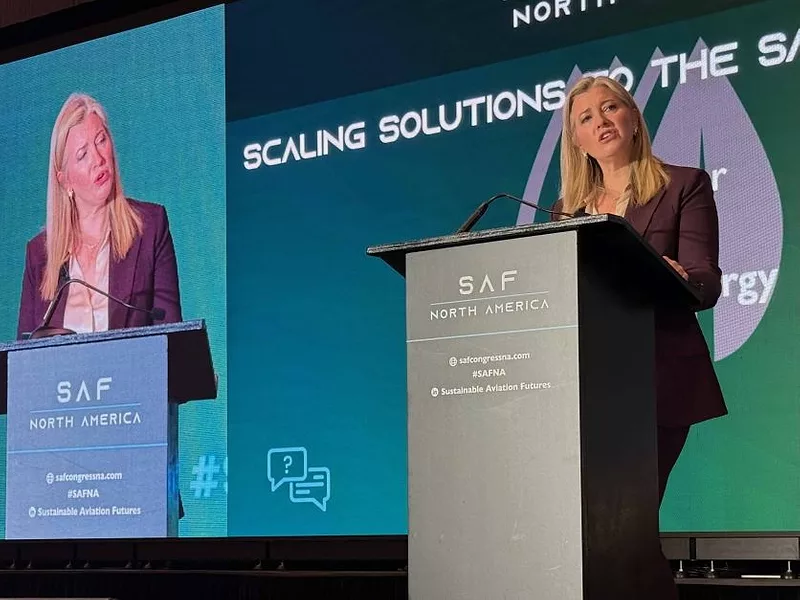
The sustainable aviation fuel industry needs to harness the political power of U.S. agriculture and rural America, and take up the Trump administration’s goal of American energy dominance, an ethanol industry leader says.
“If we want to bring more people to our side, we need to start talking about how SAF can build new markets for farmers,” Growth Energy CEO Emily Skor said Thursday at the annual SAF North America conference in Houston.
“We need to start talking about how SAF fits into this administration's goal of energy dominance, and we need to start talking about how this is a high-growth opportunity that America cannot afford to miss out on.”
While SAF production has increased in recent years, primarily in the form of fuel made from vegetable oil and waste fats and oils, it still represents a small fraction of aviation fuel. SAF can also be produced from ethanol. The first such operation, a LanzaJet facility in Georgia, has yet to start commercial operation.
Another company developing alcohol-to-jet SAF, Gevo, plans to produce the fuel at a 30-million-gallon-a-year facility in North Dakota. A larger project planned for South Dakota has stalled because of the struggles of Summit Carbon Solutions to build its carbon sequestration pipeline in that state.
The SAF industry suffered a setback when an extension of the 45Z clean fuel production credit that was included in the One Big Beautiful Bill removed a bonus incentive for SAF. The credit, which was authorized by the Inflation Reduction Act in 2022, also was revised to exclude feedstocks not produced in the United States, Mexico or Canada. The credit, which was originally supposed to sunset after 2027, was extended through 2029.
The Trump administration has largely been supportive of biofuels, including SAF, at the same time it is trying to uproot federal climate policies.
Skor noted that the Trump administration also scrapped the Biden administration’s SAF Grand Challenge, a goal supported by airlines to produce 3 billion gallons of SAF by 2030.
Cut through the clutter! We deliver the news you need to stay informed about farm, food and rural issues. Sign up for a FREE month of Agri-Pulse here.
“The current administration is emphasizing American energy dominance while moving the focus away from climate and carbon performance,” Skor said.
Even though the 45Z SAF incentive was scaled back, Skor suggested that getting the credit extended by two years at the same time other IRA policies were being rescinded demonstrated the political clout of various sectors working together.
Speaking of the 45Z extension, she said, “That's huge. Why? Because of the coalition we helped build spanning aviation, energy, transportation, agriculture and rural interests. Each may be primarily driven by a range of different goals, from energy security to fuel affordability to economic development, yet all of our coalition understands the central importance of rural America and job creation. All of our coalition is invested in the American farmer's ability to compete well into the future.”
She also said that airlines globally were still committed to cutting their carbon footprint and face mandates outside the United States to do so.
“When we look out to see where the global economy is going, it's obvious that sustainability and low carbon are only growing more important. We can see airlines and logistics companies eager to find the supply they need to hit their SAF targets. We can see SAF mandates rolling out in the EU, the UK, and globally. We can see construction beginning on SAF plants in Asia.
“These are clear market signals, and we want to move where they're pointing us. We want to make sure American energy dominance includes dominance in the aviation market.”
The United Kingdom’s aggressive new SAF mandate starts at 2% of total British jet fuel usage, mirroring the European Union requirement, and increases to 10% in 2030 and 22% by 2040.
A study led by former Energy Secretary Ernest Moniz for Growth Energy detailed the potential carbon impacts of ethanol-based SAF, based on sequestering carbon dioxide emissions, reducing energy usage in production, and implementation of cover crops and other lower carbon farming practices.
There are currently three domestic producers of SAF and production remains limited. The Energy Department has estimated that production capacity would be about 30,000 barrels a day this year.
SAF remains significantly more expensive for airlines than conventional jet fuel, with a cost premium of several dollars a gallon that is only partially closed by federal incentives, according to Andreea Moyes, global head of sustainability for Air bp.
The clean energy provisions in the inflation Reduction Act initially made the United States attractive to investors but that’s been reversed by passage of the OBBB and the United Kingdom’s creation of its own SAF mandate, said Prathama Nabi, who is with Barclays Investment Bank's energy transition group.
“There’s just whiplash everywhere,” she said.
For more news, go to Agri-Pulse.com.

