
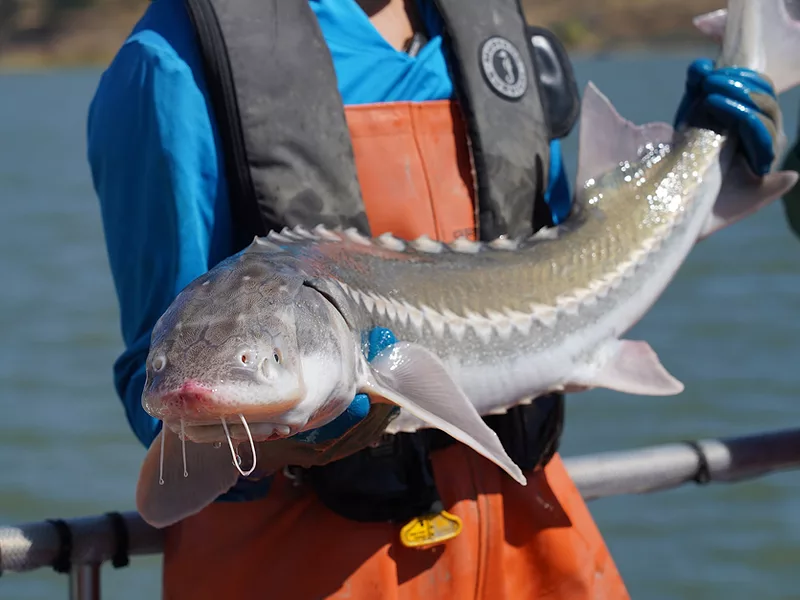
California’s effort to protect an ancient bony fish could trigger new restrictions on water deliveries, impact flows for Sites Reservoir and the Delta tunnel, and upend sensitive negotiations over voluntary agreements.
State Water Contractors and its 27 local water agencies are urging Gov. Gavin Newsom to intervene in California’s white sturgeon review process before regulators reach a final decision.
Representing 27 million Californians and 750,000 acres of farmland, SWC said the California Department of Fish and Wildlife’s temporary protections for the species, as it reviews the status under the California Endangered Species Act, are already imposing millions in costs and regulatory uncertainty.
“Even though the [State Water Project’s] potential impact on the species is minimal, CDFW has already required [the California Department of Water Resources] to fund the majority of monitoring and science for the species, in addition to funding new habitat restoration and imposing new limits on SWP operations,” SWC General Manager Jennifer Pierre cautioned in a letter to the governor this month, adding that the cost has exceeded $10 million.
The warning comes as new state surveys underscore the fragility of the white sturgeon population. In a June 2025 report, CDFW scientists found the number of adult fish between 40 and 60 inches long has dropped to about 6,500 — down from roughly 30,000 less than a decade ago. The department attributed the decline to harmful algal blooms in the San Francisco Bay, poaching, excessive fishing, and poor conditions in the Sacramento–San Joaquin Delta and its tributaries. The species has been under candidate status since June 2024, giving it full legal protection while CDFW completes its review.
Contractors warn of long-term risks
Pierre argued that CESA protections are already complicating water supply planning. The incidental take prohibition now applies to the State Water Project and its facilities, requiring DWR to demonstrate that Delta operations do not harm endangered fish. That has prompted new monitoring and operational analyses for the sturgeon and other fish.
Pierre says these costs and uncertainties fall directly on the ratepayers who fund the SWP — including irrigation districts that deliver surface water to large sections of the San Joaquin Valley, the Central Coast and Southern California.
If the sturgeon is formally listed as threatened, the group warns, DWR may need a new incidental take permit covering the project’s Delta export facilities. That could mean tighter limits on pumping during high-flow periods when the state typically captures and stores water for drought years.
“Our ability to be climate resilient depends on our ability to move and store water when it is plentiful and environmentally safe to do so,” wrote Pierre. “We ask that CDFW only require permit conditions that are proportionate to the effect of the SWP on the species.”
A divided commission
The debate over white sturgeon protections came to a head last year, when the California Fish and Game Commission voted to designate the species as a candidate for listing.
John Kelly, a senior environmental scientist at CDFW, presented data showing persistent declines in white sturgeon abundance and a clear link between successful recruitment and river flows. He said the department’s evaluation found “sufficient scientific information” to justify a status review.
Cut through the clutter! We deliver the news you need to stay informed about farm, food and rural issues. Sign up for a FREE month of Agri-Pulse here.
Jon Rosenfield, science director at San Francisco Baykeeper, one of the petitioners, warned that “unsustainable water diversions” are among the primary stressors threatening the fish. He pointed to new proposals to capture high river flows — such as Sites Reservoir, the Delta Conveyance Project and voluntary flow agreements for the Bay-Delta Water Quality Control Plan — as an “imminent threat” to the species.
The petition argues Sites would take water from the sturgeon’s spawning, rearing and migration corridor along the Sacramento River; Newsom’s Delta tunnel plan would “substantially reduce flows” in the lower portion of the river; and the voluntary agreements, now known as the Healthy Rivers and Landscapes Program, would “significantly diminish” outflow conditions in the river and Delta.
Sierra Club policy strategist Erin Woolley said even the 55% unimpaired flow objective the state water board initially proposed for its Bay-Delta Plan update would not provide enough water for the sturgeon.
The environmental and sportfishing groups behind the petition have long been fierce critics of the three initiatives.
Countering them, SWC assistant general manager Chandra Chilmakuri said the sturgeon population has been stable over the last 14 years due to a new set of biological opinions for endangered Delta fish. He argued the petition “simply identified a reduction in population … but did not consider whether the current population can self-sustain.” He warned that listing the species would have “significant real-world implications for the water supply and costs for more than two-thirds of Californians.”
Some fishing groups also voiced concerns over the potential economic fallout for their industry. James Stone, board president at the Nor-Cal Guides and Sportsmen’s Association, said a full closure would devastate bait shops and charter operators, noting that the department’s own survey suggested 43% of anglers would stop participating under a catch-and-release-only rule.
“We’re going to lose a lot of revenue,” he said, urging the commission to keep limited harvest opportunities to sustain the $7 million-a-year fishery.
 Jennifer Pierre, State Water Contractors (SWC photo)
A widening regulatory squeeze
For growers, the combination of water quality regulations, endangered species protections and climate-driven droughts has already narrowed their margin for error. SWC says the layering of new environmental mandates — from the Bay-Delta Plan update to the white sturgeon review — creates overlapping constraints that make it harder to plan for long-term infrastructure investments.
“The SWP exemplifies a modern case of ‘death by a thousand cuts,’ gradually undermined by countless seemingly small challenges over time,” wrote Pierre in her letter to Newsom.
She also raised red flags over Assembly Bill 1319, a measure Newsom signed this month that expands California’s ability to shield threatened and endangered species from federal rollbacks in protections.
Under the new law, CDFW must monitor federal actions that could weaken protection for species listed under the federal Endangered Species Act. If such actions are found to pose a substantial impact and state-level protections could mitigate the harm, the department may designate those species as provisional candidate species under CESA.
A coalition of more than 40 organizations opposing the bill, including some agriculture and water interests, argued it would grant CDFW sweeping authority to declare emergency protections without sufficient scientific review or public input. Late amendments dramatically expanded the scope of the legislation, enabling CDFW to act on listings without approval from the commission.
“This legislation would make the provisional candidate listing like that which currently exists for white sturgeon even easier, because the current modest prerequisite of some scientific support for the listing would be removed,” wrote Pierre. “Such listings will undoubtedly include Central Valley steelhead and green sturgeon, which will require DWR to immediately seek incidental take coverage, giving CDFW another opportunity to demand more money and more water from the SWP.”
With AB 1319 now law, the focus shifts to the regulatory space. CDFW’s review for white sturgeon is expected to continue into 2026, and during that period the fish will retain full legal protections. For the State Water Contractors, that means more months of monitoring, data sharing and potential operational constraints as California enters its crucial wet months for rebuilding its water supply.

