
U.S. crop growers facing a third straight year of financial struggles is prompting comparisons to the 1980s.
Corn and soybean producers who lived through the generation-defining farm crisis of four decades ago point to key differences as well as similarities. Ag watchers say the longer commodity prices slump, input costs soar and global trade markets stall, the greater the risk a challenging ag economy could tip into the worst in 45 years.
Flashing warning lights include plummeting sales of farm equipment and a nearly 90% drop in agriculture and livestock exports to China versus a year ago across 10 key states. Meanwhile, a U.S. government shutdown amid partisan bickering in Congress is delaying action on a Trump administration plan to give farmers $12 billion to $13 billion in federal aid.
That's the backdrop as President Donald Trump and Chinese President Xi Jinping are expected to meet this week in South Korea. On Monday, market optimism about an imminent trade deal that includes a resumption of Chinese soybean purchases sent futures tied to the U.S. crop to their highest level since July 2024.
If the trade hostilities don't end, the U.S. risks losing China permanently as a top buyer of soybeans, a void that has no realistic replacement anytime soon, said Jim Schultz, an agriculture sector investor who grew up on his family's fifth-generation corn and soy farm in Illinois.
"Trade issues have become much more acute and much more damaging to the farm economy, and the long-term implications could be quite extreme if we don’t have resolution quickly, and I think quickly is less than 90 days," said Schultz, founder of private equity fund management firm Open Prairie.
Still, the U.S. ag economy isn't on the verge of "catastrophic," as it was in the 1980s, "but it’s going to hurt," according to Schultz. "Some of the weaker farmers that don’t have good balance sheets are going to suffer the ill effects of bad trade policy if something isn’t done soon.”
More small and mid-size growers could exit the business, harming rural economies heavily reliant on the businesses, schools and churches built around farm populations.
As with the 1980s, farmers are searching for demand for their crops at the same time that technology is advancing, said Ed Prosser, senior vice president of special projects at Omaha, Nebraska-based Scoular, a 133-year-old crop handler with $7.3 billion in annual sales.
“There's a lot of similarities in that today, whether it's losing export customers or the technology to grow more corn per acre, we continue to grow more, but all of a sudden it's the demand side of the things that we're searching for, and some of that is self-inflicted with the trade wars," he said.
Cut through the clutter! We deliver the news you need to stay informed about farm, food and rural issues. Sign up for a FREE month of Agri-Pulse here.
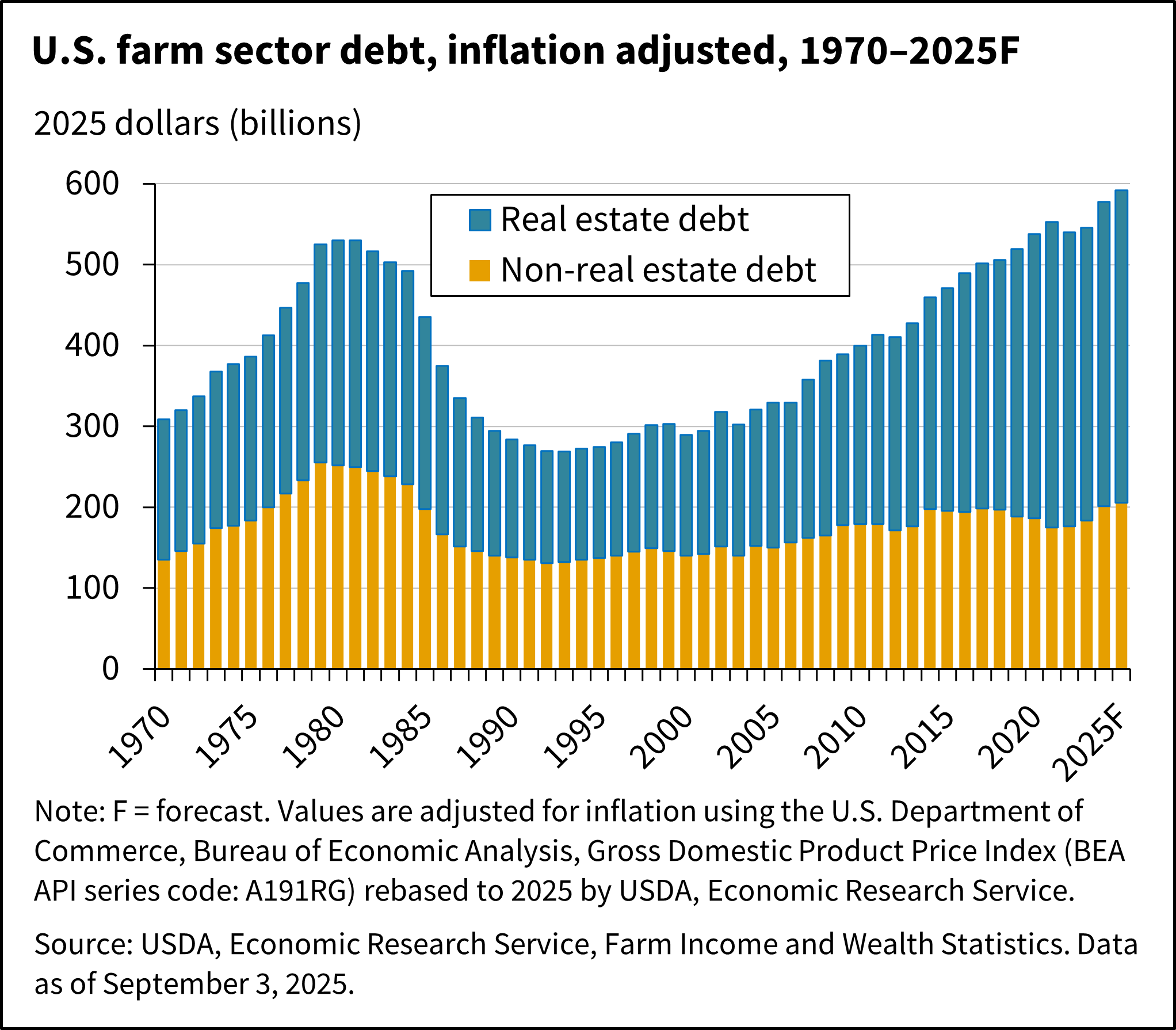
Farmers’ balance sheets overall, though, are stronger today than four decades ago, when a huge spike in interest rates led to loan defaults, bankruptcies and farmland selloffs that still haunt producers today. And stocks-to-use ratios are much lower, too, Prosser notes.
Michigan farmer Carla Schultz said while her father fared well during the 1980s crisis by buying up valuable land, he’s often been reluctant to spend money on new machinery.
“For us a lot of times it’s reeling back on that efficiency or cost-effectiveness with equipment … because we are hanging on to the fact that my dad can never forget the 1980s,” she said, adding that her family’s farm is well diversified and not over-extended.
Following the crash of the 1980s, farm lending changed dramatically, as loan-to-value ratios used to determine eligibility went from as high as 90% to around 65% today.
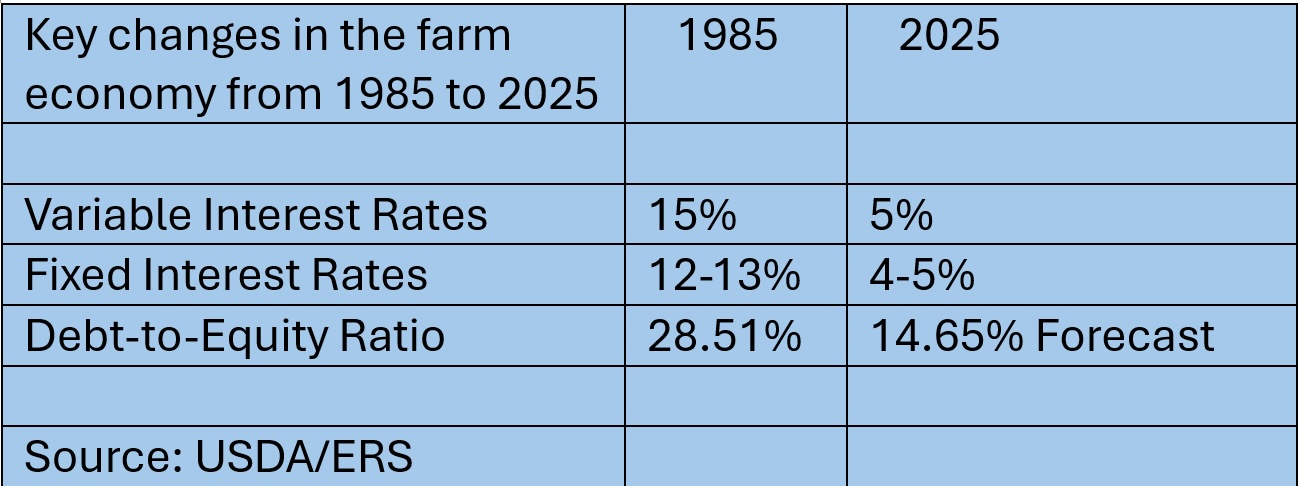
Further, farmers were hit with sticker shock in the 1980s as a 4% farm loan went to 18%, New Jersey soybean and corn farmer Patrick Giberson said by way of example. “It’s not the mortgage on your house … 18% on millions of dollars is a lot of money,” he said.
Giberson, whose fourth-generation family farm also serves as a hunting reserve, stressed the importance of diversification on the farm and the need for frugality, adding that he doesn’t foresee making any new equipment purchases in the near future.
It took a drought to end the 1980s farm crisis
Lee Strom, an Illinois corn, soybean and specialty crop grower who headed the Farm Credit Administration under both Presidents George W. Bush and Barack Obama, said while lower debt loads are helping today's producers weather the tough economy better than during the 1980s, the surging prices of inputs like fertilizer and seeds are a big problem. The farming cost on a per-acre basis is as much as five times higher, he said.
“The risk profile in the investment into agriculture today is much different than 40 years ago," he said. "That’s where I see some of the greatest risk."
The Trump administration's recently announced effort to study what's at the root of the higher prices has been tried by prior administrations. "Is this time going to be different? I don’t know."
Strom served in Washington during the 2008 financial meltdown, a crisis that didn't significantly hurt the ag industry in part because of the new national biofuel mandate that boosted demand for U.S. crops, especially corn used for ethanol. Today, uncertain renewable fuel policy has led to an uncertain outlook for new crop-based fuels like sustainable aviation fuel. Even in the brightest of scenarios, however, such markets are still many years away from fully developing.
 Ed Prosser (LinkedIn photo)
The best hope to move out of the current slump is to revive U.S. trade, Jim Schultz said.
"If the Trump administration would be wise, they'd go to China and say 'we are taking off all tariffs immediately but you will buy X million in metric tons a quarter for the next 10 years from us and at any point you fail to do so we're going to slap the 100% tariff back on," he said. "You've got to use carrot and stick. ... It's all stick right now."
Farmers can only hope they don't see a repeat of what Prosser says it took to pull them out of the 1980s farm crisis – the devastating drought of 1988. Production was basically halved that year.
That drought came on top of the creation in 1985 of the Conservation Reserve Program, which took nearly 24 million acres out of production by 1988.
“The severity and the longevity of today's problems might rival the early part of the '80s, but saying that we're in the depths of the problems that we had in the 80s, with 14% to 15% interest rates and 50% stocks to use, we're a long, long, long ways from being that dire, at least right now,” he said.
.webp?t=1762183428)
