
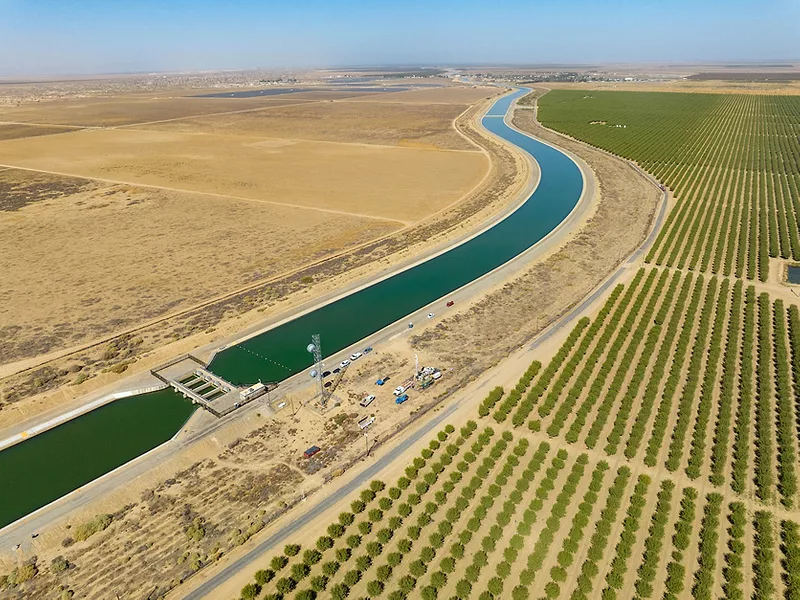
More than a decade after the passage of the Sustainable Groundwater Management Act, local agencies are still struggling to gain traction with groundwater markets for water trading. In their new paper, agricultural economists at the University of California, Berkeley, report widespread interest in markets under SGMA, but outline clear hurdles in translating that interest into functioning market systems.
The California Department of Water Resources has performed the first periodic reviews of sustainability plans five years after their submittal. A scan by Cooperative Extension associate professor Ellen Bruno and doctoral student Liz Saunders finds that while many basins have adopted allocations for pumpers — a precondition for trade — few have advanced to active trading systems.
In basins like the Kings subbasin, under McMullin Area GSA, and the Madera subbasin, agencies have laid out allocation frameworks and even simulated markets. Yet they have either put the markets rollout on hold or remain in an exploratory mode.
Don’t miss a beat! It’s easy to sign up for a FREE month of Agri-Pulse news! For the latest on what’s happening in Washington, D.C. and around the country in agriculture, just click here.
The paper, published by the UC Giannini Foundation of Agricultural Economics, cites hurdles like the political complexity of setting fair allocations; considerable administrative burden for agencies to build monitoring, accounting and trading infrastructure; and stakeholder wariness of potential adverse outcomes like well drying, land fallowing, consolidation of water rights and local economic impacts.
Yet the payoff can be significant. Economic modelling by the Public Policy Institute of California suggests that allowing trade in groundwater allocations could significantly reduce compliance costs for SGMA.
Bruno and Saunders conclude that “developing allocation schemes and trading frameworks is more easily said than done” and warn that “it remains to be seen whether GSAs will successfully establish functional, well-governed systems for groundwater trading in California.”
Outside of the article, other research affirms the slow uptake. An analysis by the Property and Environment Research Center last year notes that while a substantial minority of GSAs are “considering developing groundwater markets,” implementation remains nascent. And a PPIC blog post in June emphasizes that for markets to be equitable and effective they must include transparent, low-cost rules, protections for disadvantaged communities, and monitoring of local impacts.

