
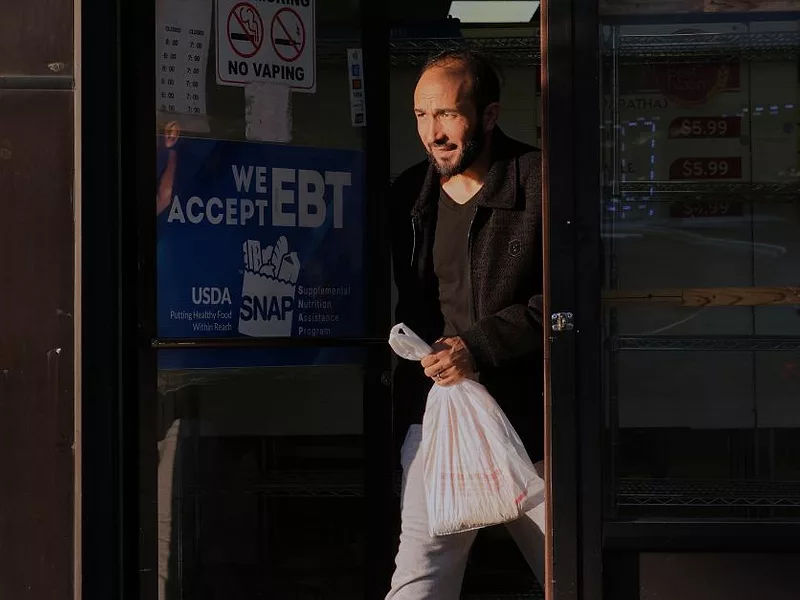
States are scrambling to provide reduced Supplemental Nutrition Assistance Program benefits for November, but it’s not clear exactly when people enrolled in the program will get them.
“State SNAP systems, in many cases, are years, if not decades, old,” said Brandon Lipps, who served during the first Trump administration as deputy undersecretary for food, nutrition and consumer services at USDA.
“It’s more difficult than simply issuing 50% of the previous benefit,” he added. “Issuing any partial benefit is much more complicated and takes significantly longer than issuing the full benefit. The systems were not designed to issue partial benefits.”
“I’ve heard that, for some states, it will take a minimum of two weeks, some longer. You may find that a few can issue them faster.”
Karen Ehrens, U.S. policy manager at the Alliance to End Hunger, echoed those comments.
Asked when states could be expected to provide partial benefits, Ehrens said, “The short answer is, no one can give a date.”
Part of the problem is that guidance sent to the states Tuesday by USDA “appeared to be more complicated than what was thought,” she said. The American Public Human Services Association sent a letter to USDA Nov. 3 seeking “time and flexibility” to implement necessary changes.
“Many states operate on computer systems that are quite old,” Ehrens said, noting that states have also been trying to implement new SNAP work requirements included in the One Big Beautiful Bill Act.
“The new work requirements are a major systems change for state agencies, so it is certainly a heavy lift to add the issuance of partial benefits on top of the changes they're already working to implement. State agencies are often underfunded and understaffed,” Lipps said.
States are “working really hard to comply and doing their best to get these benefits out the door,” Ehrens said.
Agriculture Secretary Brooke Rollins said on X Tuesday that disbursing benefits will be “a cumbersome process, including revised eligibility systems, state notification procedures, and ultimately, delayed benefits for weeks.”
Don’t miss a beat! It’s easy to sign up for a FREE month of Agri-Pulse news! For the latest on what’s happening in Washington, D.C. and around the country in agriculture, just click here.
She said her “team stands by to offer immediate technical assistance,” but Ehrens said response times have varied depending on the state.
A Food and Nutrition Service employee who asked not to be identified for fear of retaliation said calculating reduced benefits and informing recipients of the changes “does put more of a burden on states.” Karen Ehrens (LinkedIn photo)
The government made the same argument in the court cases that sought immediate funding of November benefits through use of a SNAP contingency fund that can cover about half the month. The plaintiffs in those cases, including states, cities and nonprofit groups, said USDA also has the authority to transfer money from other nutrition programs to fully fund SNAP.
Plaintiffs go back to court for more relief
An estimated 42 million people receive SNAP benefits monthly, but Congress has not funded the program due to a congressional impasse on government funding that is now in its second month.
On Monday, the Agriculture Department responded to court orders issued by federal judges in Rhode Island and Massachusetts by saying it would provide benefits equal to about half of what people normally receive. A household of four people, for example, would receive a maximum of $149, versus the normal $292.
That prompted plaintiff cities and nonprofits in the Rhode Island case to seek enforcement of U.S. District Judge John McConnell Jr.’s temporary restraining order.
“Undertaking a partial payment plan at this point cannot meet the court’s directives or adequately remedy the harm plaintiffs are suffering,” they said in their Tuesday filing. “[T]he court should grant plaintiffs’ motion to enforce and should temporarily enjoin and compel [USDA] to release the withheld funding, in its entirety, for November SNAP benefits.”
A hearing is scheduled for Thursday, which could further complicate recipients getting their benefits.
Food banks and pantries, as well as grocery stores, are bracing for the shift.
“Even a temporary reduction or delay threatens to disrupt household food security and destabilize the small retailers that anchor access to affordable, nutritious food in underserved communities,” Food Systems for the Future said in a news release. The organization “addresses malnutrition with an economically sustainable climate lens,” the release says.
The National Grocers Association also expressed concerns. “Independent grocers are often the only source of fresh produce, dairy, and other nutritious essentials for millions of families, veterans, and seniors who rely on federal nutrition assistance to make ends meet,” the group said in a news release.
“With SNAP fueling over 389,000 American jobs and creating over $20 billion in wages, the disruption to program funding may lead to reduced employee hours, perishable food losses, and declining sales for many community grocers across our nation,” NGA’s release said.
But USDA said use of Section 32 funding, which now totals $23 billion, “must remain available to protect full operation of Child Nutrition Programs throughout the fiscal year, instead of being used for SNAP benefits. Section 32 Child Nutrition Program funds are not a contingency fund for SNAP.”
The use of the child nutrition program for SNAP “would leave an unprecedented gap in child nutrition funding that Congress has never had to fill with annual appropriations, and USDA cannot predict what Congress will do under these circumstances,” said Patrick Penn, USDA deputy undersecretary for food, nutrition and consumer services, in a declaration filed with the court.
 Zakariyah Hill (Personal photo)
Zakariyah Hill, who co-founded Supply Hive in Des Moines, Iowa, which connects people in underserved communities to food, says the partial funding of SNAP is another obstacle to getting people the food they need.
“Our holiday season is usually very busy, regardless, and so it's just another thing,” she said. “It’s stacking issues upon issues and making it even more stressful than policies already are. It's like, what's next?”
“The surge of asks for help, it's big, and if people aren't getting food, then they have to make tough choices,” she said.
She said the administration’s cut of $500 million in food bank aid earlier this year has resulted in staff cuts and a drop in volunteers, partly because there’s no one to train them.
The Tennessee Justice Center, which helps state residents navigate the SNAP application process, is urging people to contact Congress “and do what they can to try and lift their voices in an effort to to get some change,” said Signe Anderson, senior director of nutrition advocacy.
“People really wait for those benefits to drop so that they can buy food or pay rent, and if they don't have them, it can set set off a landslide of problems for a family,” Anderson said.

