
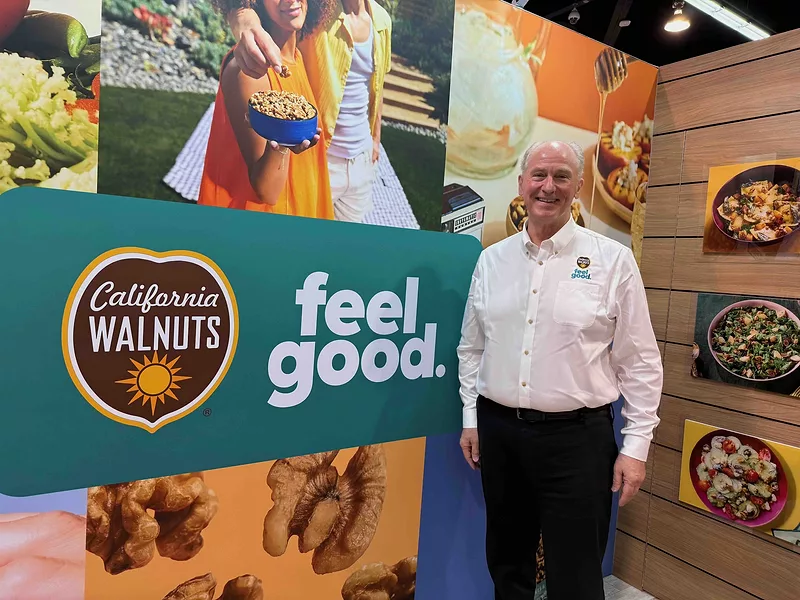
California walnut growers and handlers don’t want you to stop baking banana walnut bread or other traditional favorites anytime soon. But they do want you to start looking for their products in some innovative new places like creamers, parfaits, sauces, plant-based tacos and the produce aisle.
It’s all part of a strategy honed by the California Walnut Board & Commission and their CEO Robert Verloop, who brings a wealth of experience with lettuce, citrus, berries, avocados and now, an unparalleled exuberance for all things walnut. Since taking the helm in 2022, he’s focused on repositioning the tree nut for expanded domestic and international sales. Agri-Pulse caught up with him in late October to discuss the changes underway. The following interview has been edited for brevity.
You were named CEO about three years ago. What’s changed since then?
When I came on, somebody said to me: “You're a genius. You're coming on at a time that we've had COVID, we've had disruptions. It's the worst time in the industry. It can't get any worse.” Two months later, we had a heat wave that destroyed the whole crop, and so we really have been in kind of a crisis mode since I came, which allowed us to do strategic planning. Sometimes, when you're in the deepest valley, that's the best time to start having those discussions.
What did that process entail?
We had 700 growers respond to a survey. We did roundtables, listening sessions. The beauty of it was, I had nothing to do with what happened in the past, but I had everything invested in the future. I like to ask: Why do we do this? Why don't we do that? Through that uncovering process, we saw some things that everybody knows are important. You’ve got to make sure you deliver quality, but you also have to understand the pathway to the consumer. It’s not just about building demand; you’ve got to build sales.
Our staff has taken a much more progressive attitude, where we think more like the growers and the handlers, rather than just marketers. I use this phrase all the time: It's not about pretty pictures and clever taglines, it is really coalescing around adding a lot more energy to walnuts.
It’s easy to be “in the know” about agriculture news from coast to coast! Sign up for a FREE month of Agri-Pulse news. Simply click here.
For example, we started to identify that in the U.S, most walnuts are sold in the baking aisle. The baking aisle is shopped by fewer people, and they are of older ages. That is not our future consumer and we started talking about what’s going to be required to shift. Part of that is a mindset. We're not just selling an ingredient for brownies and banana nut cake and all of that. We actually have a very healthy, nutritious product that should be aligned where people think about health, nutrition, and goodness. That to me is the produce aisle.
How are you trying to position walnuts next to fresh fruits and vegetables?
On the back of my card, there's a hashtag, #walnutsareproducetoo! That kind of came by accident. When I was leaving the lettuce industry, someone told me they were sorry to see me leave produce. And I said, what do you mean? Walnuts are produce, too! It evolved into more of a mindset of not being just an ingredient. It is something that can accompany, and in a sense, co-market with salads and other things that are nutritious and healthy. In order to reach the generation we are interested in, we have to have a mindset change.
We did scan data analysis and a market basket with walnuts has a value that's $54 more than a basket without walnuts. The walnuts are not that expensive, so what's happening? Well, it's no different than charcoal being in the market basket, because when there's charcoal, that basket is worth $150-200 more. Why? It's meat, chips, guacamole, alcohol - all high margin items. Charcoal may not be the high margin item, but everything else adds a lot of value to a retailer.
We wondered: “How can we bring more value to retail, and where does that value reside? Out of the top 20 items in the market basket when walnuts are there, eight of them are produce items. Our instinct told us something more than just banana nut bread and brownies. The data is starting to show that. Since then, we've hired three regional marketing directors who are working with retailers to set up pull-through retail sales promotions. in addition, we have a revitalized consumer campaign that's all around the feel-good concept about what I'm eating, what I'm providing my family and around entertaining. Because the younger generation loves to share success stories, they love to share new ideas and foods that they've discovered, and they do that often around the table. Food is that connector, and we want people to feel good about that part of it.
How are you working to promote the health benefits of walnuts?
We have a very healthy product with the Omega threes. It's a nutrient dense nut and people are starting to understand more and more that walnuts are very impactful for brain health, dementia prevention, and then the gut. The two are very connected, and gut health is very important. Tied to that is sleep quality, on top of the traditional things that we always looked at such as cardiovascular benefits and cancer prevention. Cancer is kind of interesting in the sense that colon cancer can be reduced with an increased consumption of walnuts. It's just new information that's coming out through some research that we've conducted. And then we're going back and revisiting allergies a little bit more, because tree nut allergies are sometimes demonized.
Tell us about how you’re changing your promotions in the produce section?
We do four promotions per year at different times. We also do custom promotions, and we're tying this in with a consumer campaign, because retailers are more frequently looking for us to help them with their online executions of marketing campaigns. Twenty years ago, when I started my career, it was point of sale material at the display. Now it's that plus, work we are doing on the airwaves and with influencers. We've built up a cadre of influencers that we can then incorporate with our retail programs as well.
Why are you also rethinking your approach to food service?
Fifty percent of U.S. food dollars are spent through restaurants or out of home, and we have virtually limited presence there. From my experience, food service tends to be the tip of the spear of new trends, where people try new products and where innovation gets started. We brought in Chef-in-Residence Robert Danhi. He was able to really look at how we can think about walnuts differently.
Robert developed a flavor wheel, which serves as a starting point for re-imagining walnuts, because it isn't just that ingredient in the banana nut bread. This has opened up a whole bunch of exploration that we've started to work on innovation, new products, new positioning. One of the big takeaways that we're working on right now is walnut cream. If you blend walnuts and water, the longer you blend it, it gets thicker. It's like a beautiful, non-dairy cream. You can put a little vanilla in there, or little cinnamon or cardamom, depending on how you're using and applying it.
We had a presentation recently at Google with 150 of their chefs and they were blown away. We're trying to show not only the flexibility of it, because if you blend it for a short period of time, it's very fluid, but if you wait longer, it becomes more like a topping or a base for soups and gravies. It’s a plant-based protein source.
How are you working to expand other uses for walnuts?
We also explored how walnuts can substitute for meat. In England, we have a customer who has taken our work and come out with a line of products that are Mexican food, Italian and Mediterranean, and it's a blend of spices and everything. It’s replaced the meat protein with walnut protein. In all the initial tests, it's been phenomenal. We know that it's a trend for this younger generation.
It's a multi-pronged approach. We’ve got health, retail, food service, and the other area is food manufacturing. Think of sport bars, cereals, breads. In Japan, we have contests for the best banana bread in Japan, and we have a famous actress who said her last meal will be walnut bread and champagne. It's a huge hit. We don't have it here in the U.S, but it's an example of a manufactured product in bakeries.
We’re trying to connect food manufacturers with the fact that this story is appealing to a younger audience that's growing in size and in purchasing power. This audience wants to make sure that they're buying from a sustainable source. Walnuts are a phenomenal sustainable source, both in how they're grown and also because the trees act as a carbon sink. We cultivate with care. These consumers want to hear about things like that. They want to hear about family farms. We have a lot of farms that are fourth and fifth generation.
We look at all these segments within the market as opportunities for development. Thirty-five percent of our walnuts stay in the U.S. The other 65% go abroad. Each one of those countries has unique and different ways of using and consuming walnuts. It’s all about innovation. It's about creating that excitement, one person at a time.
Tell us about your growers and handlers and how they're adapting to these changing market dynamics.
We have about 3,700 growers and 72 processors. About 20% of our walnuts get sold in shell; completely intact. A lot of that goes to countries like India and Turkey and other countries where they do the cracking. It provides an income opportunity for people in those countries.
Our growers have gone through some really difficult times. We had the recovery from COVID and then the heat wave, which destroyed a large part of the crop. Finally, when we broke the drought, we had the largest crop in history. Last year, was one of the smallest crops in history. This year, we're really at a moderate level. If you were a grower last year who had a decent harvest, you did okay. It was break even and above this year because of the exceptional quality we've had. The total crop estimate is 710,000 tons for this year. The meat yield, which is a really important indicator, is much higher than it has been the last 4-5 years. Nut size is good, yield is good, and the color is phenomenal. This is a very manageable volume and it's a very manageable inventory picture.
What is your outlook for exports?
Some markets are looking for more walnuts. Other markets are waiting to finish with their Chilean product, which will be in November and December, and then they'll start buying.
We ship to 80 countries and by the end of next year, we'll have marketing programs in 20 different countries. We're going from nine that have been funded by the Market Access Program and we've added 11 countries in the Regional Agricultural Promotion Program.
Eight years ago, we were very excited about India and the Chinese were buying a lot of product. China has become a net exporter and India put on some tariffs, which slowed down the movement into that market. China is probably not going to be coming back. Once the negotiations between President Trump and Prime Minister Modi get settled, we're very optimistic about India. Moms in India give their kids two walnuts in the morning that have been soaked overnight. They do it with other nuts as well. There's a culture in India and an understanding of the nutritional value.
Where do you see the most potential in other markets?
The U.S. may be the biggest potential for us, for a lot of different reasons. One, it's closer to home. It's easier to serve. You don't have to worry about tariffs, about ships and all those outside forces.
Germany, which is our largest market, continues to grow. Even last year, when we had the smallest crop in history, our sales into Germany went up. Italy has been going up. In Europe and the UK, where there is a really strong nut culture, they've been improving their consumption levels quite a bit.
Last year, Turkey disappeared for us. They opted out for more inexpensive, lower quality Chinese product because they do a lot of hand cracking, then sell it to competitive markets. But at the retail level, they stayed with California all the way through. We think there's still some opportunity there for high quality California walnuts in Turkey, where per capita consumption is something like seven kilos.
What keeps you up at night?
We have too many handlers, too many processors that divide the voice of the industry. This industry was built on the premise of having more demand than supply. Internationally, the industry is in the opposite direction.
We're over supplied and we have too many sellers. It's more about trying to grab my share of the pie, rather than increasing the size of the pie. Fundamentally, that is something that keeps me awake at night. How do we balance marketing in a way that is constructive for everybody? When you talk to consumers, they know walnuts are unique, but you can't buy it if you can't find it. We need to continue to push hard on increasing our footprint, our distribution at retail, whether it’s in the U.S. or foreign markets.
Input costs continue to go up, and the price of goods sold hasn't matched that. We have to look at the impact of tariffs on fertilizers. How do we find a way to support a specialty crop? That segment of the industry sometimes is forgotten because you have one state, in the case of walnuts, that doesn't have the same political clout as soybeans that are in the news every day covering 20 states. It’s not about pitting us against each other. It’s how we can all find a way to satisfy the consumer needs and our grower’s needs. Nobody should be embarrassed to say that we farm to make money, and nobody should fault agriculture for wanting to be a profitable enterprise in the long term. We have some really great opportunities to expand on feeding the world, but we need to do it in a way that's competitive at a production level, and some of our input costs and regulatory costs are not in line with what we compete against.


