
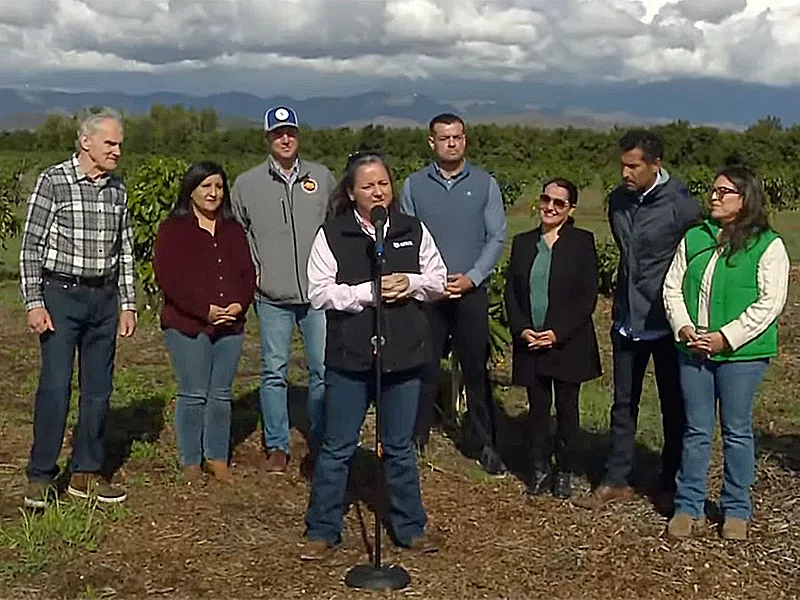
California’s top legislative leaders traveled to Ventura County this week to spotlight local agriculture, hear directly from growers, and highlight workforce concerns amid ongoing immigration enforcement actions that have shaken farmworker communities.
Senate President Pro Tempore Monique Limón, in just her second day leading the upper house, joined Assembly Speaker Robert Rivas, California Farm Bureau President Shannon Douglass and others to tour Chris Sayer’s avocado farm on the outskirts of Los Angeles. Joining the delegation were Assembly Agriculture Chair Esmeralda Soria and Senate Agriculture Chair Melissa Hurtado.
The group discussed regulatory pressures, affordability issues and the future of farming in the region.
Asm. Steve Bennett, D-Ventura, opened a press briefing by stressing the region’s unique agricultural advantages — deep topsoil, a strong aquifer and a skilled workforce — but warned that long-term resilience depends on ensuring those assets remain viable for future generations. Sen. Henry Stern, D-Canoga Park, echoed that message, pointing to his family’s 40-acre orchard nearby.
“This is the edge of it all,” he said, noting the proximity to the city. “Most people don't even know about this part of Los Angeles or where their guacamole comes from.”
Douglass thanked Rivas for organizing the visit and said the farm bureau welcomed opportunities for lawmakers to see firsthand the pressures on producers and the innovations in the sector.
“It's such an important part of the economy here in California — but we face some pretty incredible challenges,” said Douglass, referring to mounting regulatory costs and barriers preventing wider adoption of technologies.
It’s easy to be “in the know” about agriculture news from coast to coast! Sign up for a FREE month of Agri-Pulse news. Simply click here.
Soria, who grew up in a farmworker family, underscored the fear gripping agricultural communities following recent immigration raids across the state.
“It’s no secret that many of our farmworker families are still feeling a lot of fear and uncertainty,” she said, adding that protecting the workforce is central to California agriculture and remains one of her priorities heading into the next legislative session.
Limón tied the region’s farm economy to her family’s history, noting her grandfather picked strawberries on the same fields where local third graders were touring that morning. She said policymakers must confront not only land use, economic and natural resource issues, but also broader safety and community concerns tied to immigration enforcement and affordability.
Rivas praised the “incredibly vulnerable workforce that fuels California agriculture,” saying Washington’s approach to tariffs and immigration has created chaos for both workers and growers. He hoped the farm tour would guide upcoming legislative efforts.
“We’re never going to shy away from the challenges this state faces,” he said, emphasizing that supporting agriculture and its workforce will remain a priority.

