
Expiring expanded premium subsidies for Affordable Care Act insurance will be a big issue for Congress in its post-holiday stretch. Democrats were promised a vote on the issue as part of a deal to reopen the government.
“That vote will happen. And whether it will pass is in the hands of Donald Trump and the Republicans. People are seeing their health insurance premiums double or triple,” Sen. Amy Klobuchar, D-Minn., said Sunday on CNN’s State of the Union.
Klobuchar, ranking member on the Senate Agriculture Committee, says Democrats stand to gain politically if Republicans don’t agree to an extension. “If they don't want to do anything about people's costs and their grocery bills and their health care and pummel them with these punishing Trump tariffs, then we will simply have to beat them in the midterms. We have no other choice.”
Prior to Thanksgiving, the White House reportedly floated a two-year extension of ACA subsidies. Congressional Republicans criticized the idea, but Trump told reporters some kind of extension may be necessary.
For more on the D.C. policy agenda, read our Washington Week Ahead.
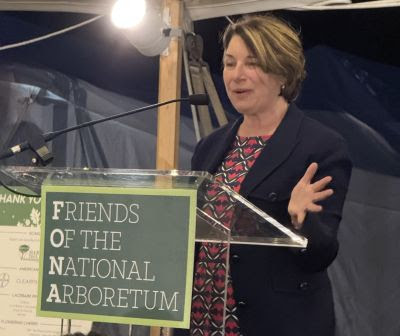 Sen. Amy Klobuchar, D-Minn. (Agri-Pulse photo)
Groups urge officials to learn lessons from last tariff bailout
A coalition of nonprofits say they want to avoid repeating the mistakes of the tariff bailout during the first Trump administration and ensure that any tariff assistance program is administered efficiently.
The groups, which include the R Street Institute, Farm Action and Taxpayers for Common Sense, wrote last week to Agriculture Secretary Brooke Rollins and USDA Undersecretary for Trade and Foreign Agricultural Affairs Luke Lindberg that any aid should come with strict payment limits and oversight.
Take note: A 2022 Government Accountability Office review of the 2018-2019 Market Facilitation Program found $800 million went to ineligible recipients or were incorrect payments. Another review also found issues with the way USDA calculated the tariff impacts.
European Parliament votes to delay deforestation rule
The European Parliament voted to delay implementing the European Union’s proposed deforestation regulation, bringing the bloc one step closer to postponing the rules.
The parliament voted to delay the rules for medium and large companies until Dec. 30, 2026 – a one-year extension. Small and micro-operators would have until June 30, 2027, to comply.
Don’t miss a beat! It’s easy to sign up for a FREE month of Agri-Pulse news! For the latest on what’s happening in Washington, D.C. and around the country in agriculture, just click here.
Smaller businesses would also have to submit a simplified due diligence declaration. The parliament also backed a proposal to mount a “simplification review” of the law by April 30 to examine other ways to streamline the law.
Take note: The parliament must still reconcile its position with EU member states before the delay becomes official. But a Brussels-based trade lawyer told Agri-Pulse in an email that following the vote, a delay is now “virtually sure to be adopted” before the Dec. 30 deadline.
SNAP lawsuit filed over guidance on immigrants, refugees
Attorneys general of 21 states and the District of Columbia are suing the Agriculture Department over its guidance barring certain immigrants from receiving Supplemental Nutrition Assistance Program benefits.
“The attorneys general warn that the guidance would saddle states with catastrophic financial penalties unless they immediately implement the unlawful restrictions, and they are urging the court to strike down the guidance before it can cause lasting harm,” they said in a news release announcing the suit.
The lawsuit, which was filed in Oregon, says USDA “waited nearly four months before it issued implementing guidance to states on Oct. 31, 2025, that directed them to limit eligibility for non-citizens.” The guidance implements changes made by the One Big Beautiful Bill Act, but the lawsuit says the guidance goes beyond the law and “arbitrarily” excludes from SNAP “many lawful permanent residents who remain eligible under the statutory scheme established by Congress”.
Ag Department’s chief economist says no date scheduled for his departure
USDA Chief Economist Seth Meyer tells Agri-Pulse there's no set date for his exit from the department this month. Meyer begins a new job as head of University of Missouri’s Food and Agricultural Policy Research Institute on Jan. 1.
"I'll be working up until the last moment," he said.
Meanwhile, USDA staff is dealing with an avalanche of data to analyze and prepare for public release following the six-week government shutdown.
USDA to hear input on meat processing expansion grant
The Flower Hill Institute will host a public stakeholder listening session to gather input as the U.S. Department of Agriculture finalizes the application process for another Meat Processing Expansion Program grant.
The session will begin at noon EST Dec. 2 and will include representatives from USDA Rural Development, who will provide information and answer questions. Flower Hill regional directors Chris Roper and Dave Carter will facilitate the discussion.
The application window for the new grant is expected to open in early 2026.
Final Word
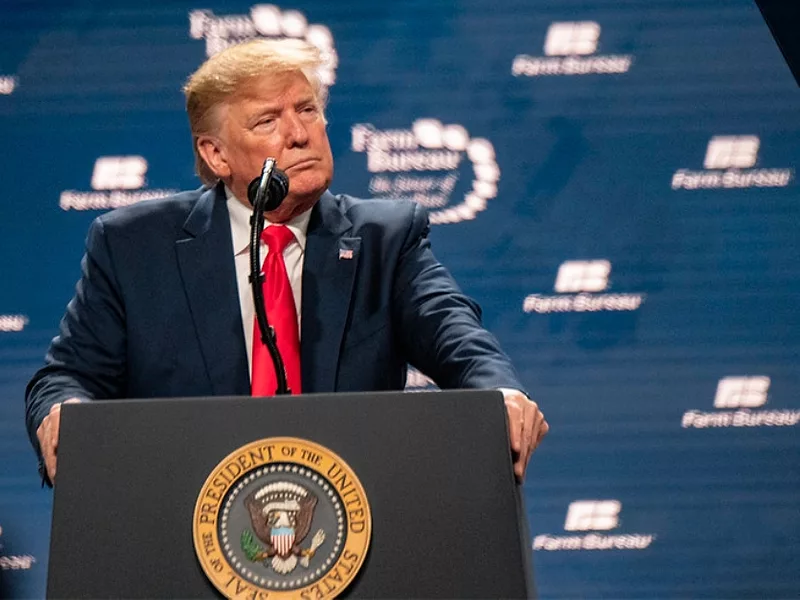
"Over the next couple of years, I think we'll substantially be cutting and maybe cutting out completely, but we'll be cutting income tax. Could be almost completely cutting it because the money we're taking in [from tariffs] is going to be so large." – President Donald Trump speaking to U.S. military service members on a video call from Mar-a-Lago on Thanksgiving.
Philip Brasher, Kim Chipman, Oliver Ward and Noah Wicks contributed to today’s Daybreak.

.webp?t=1762183428)


