
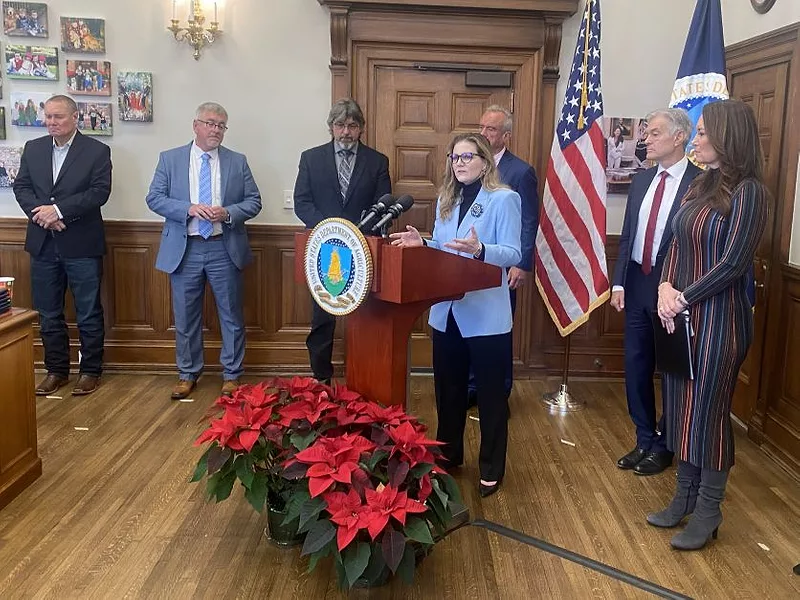
The Trump administration is launching a $700 million initiative, potentially supplemented with corporate funding, to help farmers adopt regenerative agriculture practices.
In an announcement at USDA this morning, Agriculture Secretary Brooke Rollins said the funding for the pilot project would be delivered “through existing programs our farmers already know and already trust,” which Natural Resources Conservation Service Chief Aubrey Bettencourt specified would be the Environmental Quality Incentives Program and the Conservation Stewardship Program.
“It'll be the same application that our farmers know already,” Bettencourt said. “The difference is, they'll be able to apply for multiple practices on a single application.”
She added that “what's important about that is, it ties back to that whole-farm plan, the idea being that we're going to look at all of the resource concerns on the property at one time, instead of drive-by conservation, where we're only looking at maybe soil health here, and maybe in a few years, we're going to look at water management.”
The program appears similar to the $3.1 billion Partnerships for Climate-Smart Commodities program begun during the Biden administration. That program, which was canceled and then rebranded as Advancing Markets for Producers, uses both government and corporate matching funds to help farmers implement a host of conservation practices.
Participants in the PCSC were asked to reapply under new criteria after Rollins took over the department.
The secretary said the department would use the SUSTAINS Act passed by Congress in 2023 to “bring corporate label and supply chain partners directly into partnership with NRCS supporting regenerative agriculture, adoption, farmer recognition and consumer education, because success depends on strong partnerships.”
She didn't say whether any corporations had committed funds to the initiative yet.
Interested in more news on farm programs, trade and rural issues? Sign up for a four-week free trial to Agri-Pulse. You’ll receive our content - absolutely free - during the trial period.
"It connects the producer and the work that they're doing on the farm, granting them the credit for that voluntary action or change of practice on their farm that then can transition into the supply chain, into the marketplace and directly back to the consumer," Bettencourt said.
Regenerative agriculture has no widely agreed-upon definition, but Rollins called it “a conservation management approach that emphasizes natural resources through improved soil health, water management and natural vitality for the productivity and prosperity of American agriculture and all of our communities.”
Rollins was joined at the announcement by Health and Human Services Secretary Robert F. Kennedy Jr. and Centers for Medicare and Medicaid Services Administrator Mehmet Oz. They touted the signing of six new SNAP waivers for Hawaii, Missouri, North Dakota, South Carolina, Virginia and Tennessee, bringing to 18 the number of states that have received waivers from the SNAP requirements, allowing the states to prohibit recipients from buying certain foods and beverages.
Oz pointed out that when states receive money from the Rural Health Transformation Fund, which was created in the One Big Beautiful Bill Act, they can get a bonus if they apply for or get their SNAP waivers approved.
The RHTF has $50 billion to distribute over five years.
“One of the ways that you get the money is by applying for SNAP waivers,” Oz said. “If you apply for a SNAP waiver …, you get paid extra money. If you actually get your legislators to ratify these agreements, you get additional money.”
For more news, go to Agri-Pulse.com
This story has been corrected to reflect the total amount of funding for the former Partnerships for Climate-Smart Commodities program.

