
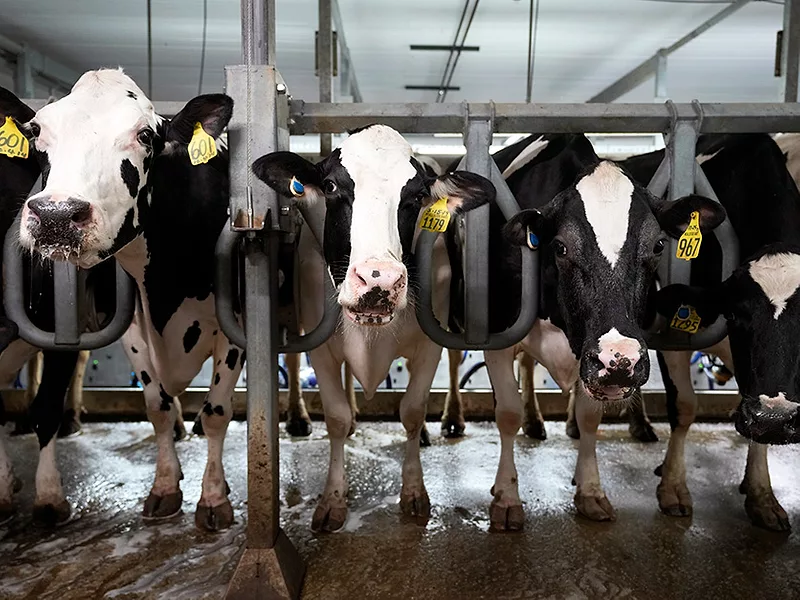
A top U.S. trade official this week briefed House and Senate lawmakers on the administration’s priorities for an upcoming review of a North American trade pact. Among the improvements the U.S. will push for, he listed securing greater Canadian market access for U.S. dairy, addressing low-cost produce imports from Mexico and securing protections for U.S. products from geographic indicators.
The administration has been gearing up for its six-year review of the U.S.-Mexico-Canada Agreement, slated for July, and has been gathering feedback from stakeholders.
As part of that process, the Office of the U.S. Trade Representative has to report to Congress on its assessment of the deal and any recommendations for improving it. Some lawmakers had been pushing for a written report, but the Office of the U.S. Trade Representative chose to brief lawmakers in closed-door meetings instead.
In recent public comments, USTR Jamieson Greer has stressed that the U.S. stands ready to walk away from the deal, if necessary.
But in his opening statements to the House Ways and Means Committee and Senate Finance Committee in private meetings this week, Greer acknowledged the strengths of the agreement, and the broad support it enjoys among U.S. industries and across Capitol Hill.
“There is broad support for the Agreement,” he told lawmakers, according to a version of the remarks published by the USTR. “The USMCA has provided some certainty for North American trade.”
He noted that U.S. exports to Canada and Mexico have climbed 56% since the free trade agreement’s adoption in 2020. But argued that it had fallen short in “strengthening U.S. manufacturing capacity and creating good jobs.”
He also complained that the U.S. goods trade deficit with each country remains too high.
“A rubberstamp of the Agreement is not in the national interest,” he stressed.
Greer outlined several country-specific negotiating priorities, as well as multiple issues that would require discussions between the three parties.
Addressing Canada’s implementation of its dairy tariff-rate quotas and its export of certain dairy products for below market value was at the top of the Canada-specific list.
Interested in more news on farm programs, trade and rural issues? Sign up for a four-week free trial to Agri-Pulse. You’ll receive our content - absolutely free - during the trial period.
The U.S. dairy industry has long complained that Canada’s management of its quotas leaves them unfilled. Meanwhile, multiple dairy producing countries have accused Canada of dumping surplus non-fat dairy solids like skim milk powder and whey protein onto international markets.
With Mexico, the U.S. plans to raise the impacts of its seasonal produce exports on U.S. producers, Greer said, although he did not provide specifics on what action Mexico should take.
During a three-day hearing earlier this month, USTR officials heard from representatives from various segments of the U.S. produce sector. While many complained that low-cost Mexican produce was eroding their market share in the U.S. market, the industry was divided over whether the U.S. should impose import restrictions.
Further, Greer said that he would use the review to press Mexico on its geographical indications that protect European meat and cheese names and, he argued, threaten U.S. market access.
Enforcement of Mexican labor and environmental laws will also feature prominently in discussions, as will both countries fisheries management, he said.
While the Canadian dairy issue is clearly a top priority for USTR, Greer’s list also demonstrates that the success or failure of the negotiations will likely depend on a myriad of factors and issues, many of them outside the agriculture and food sectors.
The U.S. wants to strengthen rules-of-origin to ensure products benefitting from duty-free trade do not contain large volumes of inputs from third-party countries. It also has concerns over adversarial countries’ investments in Mexico.
Greer did not specifically call out Chinese investments, but Chinese investment in Mexico has jumped in recent years, according to Federal Reserve Bank of Dallas. Mexico does not have a investment screening mechanism like the United States does to flag potential national security risks.
The U.S. also has concerns about the agreement’s ability to prevent Chinese companies setting up operations in the region and using the agreement to send large quantities of products into the U.S. duty-free.
“The USMCA was not really designed, and therefore has been unable, to address the surge of investment from companies domiciled in non-market economies in the region or the effects of industrial overcapacity on the three economies,” Greer told lawmakers.
The treatment of U.S. tech companies is also set to play a role in discussions. Greer railed against Canada’s Online Streaming Act which boosts domestic content to the detriment of U.S. tech and media firms, Greer said.
The three countries have plenty of time to examine their issues with the agreement and explore potential improvements, however. The agreement doesn’t expire until 2036 and if countries decide not to extend it this summer, they will meet annually until its expiry for further discussions.
Greer told lawmakers the success of the review “will depend on a variety of factors, including the ambition of our USMCA partners.”
But any potential extension will also have to be palatable to President Donald Trump, Greer said.
“We must achieve outcomes that meet President Trump’s expectations,” Greer said.
For more news, go to Agri-Pulse.com.

