
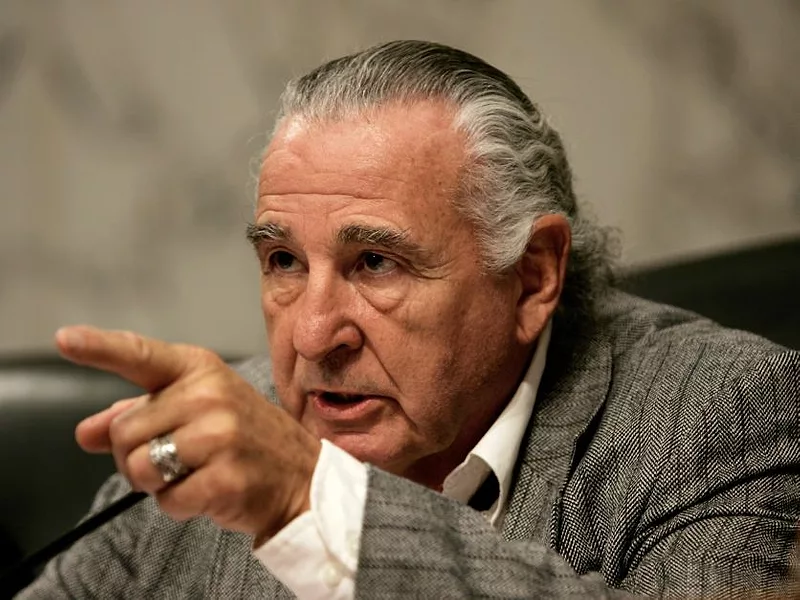
Former U.S. Senator Ben Nighthorse Campbell of Colorado, who went from working in California tomato fields to serving nearly two decades on Capitol Hill, died of natural causes on Monday. He was 92.
Campbell, who was a motorcycle-riding judo Olympian and an award-winning jeweler, also was known as a champion for indigenous people. In early years, he counseled Native American inmates at Folsom Prison in Northern California. Decades later, he served as the first Native American chairman of the Senate Indian Affairs Committee.
His agriculture roots also ran deep. After moving from his native California to Colorado, Campbell eventually bought a 120-acre ranch with his wife, Linda, that bordered the Southern Ute Indian Reservation, according to a written eulogy shared by his daughter, Shanan. He was a cattle rancher, trained quarter horses and taught 4-H.
“He knew what it was like for folks who made their living off of the land,” Dave Devendorf, a top congressional aide for Campbell who later joined him in forming a consulting firm, told Agri-Pulse on Tuesday. “He had deep, deep respect for people who were at the will of Mother Nature.”
As a boy from a troubled home picking crops in California, Campbell met Japanese immigrants who taught him judo, according to the late senator's daughter. That ultimately led him to Japan, despite not knowing the language, to study the martial art and then go on to become a three-time U.S. national champion. He served as captain of the U.S. Olympic judo team at the 1964 summer games in Tokyo, the first time the sport was part of the global competition. Campbell also had strong success with his Nighthorse jewelry business.
By the age of 10, Campbell had spent half his life in an orphanage as his father, who was of the Northern Cheyenne tribe, struggled with alcoholism and was often absent. Campbell sometimes had no one to care for him due to his mother, a Portuguese immigrant, having tuberculosis and at times being hospitalized, according to Shanan Campbell.
"For some folks, such a thing would crush them, and for him it only seemed to make him stronger," Devendorf said.
Campbell was elected to the House of Representatives in 1986 as a Democrat from Colorado, defeating the Republican incumbent. He switched to the Republican Party in 1995, shortly after winning a Senate seat. “He was very non-partisan to the extent he would always work with the other party,” Devendorf said.
Lawmakers including Rep. Lauren Boebert, R-Colo., and Sen. John Hickenlooper, D-Colo., took to social media on Monday to pay tribute to Campbell.
A key achievement for Campbell was the Smithsonian’s National Museum of the American Indian, which was established in the late 1980s through the then new House member's first piece of legislation. The museum opened in 2004 and is known for its unique architecture and proximity to Capitol Hill.
“He took great pride in the fact it was the building closest to the Capitol and that it looked different than any other cookie-cutter building there,” Devendorf said.
Campbell, who in earlier life was a deputy sheriff in Sacramento County, California, also played a key role in creating the National Law Enforcement Officers Museum in Washington.
When he retired from office in 2005, Campbell had more laws passed under his name in both the congressional chambers than all other Colorado senators combined, Devendorf said, citing records going back to the early 1970s.
Campbell died peacefully at home surrounded by family, according to his daughter. He is survived by his wife of almost 60 years, Linda, daughter Shanan, son Colin and grandchildren.
For more news, go to Agri-Pulse.com.
.webp?t=1762183428)
