

Soybean farmers hoping for good news in the Agriculture Department’s January crop report were disappointed after USDA said it sees even bigger U.S. supplies and fewer exports.
The lower expected soybean sales to the world market are due to larger harvests and exports for Brazil, according to the World Agricultural Supply and Demand Estimates (WASDE) report published Monday. U.S. soybean exports for 2025-26 are estimated at about 1.6 billion bushels, down 60 million from the prior outlook.
Economist Dan Basse, president of AgResource, says the estimate for U.S. soybean exports needs to come down even more.
“By our analysis, it still needs to drop another 90 to 100 million bushels,” Basse told the radio talk show AgriTalk after the WASDE’s release. The prior lost sales to China were simply too great.
“Even though they are buying 12 million [tons] back from us, we’re not going to get the whole Chinese program that we want, and it leaves us with a lower export number, I’m sorry to say,” he said.
USDA on Monday also said it sees the average U.S. soybean price for the 2025-26 season at $10.20 a bushel, down 30 cents from its December estimate. The effective reference price for 2025 Price Loss Coverage payments is $10.71, according to USDA.
House passes measure to revive African trade program
The House of Representatives on Monday voted to revive the African Growth and Opportunity Act, which provides duty-free market access for qualifying imports from African nations. It had been expired since September.
Lawmakers from both parties supported a three-year reauthorization, which passed 340-54.
Trump says he’ll tariff Iranian trading partners
President Donald Trump says that any country “doing business” with Iran will face 25% tariffs on their exports to the U.S. The announcement comes after a threat of U.S. military action as Iran brutally cracks down on protesters.
The president provided no further details on what business dealings, or on what scale, will trigger the new tariffs. China, Turkey, India and the United Arab Emirates have been among the country’s top trading partners in recent years. But Iran does some form of trade with most countries, including the U.S.
New tools to protect endangered species from pesticides
EPA is updating tools to protect endangered species from pesticides, including BLT, or Bulletins Live! Two.
“It’s not a sandwich,” joked Kyle Kunkler, EPA’s Deputy Assistant Administrator for the Office of Chemical Safety and Pollution Prevention during the American Farm Bureau Federation annual convention. “This is going to be really critical and central to what implementing ESA on the farm looks like.”
The BLT enables growers to zoom into field level maps and see if they are in a pesticide use limitation area (PULA) because of a listed species. Kunkler said there are two major “buckets” of potential risks the agency is looking to mitigate relative to endangered species, including runoff and erosion risks and spray drift. He encouraged growers to look at the EPA website and “try to better understand how would this work on my farm.”
If growers can't figure out a way to make this ESA process work, Kunkler said he’s concerned they will not continue to have access to crop protection tools in the future.
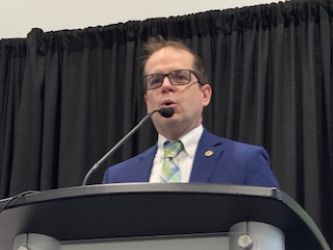 Kyle Kunkler EPA Deputy Assistant Administrator for the Office of Chemical Safety and Pollution Prevention (Agri-Pulse photo)
Rollins to launch 'rural revival' tour Thursday
Speaking at the American Farm Bureau Federation annual convention, Agriculture Secretary Brooke Rollins says she will be in Pennsylvania Thursday on the first stop of a “rural revival tour” featuring numerous cabinet secretaries. “We will be moving out across the country … really focusing on rural America and again, bringing prosperity back,” Rollins said, adding that she will be in Ohio for another event in two weeks.
Health and Human Services Secretary Robert F. Kennedy Jr., Environmental Protection Agency Administrator Lee Zeldin, Education Secretary Linda McMahon, Housing Secretary Scott Turner, and Centers for Medicare and Medicaid Services Administrator Mehmet Oz, among others, will attend events on the cross-country tour.
Also note: The announcement comes as USDA Rural Development is still operating without its leader: Undersecretary for Rural Development nominee Glen Smith. When asked if there was a hold on Smith’s nomination, Rollins told reporters, “We fully expect Glen to move in this next batch” of political nominees through the Senate.
Rollins said 97% of USDA nominees, potentially all with the exception of Smith, are confirmed less than one year since President Donald Trump took office.
Read more on Rollins’ AFBF speech highlighting USDA efforts and calling out California for Proposition 12 and other issues at Agri-Pulse.com.
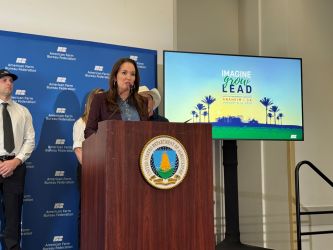 Agriculture Secretary Brooke Rollins speaks at a press conference at the American Farm Bureau Federation annual convention in Anaheim, California. (Agri-Pulse photo)
 Texas AG Paxton targets pesticides on organics in grocery stores
Texas Attorney General Ken Paxton is investigating “major grocery chains” for using pesticides on organic produce without telling consumers,
Paxton “is demanding that if Texas grocery stores continue using antimicrobial pesticides like Produce Maxx, they must, at minimum, install clear signage informing consumers that their produce has been sprayed with a pesticide and include instructions to rinse before consumption in accordance with federal law and USDA guidelines,” according to a press release from Paxton’s office.
Three major retailers in the state contacted about the investigation did not respond by close of business Monday.
Louisiana senator urges crack down on cornfield flooding
Louisiana Republican Senator John Kennedy says cornfield flooding “has enabled an unsportsmanlike practice, weakened longstanding protections for migratory birds, and adversely impacted waterfowl populations in Louisiana.” So, Kennedy wants the Fish and Wildlife Service to study how migrating birds are affected by flooded cornfields.
In a letter to Fish and Wildlife Service Director Brian Nesvik, Kennedy says “manually flooding cornfields for the sole purpose of attracting and shooting waterfowl undermines the foundational standards of wildlife conservation.” He pointed to a 1999 rule that exempts areas classified as “normal agricultural planting” under federal baiting regulation as a cause. “Data indicates that mallards are concentrating and stopping in regions where the manual flooding of corn has become widespread,” Kennedy says.
"Beyond the migratory and biological consequences this rule has presented, the artificial concentration of waterfowl in more northern regions of the flyway occurs at Louisiana's expense,” Kennedy says.
Grants to pediatrics group can’t be terminated, judge rules
A federal judge has found that the Department of Health and Human Services retaliated illegally against the American Academy of Pediatrics by canceling grant awards.
The academy sued the administration over its changes to the childhood vaccination schedule.
But by publicly disseminating information on childhood vaccinations, gender-affirming care and legal advocacy, “AAP has been targeted with public name-calling and other pejorative statements reflecting clear animus by current HHS leadership and officials,” U.S. District Judge Beryl Howell said in her opinion.
The judge enjoined HHS from “enforcing or otherwise giving effect to the terminations” of the grant awards to AAP, which total about $12 million. One of the grants was to help doctors respond to “the unique needs of autistic children and their families in rural areas,” according to Howell’s opinion.
Final Word
“The actual numbers that we would have to pay back if, for any reason, the Supreme Court were to rule against the United States of America on Tariffs, would be many Hundreds of Billions of Dollars. It would be a complete mess, and almost impossible for our Country to pay … In other words, if the Supreme Court rules against the United States of America on this National Security bonanza, WE’RE SCREWED!” - President Donald Trump in a Truth Social post on Monday
Lydia Johnson, Steve Davies, Oliver Ward, Kim Chipman, Noah Wicks and Sara Wyant contributed to today’s Daybreak.
.webp?t=1762183428)


