
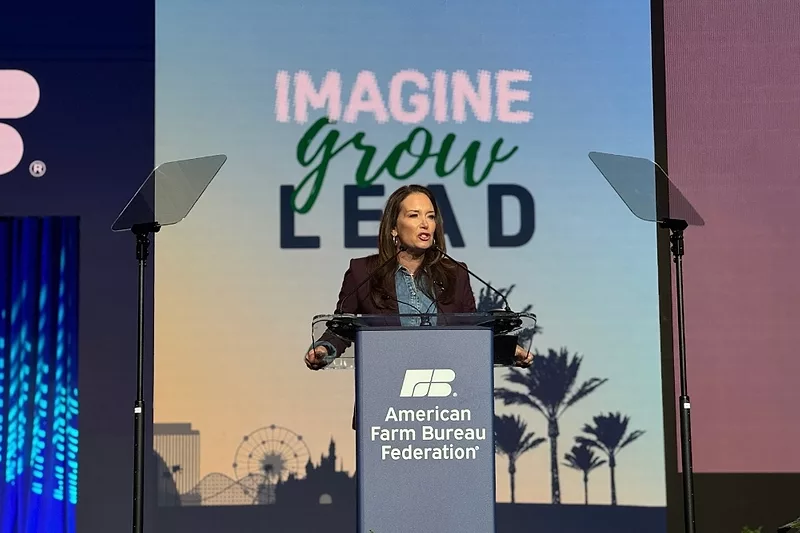
Agriculture Secretary Brooke Rollins highlighted progress her department has made over the last year in reducing the agricultural trade deficit, improving demand and reducing costs for farmers, while emphasizing the need for more work ahead.
Speaking Monday at the American Farm Bureau Federation’s 107th annual meeting in Anaheim, California, she took aim at California Gov. Gavin Newsom and Proposition 12, a law that restricts sales of certain livestock products, including eggs and bacon, that are not produced according to state animal welfare standards.
“California, not surprisingly, has gone rogue and caused real pain to consumers and to our farmers under its poor confinement restrictions and cage free egg commitments,” she said.
“It is one thing if California passes laws that affect only its own state, but it is another when those laws affect other states in violation of our United States Constitution."
Last year, the Trump administration filed a lawsuit against the state of California to stop enforcement of the law.
She cited several examples of how the Trump administration is opening up new markets for U.S. farmers, including the president’s efforts to expand use of E15 through waivers. But she said the administration has gone “as far as we can regulatorily.
“Congress must now do its job and pass nationwide, year-round E-15 legislation to continue to drive domestic crop demand,” Rollins said, noting that it would be “a clear win-win for farmers and consumers.”
In another effort to boost domestic demand for specialty crop growers, she announced that the agency will purchase $80 million in almonds, grape juice, pistachios and raisins using the department's Section 32 spending authority.
Rollins noted that the agricultural trade deficit “deteriorated dramatically” under the Biden administration, growing to an estimated $50 billion agricultural deficit last year. But she said the outlook was improving, thanks to “a lot of hustling around the world by the president and our team.” She said the trade deficit is coming down to around $41 billion last year and USDA is forecasting another drop to about $37 billion in fiscal 2026. “Making progress, but so much work left to do,” she added.
In addition to trade deals negotiated in 2025, Rollins pledged that “at least a dozen more” that will be announced in the coming weeks to a month.
Rollins discussed several ways in which the Trump administration was boosting farm income and helping farmers stay on the land, including raising reference prices, improving crop insurance and changing several tax provisions in the One Big Beautiful Bill that the president signed into law last year.
Interested in more news on California agriculture, labor, water and rural issues? Sign up for a four-week free trial to Agri-Pulse West. You’ll receive our content - absolutely free - during the trial period.
She also talked about additional ways in which the administration was focused on reducing farm labor costs through new H-2A rules from the Department of Labor and addressing anti-competitive behavior with the Department of Justice.
“We all know that anti-competitive behavior, especially when carried out by foreign-controlled corporations, threatens the stability and affordability of America's food supply,” Rollins said.
After her speech, Rollins also met with California farmers and local leaders concerned about the removal of two dams that are part of the Potter Valley Project.
In a formal filing with the Federal Energy Regulatory Commission last month, USDA asked the agency to reject or pause PG&E’s application to surrender its hydropower license, arguing the proposal is incomplete and fails to account for sweeping agricultural, economic and community impacts. The move represents one of the most direct federal interventions to date in the Potter Valley dam removal process and signals growing concern within the administration over the loss of water infrastructure that supports irrigated agriculture.
She admitted that some people might wonder why, in the midst of so many other issues, "I would lean into what is arguably a local fight." She said she sees this as “one of the existential battles of our time.”
Rollins said it was part of a broader effort underscoring “the importance of putting agriculture first and putting our people first, of ensuring there is an environment where rural America not only survives….but thrives.”
Rollins said that the late Rep. Doug LaMalfa, R-Calif., had texted her shortly before Christmas about the importance of saving water for Potter Valley farmers.
“Up until the very end, he was fighting for the very heart of our country, and he will be so desperately missed,” she said.
For more news, go to:Agri-Pulse.com
