
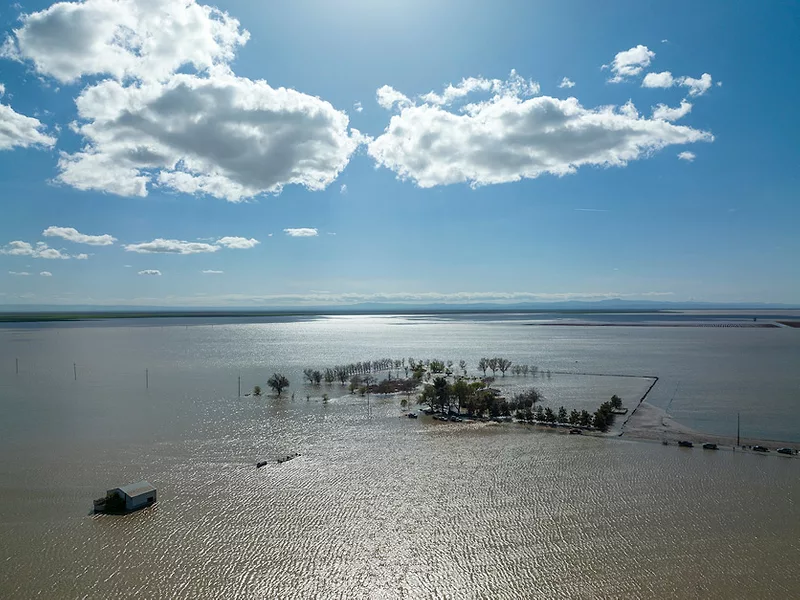
A new analysis quantifies at least $270 million in lost agricultural revenue tied to the historic California floods of 2023, underscoring the deep economic toll of extended inundation on crops across the Central Valley.
The report from the University of California Giannini Foundation of Agricultural Economics uses satellite-derived remote sensing to map flood impacts from a series of atmospheric river events that drenched the state between January and mid-April that year, reviving a long-dormant Tulare Lake and leaving vast tracts of cropland waterlogged.
Researchers found roughly 82,000 acres of cropland were affected, with about 79,500 acres of annual crops and 2,500 acres of perennial crops damaged — translating into $262 million and $8 million in lost gross revenue, respectively. Annual crops like cotton, tomatoes, corn and rice bore the brunt of losses.
Kings County — where the ancient Tulare Lake basin refilled, submerging farmland in a footprint as broad as Lake Tahoe and forcing evacuations — suffered the most severe impacts, with an estimated $145 million in crop revenue loss.
Tulare Lake’s first resurgence in decades not only drowned crops but also altered cropping patterns and disrupted planting cycles across the southern Central Valley. Prolonged flooding depressed Kings County’s gross crop value nearly 17%, with cotton production down more than a third compared with the prior year.
Interested in more news on California agriculture, labor, water and rural issues? Sign up for a four-week free trial to Agri-Pulse West. You’ll receive our content - absolutely free - during the trial period.
That spring the Legislature sought to assess the situation and explore policy options for helping recovery efforts. According to Ryan Buras, then-deputy director of recovery operations at the Office of Emergency Services, more than 55,000 people were under evacuation orders in January, while about 530,000 households lost power and 131 homes were destroyed. Counties reported $1.9 billion in damages to public infrastructure, he explained.
“Although the economic losses to agriculture are already significant and are likely to grow, we are more sobered, of course, by the human impacts of these disasters,” said CDFA Undersecretary Christine Birdsong. “It's not just people losing their homes, it's people losing their jobs and it's the loss of life.”
The study highlights the vulnerability of California agriculture to climate-driven extremes, as heavy rainfall events follow years of drought and growers face more volatile water conditions.
Insurers and analysts say such volatility is already shifting risk management strategies, with more San Joaquin Valley farmers buying crop insurance as losses mount from both drought and flooding.

