
House Agriculture Committee Democrats plan to introduce sweeping legislation soon that would provide another $17 billion in economic relief to farmers, delay cost changes in food aid for low-income Americans and end President Donald Trump's across-the-board tariffs.
The legislation sets the stage for what is likely to be a partisan, election-year battle over farm assistance and trade policy as well as the SNAP cuts included in President Donald Trump's signature domestic policy law, the One Big Beautiful Bill Act.
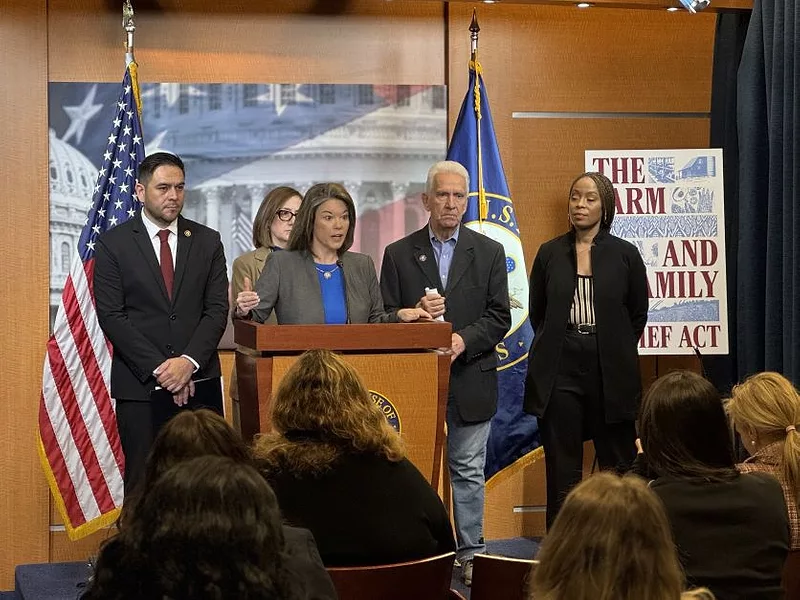
The three-pronged Democratic measure, dubbed the Farm and Family Relief Act, will call for about $17 billion in one-time payments to financially strained farmers across a broader group of agriculture sectors than the Trump administration's $12 billion program, Rep. Angie Craig, the ag panel's top Democrat, said in a news conference Thursday.
Meanwhile on Friday, two key Republicans released the framework of a proposal to provide additional financial assistance to farmers, including specialty growers and sugar producers, to augment the $12 billion Farmer Bridge Assistance program announced in December.
The amount of additional money that would be provided wasn't specified, but Senate Ag Chairman John Boozman, R-Ark., and Senate Ag Appropriations Subcommittee Chairman John Hoeven, R-N.D., discussed a $15 billion package earlier this week in a meeting with House Ag Committee Chairman Glenn “GT” Thompson, R-Pa., according to a source familiar with the matter.
The Democrats' legislation, the text of which is expected to be released next week, also would postpone by four years a cost shift from the federal government to states in providing food assistance and curb Trump's ability to wage tariffs fights with key U.S. trade partners including Canada and Mexico. Craig, who is running for a Senate seat in Minnesota, urged Republicans to back the measure in an upcoming federal funding package.
"This should not be a partisan fight to ensure the people in the wealthiest country on earth can afford food," Craig said. "It shouldn't be a red-versus-blue issue to look out for our family farmers who feed our communities and are caught in a trade war that they did not ask for."
Rep. Don Bacon, R-Neb., a moderate Republican who introduced a bill to have Congress approve any new tariffs, said he had not read Craig's proposal yet but found agreement with Democrats that the agriculture sector was bearing the brunt President Trump's trade policy.
"I do think tariffs have been hard," Bacon told Agri-Pulse leaving the House floor Thursday without directly commenting on the amount of additional farm aid needed. "We haven't had soybeans ... purchased like promised, but yet our input costs are high."
"Tariffs have always been the hardest on agriculture," Bacon added.
Don’t miss a beat! It’s easy to sign up for a FREE month of Agri-Pulse news! For the latest on what’s happening in Washington, D.C. and around the country in agriculture, just click here.
Thompson rejected the House Democrats' idea of delaying a requirement in the One Big Beautiful Bill for most states to start paying a share of food benefits costs for the Supplemental Nutrition Assistance Program. The Ag Committee chair noted the cost-share requirement doesn't start until 2027 and that "good progress" is being made in states preparing for the change.
The Center on Budget and Policy Priorities, a nonpartisan research firm, said the change in SNAP cost structure will potentially cost many states hundreds of millions of dollars a year, meaning some might opt to end its participation in the anti-hunger program.
"With states in such a bind and the stakes for low-income families so high, at minimum Congress should use spending legislation it must pass this month to delay this cost shift by two years for all states, not just the limited ones granted this delay under the megabill," the group said in a report last week.
Thompson's opposition shows the broader dilemma Congress faces in attempts to pass outdated ag provisions from the 2018 farm bill amid ongoing failure to pass a new five-year bill to deal with key agriculture and food aid programs.
Thompson wants to move a bill next month that would include controversial provisions to address such issues as pesticide labeling and California's Proposition 12 regulations on animal welfare.
Farm bill 'poison pills'
Craig said Republicans need to pursue a “clean” farm bill or risk problems getting a measure passed out of committee. “Poison pills” would include any provision stating that federal pesticide law preempts state liability claims related to label warnings on farm chemicals.
Republicans would face “tremendous pressure from the Make America Healthy Again movement if preemption for pesticides is included in their farm bill,” Craig said.
Rep. Austin Scott, a GOP ag committee member from Georgia, claimed that the planned bill led by Craig is a political move aimed at helping her Senate campaign. "They (Democrats) had ample opportunity to do things that were going to going to help the American farmer ... when they were in charge, and they did nothing," Scott said.
Meanwhile, Craig and Rep. Jim Costa, D-Calif., assailed the Trump administration over what they said was cherry picking which parts of the agriculture sector get federal economic relief.
"There's been no explanation on how they pick these winners and losers," said Costa, whose district lies in California's San Joaquin Valley, a top food-growing hub in the country's biggest agriculture state.
Democrats said their legislation would expand aid for producers across more commodities that the administration's bridge payments.
"Big losers were speciality crops in our country, sugar beet growers in our country," Craig said. "We refuse to pick between winners and losers among farmers and families, because both are incredibly important and both are hurting."
The Trump administration has said it will make $11 billion in planned payments to corn, soy, rice and other row crop farmers and $1 billion to growers of specialty crops, which includes fruits, vegetables and tree nuts.
Yet details on how funds for specialty crops will be structured have yet to be disclosed.
"Our bill ends the chaos," said Rep. Andrea Salinas of Oregon, top Democrat on the ag committee's forestry and horticulture panel. "My district is home to some of the best wine producers in the world, but Trump's tariffs and the response from our trading partners have driven up costs for supplies, restricted export markets and created real economic pain."
Rep. Gabe Vasquez, D-N.M., said additional financial help would be a lifeline for speciality crop farmers in his state, including growers of pecans, chiles and onions.
Minnesota is the biggest U.S. state in production of sugar beets, Oregon is a top grower of wine grapes and New Mexico the largest producer of chile peppers.
Hear more from Craig on Agri-Pulse Newsmakers released tomorrow.
Oliver Ward and Philip Brasher contributed to this report.
This article has been corrected to say that the actual amount of new farm aid in the Democratic plan is $17 billion.
.webp?t=1762183428)

