
President Donald Trump’s suggestion that a group of European countries will soon face higher U.S. tariffs for opposing his efforts to acquire Greenland has drawn severe criticism from European policymakers, with several arguing that the European Union should retaliate more forcefully than it has to date.
On Saturday, Trump said he would impose new tariffs on eight European countries, including France, Germany, the United Kingdom and Denmark, until the U.S. can purchase Greenland – a Danish territory.
The threat drew a swift rebuke from many EU officials and has thrown the future of two trade pacts with the UK and EU into doubt. The European Parliament still has to formally accept the U.S. deal, and lawmakers from across the Parliament’s political spectrum said Saturday that now, they don't support proceeding with adoption.
Last year, when the president unveiled new tariffs on the EU, the bloc responded by unveiling tariffs of its own, affecting more than $100 billion in U.S. exports, including many U.S. agricultural commodities. The Financial Times reported Sunday that European officials are weighing reviving this tariff list should Trump press ahead with the new duties.
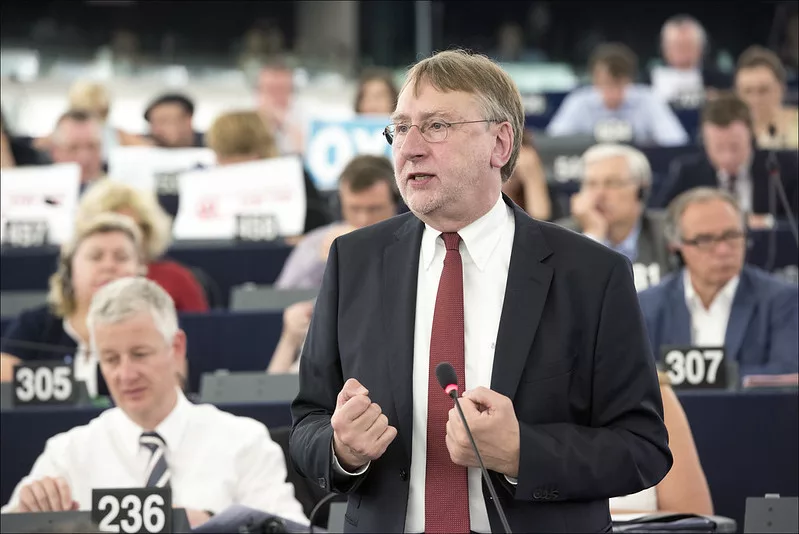
But several prominent voices are calling for the EU to respond to new tariffs even more forcefully this time around. Bernd Lange, who chairs the Parliament’s international trade committee, is pressing the European Commission to activate a novel “anti-coercion” measure to respond to further U.S. tariffs.
Representatives from French President Emmanuel Macron’s office told European media that he would also support using the trade “bazooka.”
The anti-coercion instrument allows the bloc to impose more restrictive measures than just tariffs – which it also permits on goods and services. The commission can also limit foreign direct investment, U.S. participation in public procurement projects or impose export controls, among other measures.
Several of these measures could deliver a significant blow to U.S. companies – particularly if European officials chose to target the more than $290 billion in services the U.S. sells to Europe each year.
Former EU Trade Commissioner Cecilia Malmström told Agri-Pulse in an email Sunday that there is a growing frustration with the U.S. president over his repeated threats to annex Greenland. Even Trump-aligned EU lawmakers, she said, “are turning against him.”
“Greenland is not for sale. I really think Europe is getting tired of these threats now,” Malmström added.
Dan Mullaney, former assistant U.S. Trade Representative for Europe and the Middle East, agreed that the likelihood of Europe deploying more aggressive retaliatory measures through its anti-coercion instrument “has clearly increased.”
The European Commission's decision not to deploy the instrument last year sparked criticism from some members of the Parliament.
“That choice was controversial and subject to criticism,” said Mullaney, who is now a nonresident senior fellow at the Atlantic Council. “This U.S. threat tilts the field in favor of a tougher response.”
It’s easy to be “in the know” about what’s happening in Washington, D.C. Sign up for a FREE month of Agri-Pulse news! Simply click here
It’s not only Europeans that are breaking with the president on his latest tariff foray. Mullaney pointed out that there may be less domestic support for tariffs imposed over Trump’s expansion aspirations than those adopted to address unfair trade practices.
For example, North Carolina Republican Sen. Thom Tillis was quick to criticize Trump’s latest tariff threat. Tillis was in Denmark this weekend with a congressional delegation to reassure the NATO ally in the face of intensifying administration rhetoric.
“This response to our own allies for sending a small number of troops to Greenland for training is bad for America, bad for American businesses, and bad for America's allies,” Tillis wrote to X on Saturday. “It's great for Putin, Xi and other adversaries who want to see NATO divided.”
Sens. Lisa Murkowski, R-Alaska, Jeanne Shaheen, D-N.H., and Chris Coons, D-Del., were also among the bipartisan, bicameral delegation.
Trump and European Commission President Ursula von der Leyen are slated to hold talks on the sidelines of the World Economic Forum at Davos this week, according to FT reporting. Accordingly, EU officials are hoping the face-to-face meetings are an opportunity to bring the temperature down.
Mullaney noted that there is still time for the president to walk back his promised tariffs, as he has in the past.
But "this time it does feel a little different," he added.
For more news, go to Agri-Pulse.com.

