
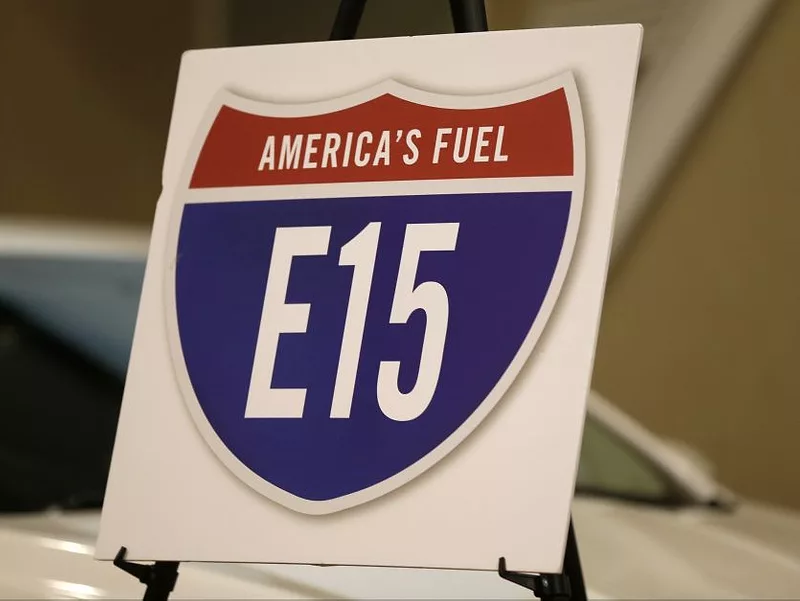
There is some positive movement toward congressional action to allow year-round sales of higher ethanol blends at U.S. gas pumps.
Industry officials tell Agri-Pulse’s Kim Chipman the American Petroleum Institute and biofuel groups have reached agreement on proposed revisions to a key bipartisan bill. This comes after the oil and gas lobby pulled its support late last year from the original legislation.
That bill led by Sen. Deb Fischer, R-Neb., would allow expanded sales of gasoline mixed with 15% ethanol, known as E15, up from the current 10% standard.
The agreement deals with the treatment of small refinery exemptions from the Renewable Fuel Standard. Under the proposed revisions, the exemptions from annual biofuel-blending requirements would only be available to energy companies that process 75,000 barrels per day of crude oil across all operations, as opposed to 75,000 barrels per day per plant.
The proposed text says starting in calendar year 2028, the EPA shall reduce compliance requirements of “[each] small refining company” by 75%. That means those firms would need to blend or buy biofuel credits, known as RINs, for the remaining 25% of a given year’s federal biofuel-blending target.
Republican and Democratic lawmakers, including Senate Ag Committee Chairman John Boozman and the panel’s top Democrat, Sen. Amy Klobuchar, said last week they are hopeful E15 legislation can pass soon after almost clearing Congress in late 2024.
Keep in mind: Congress is racing to pass funding legislation by Jan. 30 to avoid another government shutdown. It isn’t clear yet whether an E15 bill could get attached to that legislation.
Take note: Officials with oil companies opposed to the proposed policy changes are expected to be in Washington on Tuesday amid the lobbying battle, a person close to the situation said.
It’s easy to be “in the know” about what’s happening in Washington, D.C. Sign up for a FREE month of Agri-Pulse news! Simply click here
World leaders head to Davos against backdrop of tariff threats
Global policymakers and business executives are meeting in Davos, Switzerland, this week at the World Economic Forum as European leaders are hoping to avoid threatened U.S. tariffs over Greenland.
President Donald Trump on Saturday said Denmark, France, Germany, the United Kingdom and four other European countries would face 10% tariffs beginning Feb. 1 unless a deal is reached for the U.S. to buy Greenland.
European officials reacted over the weekend. The Financial Times reported that EU policymakers are looking at reviving plans to retaliate with tariffs on over $100 billion of U.S. exports. These would include U.S. grains, meats, vegetables, wine, beer, nuts, seafood and bourbon. And some are calling for even stiffer retaliation.
Trump is set to speak at the forum on Wednesday and is expected to hold meetings on the sidelines of the event; European Commission President Ursula von der Leyen, NATO Secretary General Mark Rutte and other European leaders will also be at the forum.
GOP senators push for pulses in any India trade pact
Two Republican senators want greater market access for U.S. pulse producers in any U.S.-India trade framework.
Late last year, India imposed a 30% tariff on yellow peas, Sens. Steve Daines, R-Mont., and Kevin Cramer, R-N.D., say in a letter to Trump. The action came several months after the U.S. raised tariffs on most Indian products to 50% because India was buying Russian oil.
“As a result of the unfair Indian tariffs, U.S. pulse crop producers face a significant competitive disadvantage when exporting their high-quality product to India,” Daines and Cramer argue. “As trade negotiations progress, we encourage you to push for favorable pulse crop provisions in any agreement.”
Canadian mushroom probe advances
The International Trade Commission has affirmed that fresh mushroom imports from Canada are hurting U.S. producers. The ITC decision allows the next phase of a trade investigation to proceed.
The Commerce Department will now investigate whether Canadian producers are benefitting from government subsidies or if products are being sold in the U.S. below a fair market rate. There could be new tariffs if it finds evidence of unfair trade practices.
Preliminary findings are expected in the coming months.
The decision “paves the way for much needed relief for domestic growers and packers of fresh mushrooms,” John Herrmann, counsel to The Fresh Mushrooms Fair Trade Coalition, says in a statement. The coalition, which includes several U.S. growers and packers, is the petitioner in the antidumping and countervailing duty case.
“Domestic producers of fresh mushrooms should not have to compete with products that are sold at unfairly low prices and subsidized by the Canadian government,” Herrmann adds.
Lenders can now see Rural Development portfolio online
USDA is launching what it’s calling a Lender Lens on the Rural Data Gateway, which allows the public to see USDA Rural Development’s entire commercial guaranteed loan portfolio.
Now anyone who wants to can access “where federal investments are being made,” a department news release says.
“The dashboard showcases key metrics, including total loan volume, average loan size, loan distribution by sector, geographic spread, and delinquency rates,” the news release says.
The gateway includes investment dashboards “that show how Rural Development has supported local and regional economies over the last decade through 80 different programs,” USDA says.
Final Word
“Europeans must make it clear that the limit has been reached.” - German Finance Minister Lars Klingbeil on possible EU retaliation if the U.S. imposes tariffs over Greenland.
For more news, go to Agri-Pulse.com.
.webp?t=1762183428)


