
States and counties that administer SNAP are struggling to implement new program requirements in the One Big Beautiful Bill Act that shift some administrative costs to the states and expand eligibility requirements.
States will have to pay more if their SNAP error rates are too high.
State and county officials who administer the Supplemental Nutrition Assistance Program are warning that changes to SNAP mandated by the OBBBA will saddle them with additional costs for payment errors that they have little opportunity to correct.
That bill puts states that run the program, which provides monthly allotments to about 42 million people, on the hook for additional administrative expenses – 75% versus the current 50% – in October.
Then in fiscal 2028, states with error rates in the program higher than 6% will have to pay a portion of SNAP benefits. That share ranges from 5% to 15%. Based on recent error rates, 43 states could have to provide more money for the program.
The Food Research & Action Center estimated that the five most populous states – California, New York, Florida, Texas and Pennsylvania – would have to pay nearly $7.8 billion more.
The law also changed eligibility criteria, particularly on work requirements. The Congressional Budget Office estimates 2.4 million people will lose benefits in a typical month due to the new requirements.
The Agriculture Department says SNAP is rife with fraud, waste and abuse. Secretary Brooke Rollins says a half million people have been receiving double benefits and that 186,000 deceased individuals were on the books as receiving benefits.
The data comes from 28 states and Guam that submitted information to USDA. Another 22 states and the District of Columbia are challenging USDA’s request for recipients’ personal data in court. They say there are myriad reasons why a dead person may still appear on the SNAP rolls or it might appear that someone is getting double benefits. USDA has not shared its analysis publicly.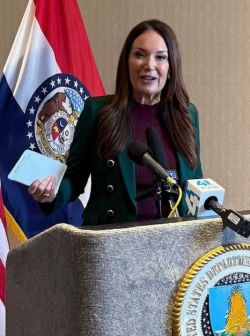 Brooke Rollins (Agri-Pulse photo)
A USDA spokesperson told Agri-Pulse that "under Secretary Rollins' leadership, USDA is committed to preserving the integrity of our programs and respecting the generosity of American taxpayers."
USDA set up a SNAP integrity team "to analyze not only data provided by states, but to scrub all available information to end indiscriminate welfare fraud," the spokesperson said. "Twenty-eight States and Guam joined us in this fight; but states like California, New York, and Minnesota, among 19 other blue states, keep fighting us. They choose to protect illegals, criminals, and bad actors over the American taxpayer."
Cut through the clutter! We deliver the news you need to stay informed about farm, food and rural issues. Sign up for a FREE month of Agri-Pulse here.
Referring to the OBBBA, the spokesperson said the department "will continue to provide state agencies with implementation guidance that will assist states in properly complying with and implementing new regulations or federal laws. Developing comprehensive guidance takes time to ensure accuracy and clarity, and USDA is committed to providing states with the information they need as quickly as possible. As additional implementation guidance to states is made available, it will be added to the FNS website at: www.fns.usda.gov/obbb."
States trying to move fast
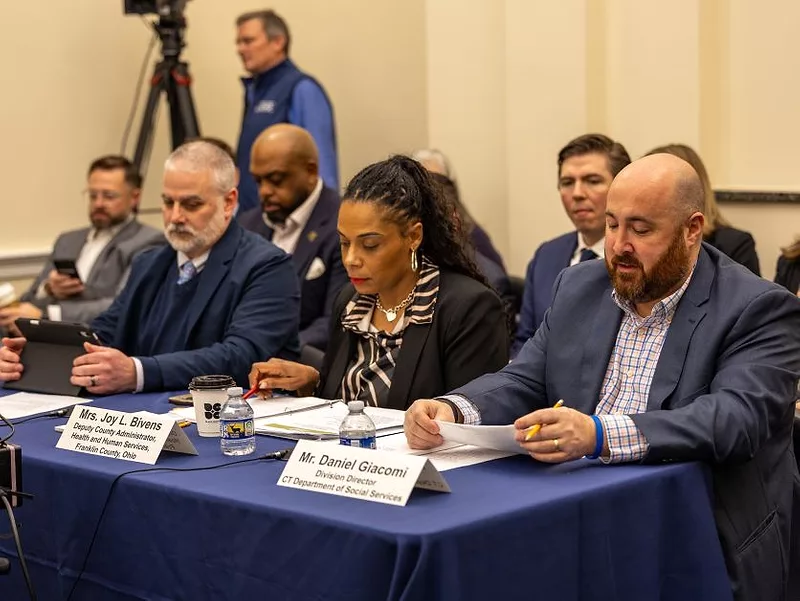
Joy Bivens, deputy county administrator for Franklin County, Ohio, told Democratic House members at a roundtable last week that her state's benefit system is not built to immediately accommodate rapid policy changes. Franklin County is home to Columbus.
“Since the OBBBA took effect in July, counties have been required to complete significantly more manual casework” because she said policy changes mandated by OBBBA could not be updated quickly in the state’s benefit system.
“There are approximately 300 SNAP case managers in Franklin County, and more manual entries will inevitably be met with more errors,” she said. “Counties have been operating without real-time feedback on accuracy while SNAP error rates are published on a three-month delay, limiting our ability to quickly correct.”
Ohio is one of 10 states where counties administer the SNAP program with state supervision.
Larry Braasch, deputy division director in the New Jersey Division of Family Development, said at the roundtable that “the implementation provisions [in OBBBA] here sort of put this program under duress.”
The “human error rate,” Braasch said, is a “fundamentally flawed metric. It does not measure what it is supposed to measure.” He added that “there is zero visibility into the payment error rate metric. Nobody knows how it is calculated.”
Chloe Green, assistant director of policy at the American Public Human Services Association (APHSA), said although the equation is public, calculating the error rate “is just very complicated. A lot of people don't understand all the pieces that go into it.”
New Jersey has disputed its 14% error rate to USDA, which is “significantly higher than our calculations indicate,” Braasch said. He added, “There is no margin of error associated with the payment error rate as there is with every other sort of financial liability.”
Dan Giacomi, director of program oversight and grants at the Connecticut Department of Social Services, said that like Ohio, his state has “an eligibility system that takes a long time to make updates to become compliant.”
Without adequate guidance from USDA, he said the program is in a “holding pattern” and eligibility caseworkers “have to either make their best estimate or best guess, or use antiquated workarounds, so to speak, to do it, which in itself tends to lead to increased errors.”
Property taxes on rise to pay for changes
At the roundtable, House Ag’s top Democrat, Minnesota’s Angie Craig, said counties in her state were raising property taxes specifically to cover increased costs of SNAP and Medicaid.
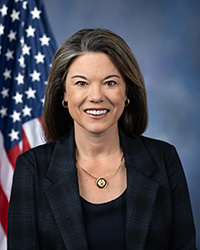 Angie Craig (Official photo)
The local officials said they weren’t asking for a repeal of the changes in the OBBBA but need more time to implement them. A bill introduced by Craig, the Farm and Family Relief Act, would delay the cost shift on SNAP benefits from October 2027 to October 2031. It also would delay for two years the cost shift of SNAP administrative expenses to states.
“We are not trying to avoid accountability, but we're asking to be set up for success rather than failure,” Giacomi said.
APHSA’s Green said her organization is working with states to reduce error rates. “All states are working incredibly hard to comply and be in line, including reducing their error rates as much as possible, although we know that that takes a lot of time.”
She noted that it’s a challenging environment, especially considering that new work requirements went into effect when OBBBA was signed on July 4, which is “hard for every state, because that means the next day they were out of compliance.”
APHSA and other groups, along with the National Governors Association, had sought delays for the new requirements that were not included in appropriations legislation. Asked about further legislative opportunities, Green said, “Never say never,” adding that “there’s a lot of different discussions and maneuvering happening for potential bills” that could allow for delays, including the farm bill.
Brandon Lipps, administrator of the Food and Nutrition Service in the first Trump administration, said OBBBA has incentivized states to reduce their error rates.
The error rate “is not the only measure of how well the program is run, but it is a measure of how well the program is run,” Lipps said.
Implementing the OBBBA changes “is a very difficult task, but I would argue that it's not one that is too difficult for the amount of money that we're talking about. States have an obligation to get this right” that did not exist before the law went into effect.
“States deal with budgets, just like everybody else, and you're going to put money where you have an incentive to do so,” he said.
Lipps, who is a principal at Caprock Strategies, added, “I will acknowledge that calculating SNAP benefits is complicated. It is a number that's a result of statutory benefit, which is decreased and increased based on any number of deductions, income, assets, etc. And it is complicated, but you know, the same is true for Congress’ expectation of me calculating my income taxes appropriately, and I don't get a pass because it's hard.”

