
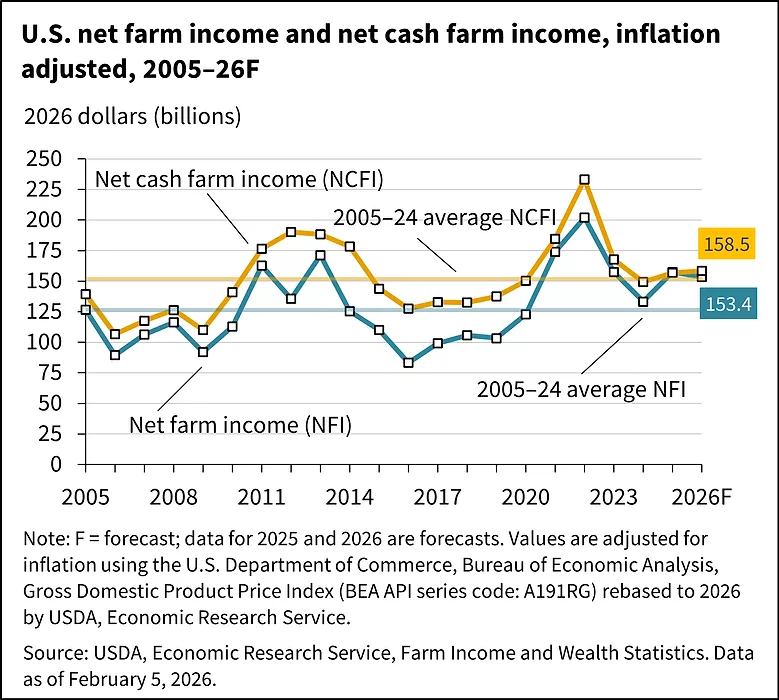
Increased government payments and a strong cattle sector should keep farm earnings relatively stable in 2026 despite no expected improvement in revenue from crops, according to USDA’s first farm income forecast for the year.
Net farm income, a broad measure of the overall profits, is estimated to decline by 2.6%, or $4.1 billion, when adjusted for inflation to $153.4 billion this year, USDA’s Economic Research Service reported Thursday.
Net cash farm income, a measure of farmers’ cash flow, is projected to increase by 1.1%, or $1.7 billion when adjusted for inflation to $158.5 billion, keeping profits close to the 20-year average.
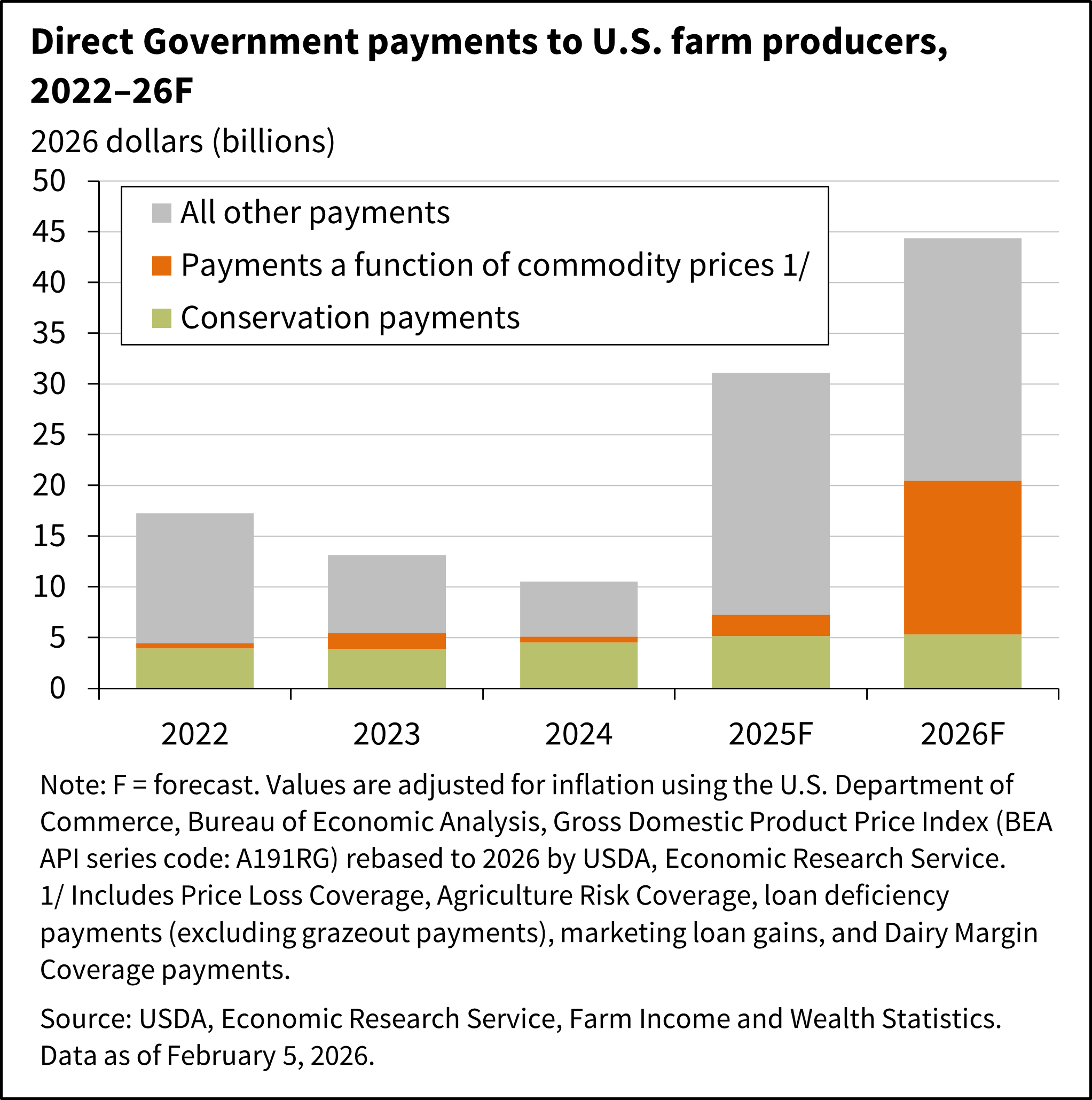
Net cash farm income is based on cash receipts from farming, plus government payments and other farm-related income, minus cash expenses. Net farm income also factors in depreciation and changes in inventory values. Direct government farm payments are forecast at $44.3 billion for 2026, a $13.8-billion increase from 2025.
The combination of ad hoc assistance and changes made to commodity programs by the GOP’s One Big Beautiful Bill Act will combine to shore up farm income. Direct government payments to farmers are expected to soar to $44.3 billion this year, a $13.8 billion increase from 2025.
Cash receipts from crops are expected to rise slightly to $240.8 billion, an increase of $2.8 billion not adjusted for inflation. Sales from corn and hay are expected to be higher, while receipts for wheat and rice fall, and soybean and cotton sales remain relatively stable.
Rice continues to be one of the toughest sectors to be in. Rice receipts are forecast to drop by $400 million, or 12.5% in 2026.
Despite continued strong cattle prices, cash receipts from livestock and poultry products are expected to fall by 5.8%, to $273.9 billion in 2026, a decrease of $17 billion not adjusted for inflation.
Receipts for cattle and calves are projected to rise 4.1% this year to $5.2 billion on continued increases in cattle prices. But sales from milk are forecast down by 12.8% to $6.2 billion, and receipts from hogs are expect to drop slightly.
Off-farm income will continue to keep farm households afloat this year, according to the forecast.
The median total farm household income is projected to increase to $113,031 in 2026, a 2.7% increase from 2025. But the median farm income for farm households is forecast at a negative $1.161 this year, only slightly better than the median loss of $1,498 in 2025.
A group of 27 former agricultural leaders and executives warned this week of the “widespread collapse of American agriculture and our rural communities” unless the sector receives additional assistance.
The signatories included past presidents and CEOs of the American Soybean Association, National Corn Growers Association, National Pork Producers Council, National Barley Growers Association, National Milk Producers Federation, US. Grains Council and Renewable Fuels Association.
For more news, go to Agri-Pulse.com.

