

|
Farmers are increasingly turning to debt to make it through a challenging farm economy.
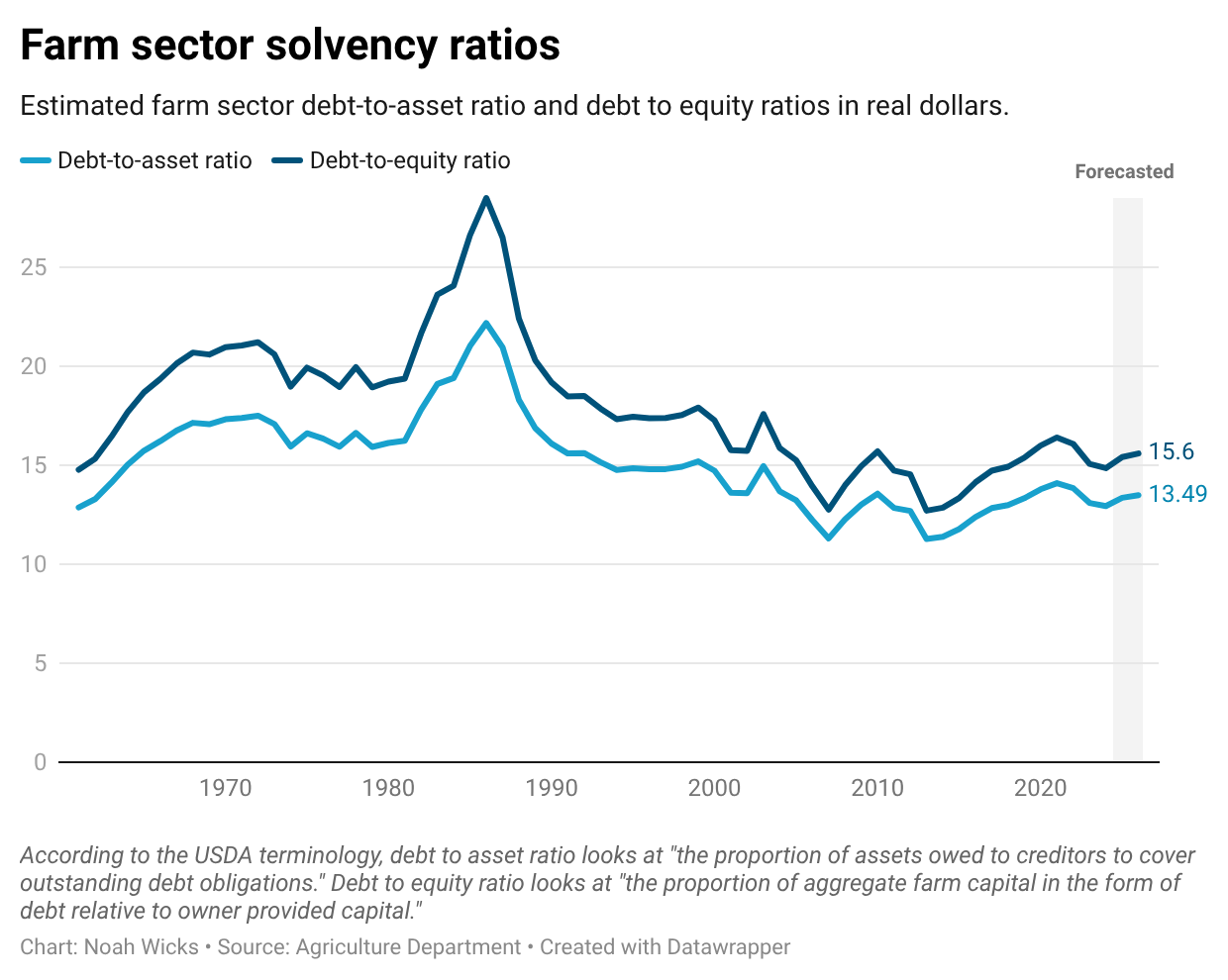
According to USDA’s most recent farm income forecast, farm sector solvency is expected to weaken this year as value of debt outpaces assets. The forecast suggests debt-to-asset ratios will increase from 13.49% in 2025 to 13.75% in 2026.
“Over the last year and a half or two, there has definitely been some tightening in terms of the overall ag economy and some amount of additional pressure by way of credit conditions and repayment,” said Nate Kauffman, senior vice president and Omaha branch executive for the Kansas City Fed.
Liquidity also is likely to decline in 2026, the Economic Research Service forecast says. Working capital, or cash available to cover operating expenses after paying off debt due within a year, is expected to drop from $154.9 billion in 2025 to $140.6 billion in 2026.
ERS expects farm sector equity to increase in 2026 by 1%, when adjusted for inflation. Assets are expected to increase by 1.3%, and debt to increase by 3.2%, adjusted for inflation.
Still, while debt-to-asset and debt-to-equity ratios are expected to increase in 2026, they remain far below spikes that have occurred at various parts of the last fifty years, according to USDA data.
The largest spike occurred in 1986, when the debt-to-asset ratio reached 22.19% and the debt-to-equity ratio reached 26.51%. Smaller, less significant spikes occurred in 1999, 2003, and 2010. Most recently, in 2021, debt-to equity ratios climbed to 16.41% and debt-to-asset ratios climbed to 14.1% before falling again in the subsequent years
According to the farm income forecast, net farm income in 2026 is projected to decline by 2.6%, or $4.1 billion when adjusted for inflation, to $153.4 billion. Meanwhile, net cash farm income is expected to increase by 1.1%, or $1.7 billion when adjusted for inflation, to $158.5 billion.
Direct government payments are expected at $44.3 billion this year, a $13.8 billion increase from last year. These payments, along with a strong cattle market, are expected to help keep farm earnings stable amid weak crop revenues.
Adjusted for inflation, farm sector production expenses are projected to decline only slightly, 0.9%, from 2025.
“Input prices remain elevated,” said Darren Hudson, a professor at Texas Tech University. “Though they're not growing like they were, and some are coming down, … they're still at very elevated levels, while [commodity] prices have come off significantly.”
Rebeca Rainey, president and CEO of the Independent Community Bankers of America, in a letter Tuesday urged lawmakers to increase guaranteed USDA farm loan limits, warning that many crop farmers were feeling “severe financial distress” amid a mix of high production costs, trade challenges, weather-related losses, and falling commodity prices.
Rising loan volumes reflect farm pressure
Kauffman said surveys conducted by the KC Fed show increased demand for financing, as well as “some amount of increased financial stress by way of things like slower loan repayment and some amount of increase in delinquencies.”
One KC Fed survey from last year found that new farm operating loans saw a nearly 40% increase in volume in the final quarter of 2025 when compared to the year prior, according to an analysis by Kansas City Fed Associate Economist Ty Kreitman. Throughout 2025, the volume of new farm operating loans “grew by an average of more than 20%,” Kreitman’s analysis found.
The analysis also found the average size of a farm operating loan in 2025 was roughly 30% larger than the prior year, when adjusting for inflation. It noted that loan sizes “have grown alongside elevated production expenses and pushed operating loan volumes well above the average of the past two decades.”
University of Arkansas Extension Agricultural Economist Ryan Loy said as a general trend, he has noticed lending tighten. It’s a trend he expects to continue into the foreseeable future.
Loy noted that the current farm economy has “made it difficult for both the lender and the farmer right now to see eye-to-eye in terms of what can be done.” However, he added, “lenders are trying everything they can to make sure folks are cash flowed this year.”
Federal Reserve System data indicate the delinquency rate for agricultural loans as of the third quarter of 2025 was at 1.09%, a slight drop from the first and second quarters. More broadly, it was also below the third quarter of 2024, which had a 1.27% delinquency rate on agricultural loans.
When it comes to farmland loans, delinquency rates increased steadily from 0.91% in the first quarter of 2023 to 1.34% in the first quarter of 2025 before dipping slightly to 1.33% and 1.32% in the second and third quarters of 2025.
Kauffman said delinquency statistics should be taken with “a grain of salt” noting that “delinquencies can be a backward-looking measure of financial stress.”
“Both borrower and lender would prefer that a loan not go delinquent,” he said. “So, to the extent that they can, they would try to take measures proactively to ensure that they're meeting their loan obligations.”
Chapter 12 use grows, though below 2008-2020 levels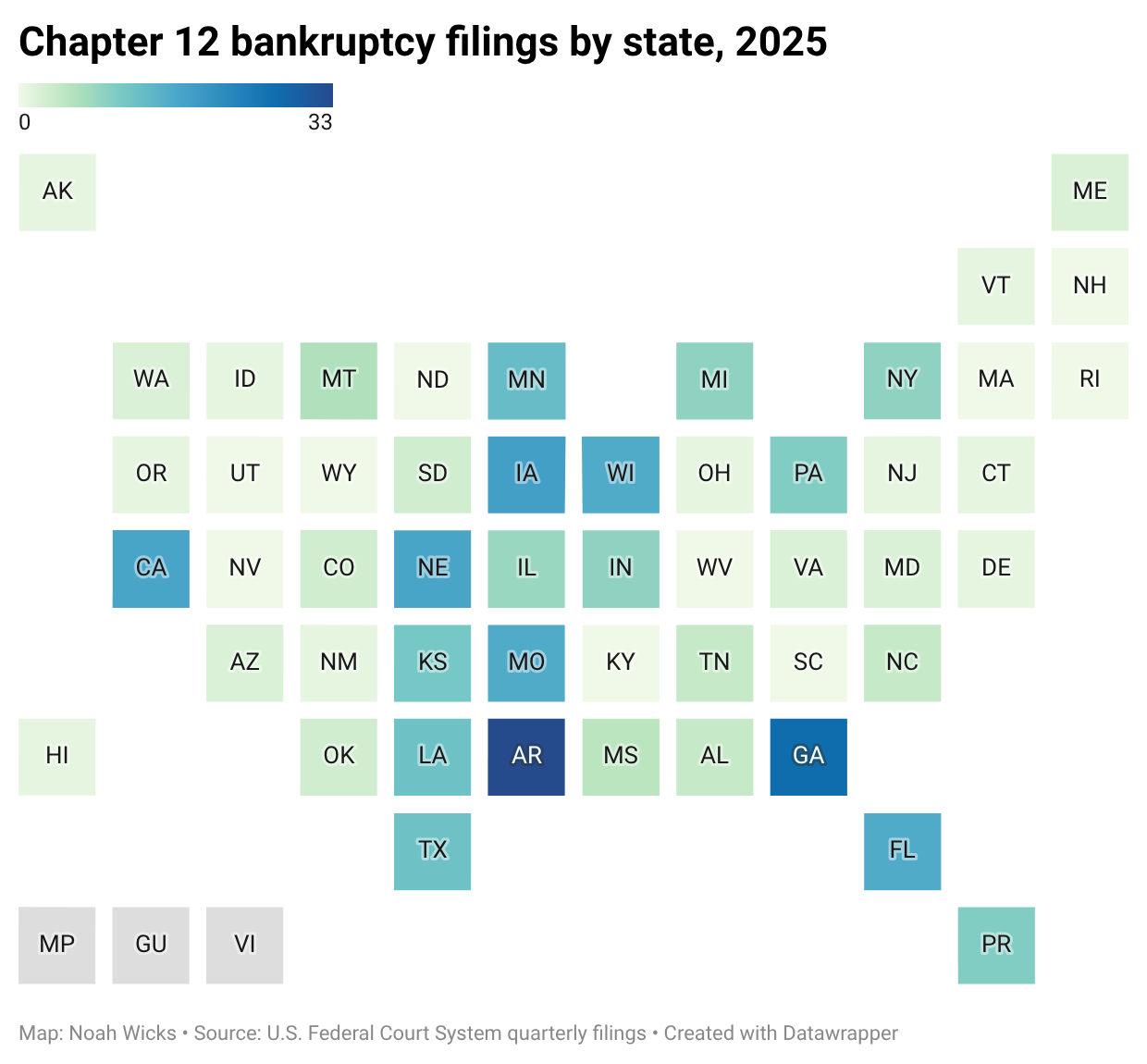
Last year, the U.S. saw farm bankruptcies rise.' The Chapter 12 bankruptcy process is designed specifically to assist agricultural producers in paying back their debts so they can continue to farm, said Loy.
An Agri-Pulse analysis of federal court data found 315 Chapter 12 bankruptcies that were filed in 2025. That amounts to roughly a 46% increase from 2024, when compared to data in an online U.S. Court Systems tracker.
Still, the total number of filings remains below those seen each year between 2008 and 2020. In terms of overall filings, 2010 remains a high point at 723, while 2011 saw 637 and 2020 saw 599, according to federal court data.
Arkansas saw the most Chapter 12 cases with 33 filings. Georgia followed with 27, while Iowa came in third with 18. California and Nebraska each had 17, while Florida, Missouri and Wisconsin each had 16.
Loy said rice and soybeans are leading crops in Arkansas, both of which saw challenging market environments last year. In addition, he said many Arkansas producers rent their land and may not have enough equity in land to lean on during tough times. These may be among the factors behind the state’s relatively high rate of farm bankruptcies.
Loy said it is important to note that farms that go through Chapter 12 bankruptcies are not “lost forever.”
“It’s meant to be used to make sure that you can stay afloat and continue to farm,” Loy said of Chapter 12. “I think we’re seeing a lot more people wanting to try to go that route because they have no reserves and times are difficult. But it doesn’t mean they won’t ever farm again.”

