
|
When Iowa farmer and crop insurance agent Pat Swanson was named to lead USDA’s Risk Management Agency in March of 2025, she developed a list of things she thought should be streamlined and improved. Within weeks, she started checking things off at a speed which seems almost unheard of for such a large federal agency that supports risk management from coast to coast.
“The biggest challenge for me is that I’m kind of an impatient person,” she admits.
USDA’s Risk Management Agency manages the Federal Crop Insurance program in partnership with private-sector Approved Insurance Providers (AIPs). For crop year 2025, the total insurance in-force in the program was over $198 billion on more than 563 million acres for crop year 2025.
First, she rescinded a requirement for new breaking acreage that seemed redundant. Next, she provided relief on production reporting for producers who switched AIPs.
“If a farmer moved their policy to a new AIP, they had to report their production to their previous agent so it would be reported in the same year. If the previous agent did not key in the production, the farmer was penalized with the assigned yields,” she said.
Even though her list has grown incredibly large as she’s traveled around the country and heard from more producers and AIPs, no one is doubting that she’s going to keep methodically checking things off the “to do” list. She’s focused on a “farmer first” delivery system, while transforming the agency in ways that embrace new technology and reduce red tape.
Industry leaders attending the annual Crop Insurance Industry Convention in Palm Springs this week consistently described her as a “breath of fresh air” who leads with a willingness to engage and brings a high level of experience to the job. Her training in computer science, her work as a crop insurance agent for over two decades and service as a former member of the Federal Crop Insurance Corporation board make her uniquely prepared to understand the complexities of an agency that relies on AIPs to deliver risk management tools to farmers and ranchers.
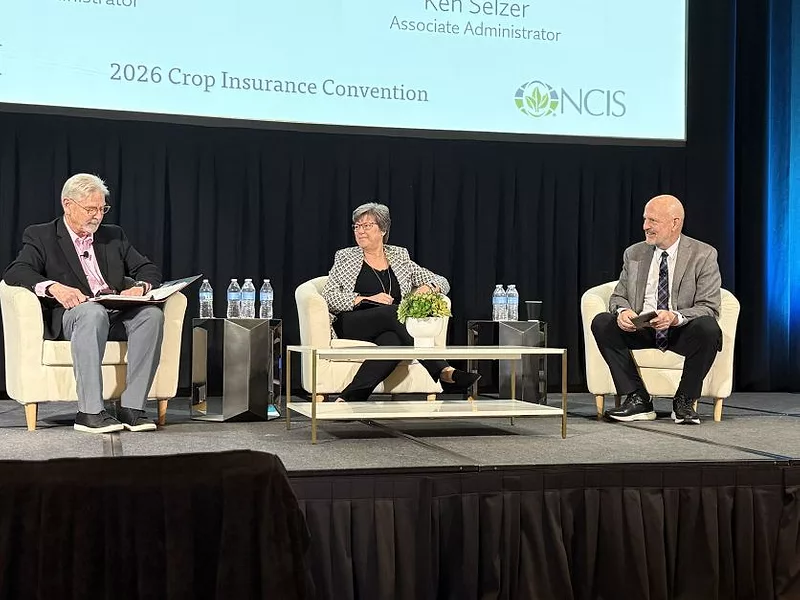
Swanson and RMA Associate Administrator Ken Selzer updated participants attending the CIIC on some of their current and future plans. Here are some highlights:
Specialty crops
Swanson hosted roundtable meetings with over 330 crop insurance agents and industry experts who deal with specialty crops about how to improve crop insurance. She said the government shutdown “took away a little bit of our momentum” and RMA is still reviewing over 300 comments that came out of those discussions. The One Big Beautiful Bill Act also provided new incentives for specialty crop growers by increasing Whole Farm Revenue Protection policies to 90% coverage and increasing the premium support. The bill also provides a minimum 17% Administrative and Operating (A&O) expense reimbursement for specialty crops. Selzer said the program currently covers about 92-94% of row crops and 67% of specialty crops but predicted further growth in both the level of coverage and specialty crop acres covered.
Selzer said “it takes a lot more brain power to come up with solutions for some specialty crops. For example, how do you rate dates on top of the tree versus those at lower levels? What do you do with alfalfa that has four different cuttings and the quality needs to be adjusted?” However, he said it's “incumbent upon us to figure out a good solution” for specialty crops.
Beginning farmers
The OBBB strengthens benefits for Beginning Farmers and Ranchers (BFR) by expanding the eligibility window from five to 10 years, which will expand the number of clients eligible for increased premium subsidies. Swanson said that change aligns RMA with the Farm Service Agency and the Natural Resources Conservation Service.
Livestock coverage
Livestock is potentially an $8 billion to $9 billion market, Selzer said. “At the end of this fiscal year, we'll be at about $2 billion on a run rate. There's a big place that livestock insurance can grow and we’re working on solutions.”
Technology updates
Selzer said USDA’s “focus on the farmer” means smoothing the crop insurance process all the way from the federal government through the AIPs and the agents to the farmer, and then back again, through the claims process. “Doing whatever we can do to make it easier for the farmer to do his job.”
On loss valuation, he said RMA is allowing AIPs to use satellite images for two pilot programs, prevent plant and harvested acres, which he said will help get indemnity checks to farmers faster. It’s optional for both farmers and AIPs. “It will also help us at RMA be more comfortable that there's a consistent valuation across all losses.”
Selzer said the “AIPs have actually gotten pretty sophisticated and we weren't always allowing them to utilize that sophistication to be more efficient and to serve the farmer better.”
Looking ahead
Swanson said RMA has studies going on with mushrooms, rice quality, peppers, shellfish and dates.
There’s a lot more to do on that list.

