
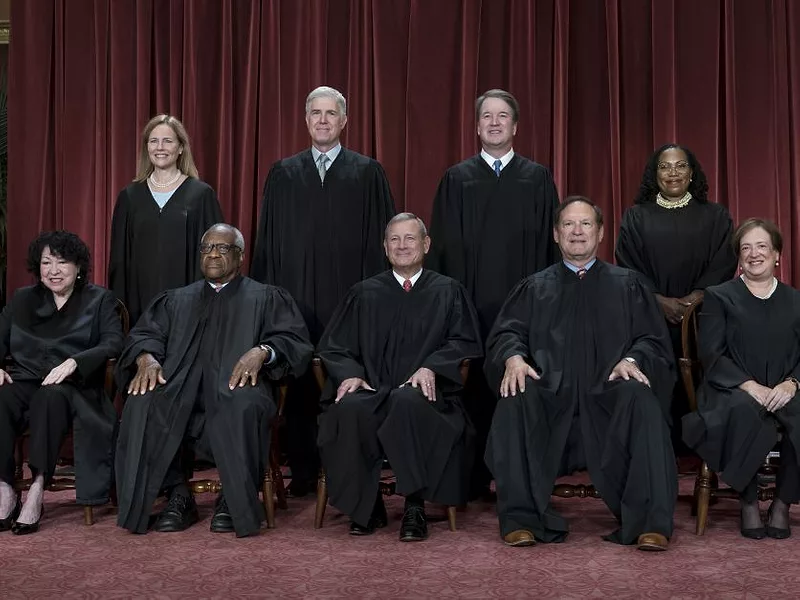
The Supreme Court on Friday issued its highly anticipated decision in a case challenging President Donald Trump’s use of emergency powers to impose tariffs, ruling 6-3 that the president overstepped his legal authorities.
The case focused on whether the 1977 International Emergency Economic Powers Act, which Trump used to slap new tariffs on almost every major trading partner last year, allows a president to impose tariffs. The dispute before the court was a consolidation of challenges brought by a slate of small businesses and 12 Democratic state attorneys general.
Solicitor General John Sauer had asserted in oral arguments that IEEPA’s granting of a president to “regulate ... importation" includes the right to impose tariffs. The justices, led by Chief Justice John Roberts, disputed this notion.
“[T]he President asserts the independent power to impose tariffs on imports from any country, of any product, at any rate, for any amount of time,” Roberts wrote. “Those words cannot bear such weight.”
Justices Sonia Sotomayor, Elena Kagan, and Ketanji Brown Jackson joined parts of Roberts' opinion, as did conservative justices Amy Coney Barrett and Neil Gorsuch.
Congress, not the president, has the constitutional authority to levy tariffs, they said, and when it has delegated that authority it has done so in clear language, often using the word “duty” explicitly.
“When Congress has delegated its tariff powers, it has done so in explicit terms, and subject to strict limits,” the opinion reads.
The justices also cast doubt on whether the persistent U.S. trade deficit constituted an emergency under IEEPA.
“The United States, after all, is not at war with every nation in the world,” Roberts wrote.
The ruling affects the so-called "reciprocal tariffs," unveiled last April which set specific duty rates for countries, as well as the 10% baseline tariff. It also affects tariff hikes applied to exports from Canada, Mexico, China and Brazil. Notably, it does not affect the tariffs on steel and aluminum, lumber and autos, which were not implemented through emergency powers.
Justices Clarence Thomas and Brett Kavanaugh filed dissenting opinions; Thomas and Justice Samuel Alito joined Kavanaugh’s dissenting opinion.
Kavanaugh was the most sympathetic to the administration’s arguments in November. He worked in the George W. Bush administration following the 9/11 terrorist attacks and has argued for the need for presidential flexibility during times of emergencies.
In his dissent, he speculated at what a refund process for the tariffs might look like.
“The Court says nothing today about whether, and if so how, the Government should go about returning the billions of dollars that it has collected from importers. But that process is likely to be a ‘mess,’” he wrote.
In his dissent, Kavanaugh wrote that the only legal question "is whether under IEEPA, tariffs are a means to 'regulate ... importation.' Statutory text, history, and precedent demonstrate that the answer is clearly yes: Like quotas and embargoes, tariffs are a traditional and common tool to regulate importation."
"As a matter of ordinary meaning, including dictionary definitions and historical usage, the broad power to 'regulate ... importation' includes the traditional and common means to do so — in particular, quotas, embargoes, and tariffs," Kavanaugh said in the dissent.
He cited two cases with similar facts in which the Supreme Court upheld tariffs. One involved President Richard Nixon's imposition of 10% tariffs "on almost all foreign imports" under IEEPA's predecessor statute, the Trading with the Enemy Act, which also used the words "regulate /// importation."
The other involved President Gerald Ford's use of tariffs in 1976, the year before IEEPA was enacted, under a "similarly worded statute" that allowed the president to “adjust the imports.”
Senate Agriculture Committee ranking member Sen. Amy Klobuchar, D-Minn, a former lawyer, said on social media that the ruling had confirmed her legal assessment.
"Today, the Supreme Court finally affirmed what I have been saying for a year: the Administration's reckless tariffs are illegal," she wrote to X.
Ways and Means Committee ranking member Richard Neal, D-Mass., called the ruling "a victory for the American people."
"Congress writes trade law, and today’s ruling restores that fundamental truth. The Constitution is clear, and no president—Trump or anyone else—can invent powers they do not have," he added in a statement posted Friday.
All eyes will now be on the Trump administration for clues to how it will respond. Trump and senior trade officials have repeatedly stressed that they don’t intend to let an adverse ruling derail the president’s trade agenda, pointing out that the administration has a raft of other legal tools it can wield to reimplement the duties.
Trump on Friday called the decision a "disgrace" while at an event with state governors, according to CNN. He also hinted that the administration has a backup plan ready to go.
U.S. Trade Representative Jamieson Greer told CNBC on Tuesday that the administration will "try to recreate that [trade policy program] in the best way possible so we can have continuity in what the president is doing."
The ruling also unblocks a slate of cases in lower courts that have been put on pause while the Supreme Court case plays out. More than a thousand plaintiffs have mounted their own legal efforts to secure tariff refunds.
The Trump administration used the threat of high tariffs to strong-arm several trading partners into making trade concessions in trade negotiations. It is not clear how the ruling will impact recently concluded agreements, including an Indonesia deal inked this week that saw Indonesia ease several non-tariff barriers for U.S. agriculture in exchange for a lower reciprocal tariff rate.
Rep. Adrian Smith, R-Neb., who chairs the Ways and Means trade subcommittee, is eying what U.S. trade partners might do next. In a statement Friday he argued that the administration needs to be vigilant for signs of backtracking.
The U.S. "must ensure our trading partners uphold the market access commitments," he wrote. "Nebraska’s farmers, ranchers, and manufacturers create world-leading products and deserve reliable access to global markets."
But Wendy Cutler, a former trade negotiator, told Agri-Pulse last month that countries that try to use the adverse ruling to reopen their deals run the risk of even higher tariffs imposed through alternative mechanisms.
"I'm not saying countries won't ask for that, but I don't think they have a lot of leverage," she said.
European Commission trade spokesperson Olof Gill said Friday that the Commission has been in contact with the Trump administration following the ruling and is seeking "clarity on the steps they intend to take."
For more news, go to Agri-Pulse.com.


