
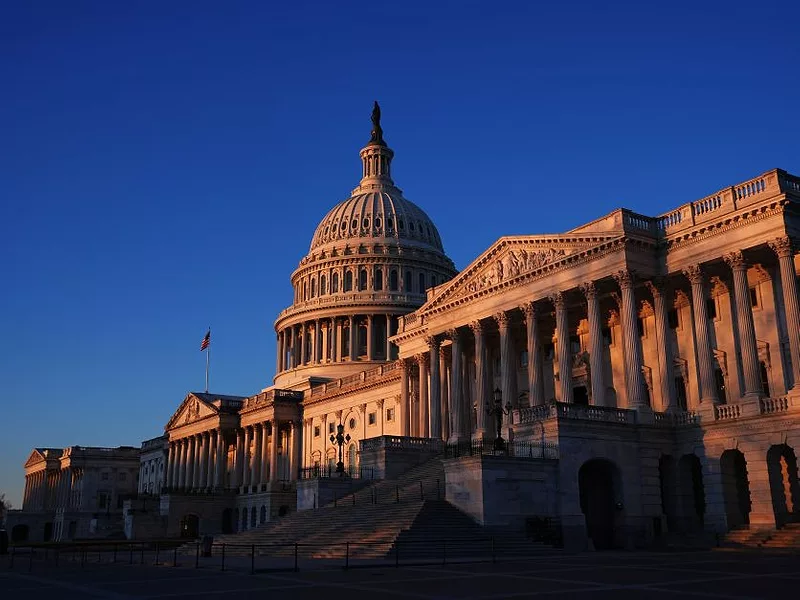
President Donald Trump has a crucial chance tonight to shore up his party’s political standing heading into the midterm elections. Trump is giving his State of the Union message to a joint session of Congress just days after expressing anger over the Supreme Court's tariff decision, which is likely to figure significantly in the speech.
The justices are expected to attend, but Trump said Friday he didn’t care if they were there or not.
“It’s going to be a long speech because we have so much to talk about,” Trump said Monday.
Farmers, ag leaders invited to SOTU
Farmers will be among the faces in the House gallery for Trump’s address.
House Ag Committee Democrat Don Davis of North Carolina has invited Nathanael Simmons, a farmer and 17-year-old high school senior, to the speech. Davis told Agri-Pulse he believes allowing Nathaniel to tell his story could help drive a discussion among lawmakers over ways to help get more young people into agriculture.
“He's a reflection, a symbol of this greater population that we have an obligation, a responsibility not to ignore, but to place back within reach, the ability to live the American dream right there on their family farms,” Davis said.
Rep. Juan Ciscomani, R-Ariz., has invited Arizona Farm Bureau Second Vice President and rancher Ben Menges to the event, while Rep. Mark Pocan, D-Wisc., will be bringing Wisconsin Soybean Association President Doug Rebout. Rep. Sharice Davids, D-Kansas, will be joined by Nick Levendofsky, the executive director of the Kansas Farmers Union.
Europe hits pause on implementing US trade pact as new tariffs go into effect
Trump’s new global tariff, which he says will reach 15%, went into effect today. Customs and Border Protection, meanwhile, has officially stopped collecting the emergency tariffs struck down by the Supreme Court.
Amid uncertainty in the aftermath of the court’s decision, the European Parliament will halt work on ratifying the U.S.-European Union trade pact agreed to last summer in Turnberry, Scotland, a senior lawmaker said on Monday.
The deal had been set to face a key vote today.
“Clarity [and] legal certainty are needed before any further steps can be taken,” said Bernd Lange, chair of the parliamentary international trade committee, in a post to social media.
The EU is particularly concerned that the new U.S. global tariff rate of 15% will be applied on top of existing tariffs. Under the terms of the deal agreed last year, most EU exports would face a tariff ceiling of 15%.
Administration opens applications for Feed the Future labs
The State Department is calling for statements of interest from organizations looking to host a Feed the Future innovation lab.
The Trump administration issued stop work orders to all but one innovation lab last year. More than a dozen labs were idled. But the program survived efforts to cut its funding, including a “pocket rescissions” package passed in August.
The merger of the shuttered U.S. Agency for International Development with the State Department brought the program under the purview of State’s Office of Global Food Security. A State official told Agri-Pulse in October that the department intended to revive the program.
The department expects to issue five to seven funding awards, according to the notice for applicants. It has $64 million in funding and anticipates a start date in late September.
Tariffs diversified used cooking oil imports, new study shows
Following the imposition of Trump’s emergency tariffs, U.S. imports of Chinese used cooking oil plummeted, new research finds.
North Dakota State University researchers note that used cooking oil imports from China fell 55% from January to November 2025, even as overall imports were close to 2024 levels.
The U.S. increased imports of used cooking oil from Australia, South Korea and Malaysia, the authors say.
Tallow imports were also disrupted by the tariffs, with imports from Brazil contracting sharply after a 50% tariff took effect in August. U.S. buyers pivoted to Argentina, which was subject to a 10% tariff.
Take note: Feedstock patterns are set to shift further. Starting Jan. 1, 2026, the 45Z tax credit excludes foreign feedstocks, incentivizing producers to use domestically sourced inputs.
RVO watch continues
A top USDA official is making it clear that any rollback of EPA’s proposed biofuel-blending rules would be a big mistake. Deputy Agriculture Secretary Stephen Vaden says the multiyear renewable volume obligations as written will be a “game changer.”
EPA is poised to send its final rules to the White House for review any day now.
Vaden and others at USDA’s Agricultural Outlook Forum last week praised EPA’s plan to encourage more use of domestic biofuel feedstocks, like soybeans and corn, by cutting in half the RIN credit for fuels made with foreign materials, such as Chinese used cooking oil or Brazilian tallow.
They also lauded EPA’s proposed reallocation of certain previously exempted renewable volume obligations (RVOs) for refineries by 100% or 50%.
What if? If the “half-RIN” is scrapped in the final rules, Devin Mogler, CEO of the National Oilseed Processors Association, says his group will “keep fighting.”
“We have to turn around and start working on the 2028 RVO, which is due this November, as soon as we get the ink dry on this one,” he says. “So, there's going to be more bites of the apple if it ultimately doesn't end up in there, but it's one of the most pro-farmer, pro-U.S. policies I've ever seen put forward in this space.”
On reallocation, Vaden was clear on the need for EPA to move ahead with its plan, saying it comes down to “telling the truth” about mandated volumes.
Emily Skor, CEO of the ethanol lobby group Growth Energy, says she’s optimistic about the RVOs because Trump has been clear in his support for strong biofuel policy.
Final Word
"I'm still pouring through the bill, but I want to be very clear that I'm definitely not ruling out voting for the farm bill." – Rep. Don Davis, D-N.C., when asked if he planned to vote for the farm bill the House Agriculture Committee will consider starting March 3.
For more news, go to Agri-Pulse.com.

.webp?t=1762183428)


