
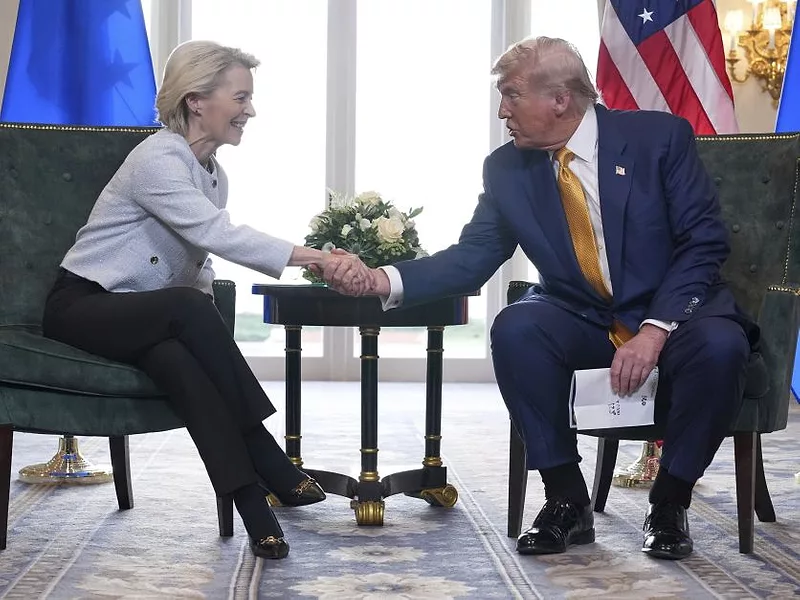
The U.S. and the European Union have come to an agreement to avoid President Trump’s steepest tariff increases from Aug. 1, with the EU accepting a 15% baseline tariff rate and agreeing to increase its investment in the U.S. and boost energy purchases, both leaders said on Sunday.
Trump met with European Commission President Ursula von der Leyen during a trip to his Turnberry golf course in Scotland.
Under the terms of the deal, the EU agreed to invest $600 billion in the U.S. beyond current investments, Trump told reporters alongside the Commission president, and will buy $750 billion of U.S. energy. The president added that it will face a 15% tariff on exports to the U.S., including automobiles.
"They're agreeing to open up their countries to trade at zero tariff," Trump said, adding that had been a "very big factor," in securing a deal.
At a press conference following the meeting, Von der Leyen said the EU had agreed to "zero-for-zero" tariff reductions in several concentrated industries, including for "certain agricultural products, natural resources and critical raw materials."
But the Commission president added that some of the details on the agri-food provisions were still in flux. Asked about specific agricultural products that might receive the "zero-for-zero" tariff arrangement, including wines and spirits, Von der Leyen said "there's no decision on that one. This is something which has to be sorted out in the next days."
Nonetheless, Trump argued during their joint press conference that the deal could lead to increased diversification of agricultural products in the European market; The White House did not immediately respond to a request from Agri-Pulse on any further ag provisions included in the deal.
The bloc had been set to face a 30% tariff from Aug. 1 after Trump wrote to von der Leyen earlier this month with a renewed tariff threat.
The arrangement is the second such deal in the last week that leaves 15% duties in place. A similar pact with Japan announced Tuesday also upholds a 15% tariff and includes similar investment and purchase commitments.
In both cases, the 15% tariff rate represents a hike on current U.S. tariff levels. Both countries have faced an across-the-board tariff rate of 10% since April. Autos have faced a sector-specific 25% duty.
As with other pacts, including one with the United Kingdom that left 10% tariffs in place, both sides will use the initial arrangement as a framework to secure further reductions for tariffs and non-tariff trade barriers, Von der Leyen said on Sunday.
Trump also suggested on Sunday that further deals could emerge before his Aug. 1 tariff deadline, when dozens of countries are set to see steep tariff hikes.
“We're looking at deals with three or four other countries,” Trump told reporters. But he added, “This was the big one. This is the biggest of them all.”
Asked what concessions the U.S. had made in the trade talks, von der Leyen said that the purpose of the deal had been to ensure transatlantic trade could continue, unimpeded, while reducing imbalances in the cross-border trade relationship.
“The starting point was an imbalance, a surplus on our side and the deficit on the U.S. side,” von der Leyen said. “We wanted to rebalance the trade relations, and we wanted to do it in a way that trade goes on between the two of us across the Atlantic. … I think we hit exactly the point we wanted.”
Senate Majority Whip John Barrasso, R-Wyo., was quick to tout the deal's potential benefits for his home state.
"Wyoming’s energy workers are ready to power the world. Thank you, POTUS," the senator wrote to X.
Although the EU has had to swallow a 15% baseline tariff, the fact that other countries -- with the exception of the UK -- have only secured comparable rates or higher, should bode well for the bloc, Daniel Mullaney, former assistant U.S. Trade Representative for Europe and the Middle East, told Agri-Pulse.
Tariff rates in line or lower than critical competitiors is "a key competitive indicator of success," said Mullaney, who is now a nonresident senior fellow at the Atlantic Council. But he added that von der Leyen's acceptance of the 15% tariff rate could draw criticism from some European quarters that don't want to be seen as rewarding "what they see as bad behavior."
The Commission had already assembled a package of retaliatory tariffs in preparation for a no-deal scenario. Some may press for a portion of those retaliatory tariffs to be put into place over the 15% rate, Mullaney argued.
"If successful, this could throw the deal off the rails between now and Aug. 1," Mullaney said.
For more news, go to Agri-Pulse.com.

