
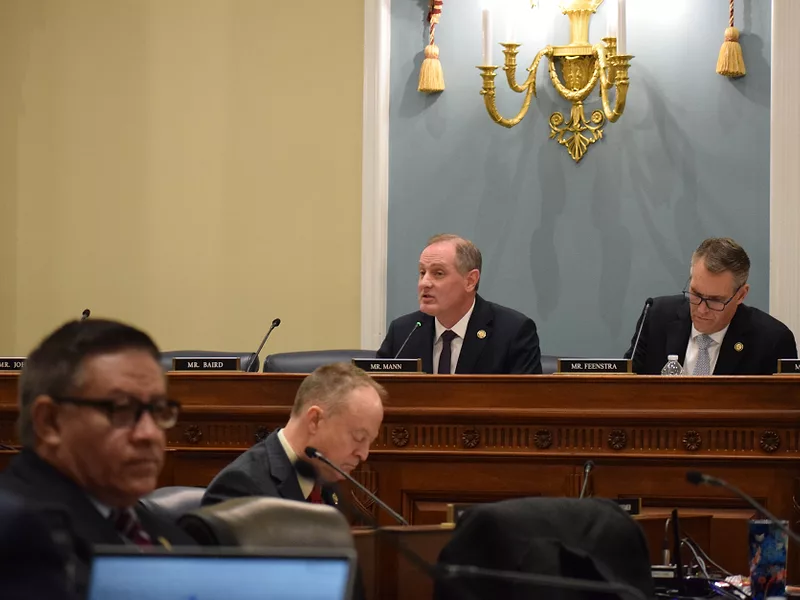
Farm bill deliberations got off to a raucous start Tuesday night.
A marathon of opening statements teed up further debate this week on tariffs, food costs, farm economics, nutrition assistance and pesticide safety.
House Ag Committee Chairman Glenn “GT” Thompson, R-Pa., opened by defending the Republican-led bill from attacks by the panel’s top-ranking Democrat, Angie Craig.
Thompson said the absence of investment in anti-hunger programs like SNAP was due in part to an “inability” to engage Democrats on how to pay for such spending.
“While we have not abandoned these priorities, more work is needed to ensure these investments are responsibly funded,” Thompson said.
Democratic pushback: Craig said only 10% of Democratic priorities are in the bill. She and others also went after President Donald Trump’s trade policies for hurting ag producers.
“Despite the administration’s claims, all is not well in farm country,” Craig said an opening salvo against the legislation.
Craig decried what she calls “poison pills,” including pesticide provisions sought by major manufacturers like Bayer and supported by major farm groups.
MAHA, bankruptcies
Rep. Jim McGovern called the bill “one giveaway after another to the pesticide companies.”
The Massachusetts Democrat said the legislation clashes with the Make America Healthy Again movement.
“Your farm bill makes food less healthy and more expensive,” McGovern said. “In short, your farm bill is a betrayal of MAHA.”
Democratic Rep. Jim Costa of California repeated his call for Agriculture Secretary Brooke Rollins to appear before the committee and explain the USDA’s plan to reorganize the agency across five states.
He assailed the plan for not including California, the country’s biggest ag producer and exporter.
Democratic Rep. Alma Adams of North Carolina said more farms are at risk of going under.
Interested in more news on farm programs, trade and rural issues? Sign up for a four-week free trial to Agri-Pulse. You’ll receive our content - absolutely free - during the trial period.
“Not exactly the golden age that was promised,” she said.
Follow our coverage at Agri-Pulse.com
Common ground, conservation
Republicans also said farm bankruptcies are a concern. Other common ground included agreement that farm input prices are too high – and interest rates, too.
Craig noted bipartisan provisions in the farm bill. These include expanding rural broadband access, boosting USDA loan limits and making crop insurance more affordable for veterans.
Thompson stressed that his proposed bill would improve conservation programs.
She said it. Rep. Kat Cammack, R-Fla., said at one point during the meeting that there had been “an incredible amount of blaming being thrown around the room and pointing of fingers of which administration to blame. You know, the farm economy is hurting. Candidly, our producers don't care who broke it. They just want it fixed.”
Iran conflict sends shockwaves across ag supply chains
Iran’s threats to attack any ship moving cargo in the Strait of Hormuz is rippling across U.S. markets, including fertilizers.
Around 45% of global urea is produced in sites in and around the strait, Bloomberg Intelligence fertilizer analyst Alexis Maxwell told Agri-Pulse Tuesday.
“We're seeing prices trade up sharply,” she said. Egyptian prices jumped from $490 per metric ton last week to $620 on Tuesday afternoon.
The price jumps couldn’t have come at a worse time for U.S. farmers, Maxwell said. With planting approaching in April, fertilizer purchases need to occur in the next 15 to 30 days to ensure they arrive in time for application.
Take note: President Donald Trump on Tuesday afternoon said the U.S. would begin escorting oil tankers through the strait, if necessary, to limit trade disruptions. In a social media post, he teased that “more actions” would follow but did not mention fertilizer directly.
But, but, but: Trump has also fanned trade uncertainty stemming from the conflict. In the Oval Office on Tuesday, he told reporters that he had directed Treasury Secretary Scott Bessent to “cut off all dealings with Spain” over its decision to bar U.S. planes from using their bases to attack Iran.
Syngenta to cease paraquat production
Pesticide manufacturer Syngenta is ending its global production of paraquat, citing competition with generic producers of the ingredient.
The company will be phasing out paraquat production at its site in Huddersfield, located in the United Kingdom, by the end of June. A press release says this is Syngenta's only manufacturing facility for paraquat globally, and that the ingredient accounts for less than 1% of the company’s global sales.
“This decision is about focusing our resources where they deliver the greatest value for our business and our customers,” Mike Hollands, the president of Syngenta UK and head of the company's global production and supply division, saya in the release.
Take note: Syngenta is facing thousands of lawsuits in the U.S. alleging exposure to paraquat-caused Parkinson’s disease.
Environmental groups guardedly welcomed the Syngenta announcement but said the herbicide still needs to be banned.
“It’s great news that Syngenta is exiting the paraquat business, but it’s also a reminder that smaller companies will readily fill the void as long as this poison remains approved in our borders,” the Center for Biological Diversity’s Nathan Donley told The Guardian.
Industries across US economy urge USMCA extension, minimal disruptions
A coalition of dozens of U.S. industries, including groups from across U.S. agriculture, is calling on the Trump administration to minimize disruptions as it reviews a North American trade pact.
In a letter to U.S. Trade Representative Jamieson Greer on Tuesday, almost 70 groups pledged their “strong support” for the U.S.-Mexico-Canada Agreement and asked that any reforms are “clear” and “implementable.”
“Material changes to USMCA requirements or rules of origin could lead to multi-year supply chain disruptions at significant cost to companies invested in America, raise consumer prices, and erode North American competitiveness,” the groups write. “Maintaining duty-free treatment for USMCA-compliant goods throughout this process is an indispensable prerequisite for North American stability.”
The American Seed Trade Association, National Corn Growers Association, American Soybean Association, National Council of Farmer Cooperatives, Corn Refiners Association, CropLife America and National Pork Producers Council are among the signatories.
Lindberg to appear before appropriations subcommittee
USDA Undersecretary for Trade and Foreign Agricultural Affairs Luke Lindberg will testify before the House Ag Appropriations Subcommittee this morning.
Expect Lindberg to tout the administration’s recent trade missions to Indonesia, Mexico and Peru, among others. His appearance comes as sources say he is in the running to succeed Cindy McCain as the executive director at the UN World Food Program.
Final word
“My general rule on nutrition advice is never take nutrition advice from a, usually a man, with his shirt off.” – Peter Lurie, president and executive director of the Center for Science in the Public Interest, on Health and Human Services Secretary Robert F. Kennedy Jr.
For more news, go to Agri-Pulse.com.

.webp?t=1762183428)


