
President Donald Trump’s suggestion that the Navy could escort ships through the Persian Gulf has done little to stem the rise of fertilizer prices caused by the widening Middle East conflict.
As of Thursday, vessel traffic in the Strait of Hormuz was still at a standstill.
“If this continues, it is impossible to know just how bad it gets,” StoneX fertilizer analyst Josh Linville said in a note to reporters Thursday. Four of the seven largest urea producers are affected by the war, including Egypt, which has seen supplies of Israeli gas interrupted, Linville said.
“It will essentially turn into a market where the highest bidder gets the tons,” Linville said.
The impacts are not limited to urea. The disruption to natural gas supplies is likely to impact ammonia production, Corey Rosenbusch, CEO at The Fertilizer Institute, said in a post to social media. And around 50% of the world’s sulfur, major input in phosphate fertilizers, comes through Hormuz, he said.
If the disruption persists and farmers struggle to get urea by planting time, demand for other fertilizers could also rise, driving prices higher, Bloomberg Intelligence’s Alexis Maxwell told Agri-Pulse.
Freight prices also are up as vessel supplies tighten, even on routes far from the conflict.
Analytics firm Xeneta noted in a statement to reporters Thursday that capacity is down more than 5% from a week ago on routes from Asia to the U.S. West Coast and over 7% from Asia to the East Coast.
“It’s gonna pass”
That’s the word from House Agriculture Chairman Glenn “GT” Thompson on the prospects of his committee’s farm bill clearing the House of Representatives.
The legislation approved by the Republican-led panel in the early hours of Thursday drew support from seven Democrats, even after heated partisan debates over food assistance cuts, pesticide labeling and other issues.
Thompson tells Agri-Pulse that unlike 2024, when Democrats had control of the chamber, the latest farm bill will advance to a full vote on the House floor.
“We’ve got a good pathway,” the Pennsylvania Republican said. “I know there are Democratic members who are not on the Ag Committee who are pretty excited about the farm bill.”
Take note: The House is out of session until March 16.
E15 wait almost over? Rep. Randy Feenstra, R-Iowa, tells Agri-Pulse a bill aimed at expanding the U.S. ethanol market is expected to be finalized as soon as Friday.
The House Legislative Counsel, which helps write new bills, is working on a measure that would allow year-round and nationwide sales of higher-ethanol blends, known as E15, says Feenstra, co-chair of the Rural Domestic Energy Council.
State AGs, governors challenge Trump’s new global tariff in court
Just weeks after the Supreme Court felled Trump’s emergency tariffs, his plan B is also facing legal scrutiny.
A group of Democratic state attorneys general and two governors filed a lawsuit at the Court of International Trade on Thursday challenging the president’s new global tariff.
The legal authority Trump used, known as Section 122, is supposed to be used to address balance-of-payments issues and protect the dollar’s stability.
“Notably, a trade deficit is not a balance-of-payment deficit, meaning that once again the president is acting unlawfully,” a press release from Arizona Attorney General Kris Mayes reads.
Trade lawyer Ryan Majerus at King & Spalding tells Agri-Pulse that the argument has legs.
Interested in more news on farm programs, trade and rural issues? Sign up for a four-week free trial to Agri-Pulse. You’ll receive our content - absolutely free - during the trial period.
“This is not what the law was intended for,” he said. But he added that, like the original IEEPA challenges, the case and any appeals could take more than a year to play out, and a judge is unlikely to suspend the tariffs in the meantime.
The recent SCOTUS ruling may make it even harder to get a preliminary injunction to suspend the duties, he said. Several justices in their IEEPA decision specifically noted that Trump had other statutes to impose tariffs, like Section 122.
Rollins’ former top adviser launches campaign for Congress
Kailee Buller, who was Ag Secretary Brooke Rollins’ chief of staff until mid-February, has officially launched her campaign for New York’s 22nd congressional district.
She is seeking to unseat House Ag Committee member and first-term Democrat Rep. John Mannion in a “solid Democrat” race, according to the Cook Political Report’s most recent rating.
“Conversations with families, farmers, and small business owners across the region have made clear that Central New York needs stronger and more bipartisan representation in Washington,” Buller said. She grew up in Auburn, just 30 miles west of Syracuse, in the district.
NY-22 is home to just over 2,000 farms, according to the 2022 Census of Agriculture.
Dairy and livestock sales represent about two-thirds of ag product sale value. The region is also home to apple orchards and a variety of fruit, tree nut and berry production.
In the announcement, Buller touted her experience as a working mom of three as well as a food and economic policy expert. She has led both the National Oilseed Processors Association and Edible Oil Producers Association and served in various policy adviser roles at USDA during the first Trump administration. She enters the race with the backing of all New York Republican and conservative party county and state chairs.
Back at USDA: Tate Bennett, the former director of rural policy at the Trump-aligned America First Policy Institute, became Rollins’ chief of staff immediately upon Buller’s departure.
Protein interest will boost meat demand, industry leader says
The meat industry is likely to demand accelerate in coming years due to the new attention on protein that’s reflected in the federal government’s new MAHA-inspired dietary guidelines. That’s the view of Julie Anna Potts, president and CEO of the Meat Institute.
“We have the benefit of not just federal government policy, but also influencers, health advocates, folks in the gym, dieticians,” Potts says in an interview for this week’s Agri-Pulse Newsmakers.
“There's just a lot of attention to the role of protein in health. And so, I expect that this is a paradigm shift. It's going to be a more permanent change. And I believe we will see demand numbers rise over the normal level of increases year over year.”
Potts also talks about how she sees the administration handling the saturated limit fat that’s still in the government’s dietary guidelines.
Newsmakers will be available today at Agri-Pulse.com.
Mullin takes over for Noem at DHS
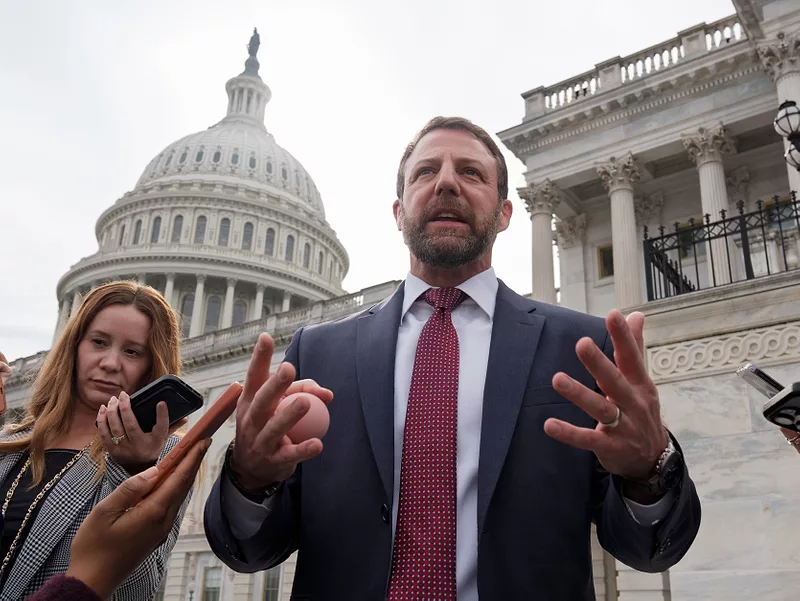
Oklahoma Sen. Markwayne Mullin, a staunch defender of President Trump’s policies, is replacing Kristi Noem as secretary of the Department of Homeland Security.
The Republican started his political career in 2012 as a congressman representing the state’s second district in eastern Oklahoma. He became a senator in 2022 when he won a special election to fill retiring Sen. James Inhofe’s seat.
Mullin first ran on the slogan of "A rancher. A businessman. Not a politician!" and has long railed against regulations written by “Washington bureaucrats.”
In an interview with Agri-Pulse’s Meet the Lawmaker in 2013, Mullin discussed his upbringing in Oklahoma and why he chose to run for office.
“It seems like we’re constantly having to ask permission from the federal government to run our own company so I got fed up,” he said. “I got fed up with the fact that the biggest threat to our way of life is the federal government.”
Final word
“GT did a tremendous job of shepherding it through and so we're going to be visiting with him, visiting with people on our committee, and seeing if we can do as good a job getting our bill out. … [But] our dynamics are a little bit different than his, as far as the makeup of the committee.” — Senate Ag Committee Chair John Boozman, R-Ark., on the House farm bill advancing out of committee.
For more news, go to Agri-Pulse.com.

.webp?t=1762183428)


