
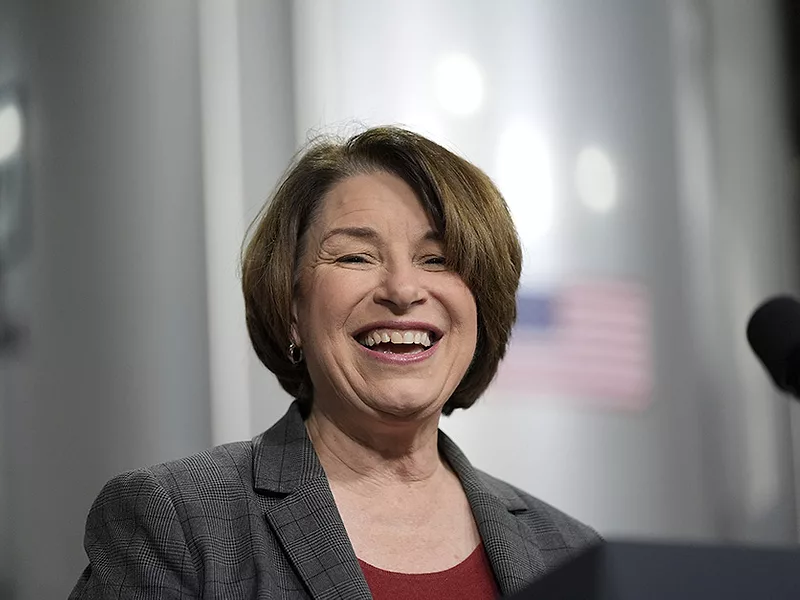
The House Ag Committee’s new farm bill heads to the floor with some significant Democratic support behind it. Seven committee Democrats voted for the measure. But the top Democrat on the Senate Agriculture Committee, Amy Klobuchar, says the legislation won’t attract Democratic votes in that chamber unless it addresses some SNAP cuts that Republicans forced through Congress last year.
"I think that these shifts of the SNAP cuts to the states are going to unite Democrats in the Senate,” the Minnesota senator told Agri-Pulse. The One Big Beautiful Bill Act passed last year requires states to start paying 5% to 15% of SNAP benefit costs if they have a payment error rate above 6%.
“The Republican governors came out and said they can't do it. So, I think that should be part of the deal,” she said.
Iran fallout: Fertilizer jitters
The heads of major farm groups appear before a Senate Agriculture Committee hearing this afternoon to discuss domestic ag markets. Global concerns are sure to come up too, as war in the Middle East disrupts availability of fertilizer. The supply squeeze could have lasting impacts on U.S. production and prices, analysts and producers say.
The Southern Hemisphere faces an even bigger risk for corn and soybeans later this year because of the conflict’s timing versus the cropping seasons, says AgResource Co. President Dan Basse.
“It’s all about Brazil,” Basse told Agri-Pulse Monday after a trip to the South American nation. “If indeed this war does not end, let's say by the end of June, that becomes a very big risk and a real risk in terms of productivity for the Southern Hemisphere.”
Duvall asks Trump to secure fertilizer supply chains
American Farm Bureau President Zippy Duvall is calling on President Donald Trump to take steps to shore up U.S. fertilizer supplies. In a letter to Trump on Monday, Duvall warned that the fertilizer supply shock could lead to a production shock if producers don’t get the fertilizer they need for the coming planting season.
Interested in more news on farm programs, trade and rural issues? Sign up for a four-week free trial to Agri-Pulse. You’ll receive our content - absolutely free - during the trial period.
Accordingly, he asked the president to use the U.S. Navy to protect fertilizer cargos through the Strait of Hormuz, deploy tools to address insurance and financing issues for carriers, as well as suspend countervailing duties on fertilizer imports.
“Not only is this a threat to our food security – and by extension our national security – such a production shock could contribute to inflationary pressures across the U.S. economy,” Duvall wrote.
WASDE watch today
USDA’s monthly crop report due out later today is expected to be little changed from February, though market watchers will be looking for any mention of the potential impact of the Iranian conflict.
USDA’s survey-based prospective planting intentions is typically the bigger report to watch this month. Dan Basse expects about 1 million acres initially planned for corn this spring to shift to less fertilizer-reliant soybeans due to a 25% rise in nitrogen prices.
By the way: The latest WASDE, which stands for World Agricultural Supply and Demand Estimates, is set for release on the heels of top corn growing groups calling for an investigation of the methodologies used by USDA in calculating its forecasts. Revisions, including a big one for corn supplies in January, have drawn scrutiny to the accuracy of the reports.
A USDA spokesperson told Agri-Pulse on Monday that while "the data and statistics used to inform these reports are often considered the benchmark for other agricultural forecasts, there is always room for improvement to further enhance accuracy and usefulness."
The agency said it “remains committed to providing timely, accurate, and useful statistics in service to American agriculture” and encourage all stakeholders to provide feedback via its website.
NFU calls for sweeping ag measures
Delegates to this year’s National Farmers Union convention in New Orleans have approved a broad set of recommendations to address what the group says is “immense financial pressure” that is “reminiscent of the 1980s farm crisis.”
In a special order of business, the NFU members called on Congress to pass “comprehensive agricultural legislation that not only addresses a safety net for agricultural products, but supports communities, builds jobs, and establishes long term markets.”
The policy priorities set by NFU delegates include an immediate moratorium on farm loan foreclosures and a new law to “address market consolidation in our communities and decentralize production, processing, and marketing.” NFU also is calling for a “comprehensive debt restructuring initiative, modeled after the Troubled Asset Relief Program (TARP)” of the 2008-2009 financial crisis.
USDA ends paper-packaging checkoff
USDA has terminated the paper and paper-based packaging checkoff program after manufacturers and importers voted to end it last year. In the Federal Register, USDA announced it was ending the program, which was first established in 2014. Two checkoff board members have been named trustees to liquidate affairs.
Last summer, about 73.5% of paper manufacturers and importers voted in a referendum to terminate the program, according to the notice.
USDA to offer $20 million for school kitchen equipment upgrades.
USDA’s Food and Nutrition Service plans to make $20 million available for schools to install new equipment that can help with scratch cooking.
The announcement by Jess Saracino, acting associate administrator for child nutrition programs at FNS, came at the School Nutrition Association’s Legislative Action Conference. School meal providers are concerned about the resources needed to fulfill the “eat real food” promise of the Dietary Guidelines for Americans. A 2020 study cited by one attendee said it would cost $5.8 billion just for California schools to become scratch-compliant.
Saracino and other FNS officials at the meeting said a proposal to implement the guidelines in school meals would be out for comment this year. They urged all those in attendance to make their views known.
“We know you're going to comment, and we're looking forward to that,” said Tina Namian, deputy associate administrator for child nutrition programs, drawing chuckles from the audience.
Final word
"I'm hoping this is just a blip in the screen. I'm hoping that this war is over very soon, and that with it, the prices will come back down. But they were high to start with, so we've got challenges ahead of us." -- Sen Roger Marshall, R-Kan., on soaring fertilizer prices following the Iran strikes.
For more news, go to Agri-Pulse.com.

.webp?t=1762183428)


