
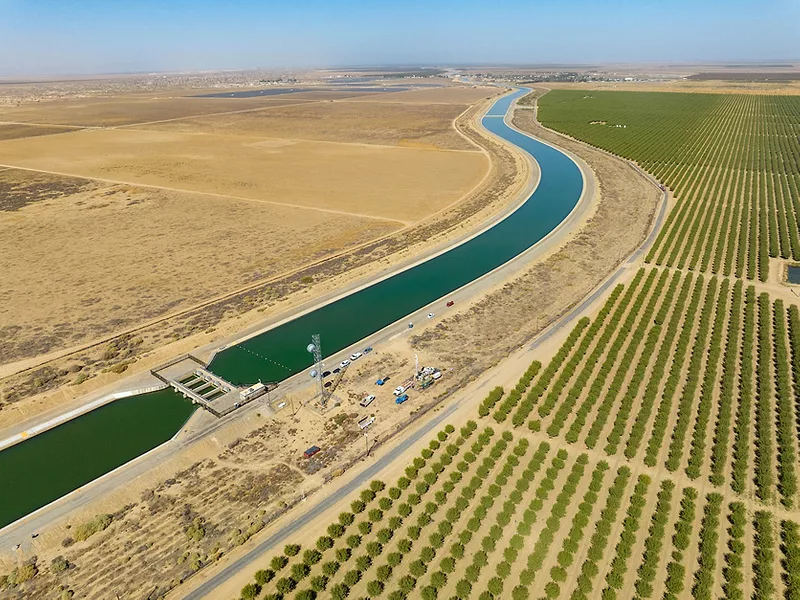
Farmers in the Westlands Water District produced more than 50 high-quality crops in 2025 while leaving hundreds of thousands of acres idle due to ongoing water uncertainty, according to the district’s latest crop report.
The report shows that growers in the sprawling Central Valley district continue to play a significant role in national food production. Westlands farms produce roughly 3.3% of the nation’s fruit and nut crops and 2.8% of its vegetables and melons, underscoring the district’s importance to the U.S. food supply.
At the same time, water constraints remain a major factor shaping production decisions. The district reported that more than 242,000 acres were fallowed in 2025, largely because of an unreliable water supply.
“Water reliability directly translates to food reliability,” said Allison Febbo, district general manager. “When Westlands growers have access to essential water supplies delivered through the [Central Valley Project] that power agriculture, they produce the fruits, vegetables and nuts Americans depend on every day.”
Interested in more news on farm programs, trade and rural issues? Sign up for a four-week free trial to Agri-Pulse. You’ll receive our content - absolutely free - during the trial period.
The district spans more than 563,000 irrigable acres, though less than 300,000 acres were in production last year.
Pistachios remained the district’s largest crop by acreage at 83,802 acres, followed by almonds at 72,857 acres and processing tomatoes at 39,460 acres. Other leading crops included wheat, garlic, cantaloupes, onions and wine grapes.
Growers are also experimenting with new crops as they adapt to water challenges and shifting markets. The report notes that agave acreage nearly doubled between 2024 and 2025, reflecting interest in the drought-tolerant plant used to produce syrup and spirits such as tequila and mezcal.
Meanwhile, crops such as basil, broccoli, cherries, grapefruit and hemp expanded in acreage, while wine grapes, tangerines, pistachios and peaches posted slight declines.
Despite the production challenges, agriculture in Westlands remains a major economic driver for the region. District-supported agriculture generated an estimated $3.6 billion in economic activity and supported more than 28,000 jobs, according to a recent analysis cited in the report.
District growers are increasingly relying on precision agriculture tools and advanced irrigation systems to stretch limited water supplies.
Those technologies, along with soil moisture monitoring and other conservation practices, have helped Westlands farmers remain among the most water-efficient producers in the world.

