
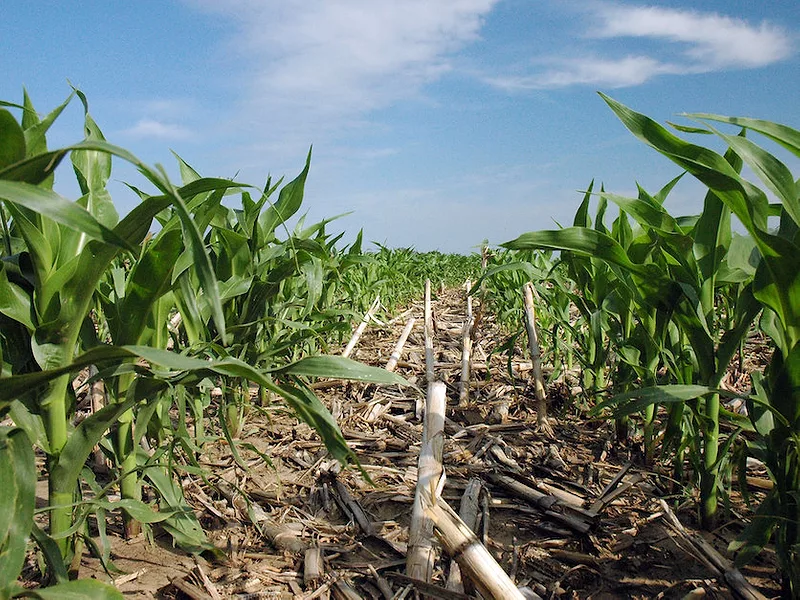
Regulations for the new 45Z biofuel tax incentive need to account for cover crops, precision fertilizer applications and other regenerative agriculture practices to ensure that farmers fully benefit from the subsidy, farm-state Republican lawmakers say in a letter to the Trump administration.
The Internal Revenue Service is currently finalizing regulations for the tax credit that was created by the Inflation Reduction Act in 2022, then modified and extended by the One Big Beautiful Bill Act in 2025. USDA is developing a separate tool calculating the carbon intensity of agricultural feedstocks.
“It is critical the final rule clearly identifies the types of on-farm conservation practices capable of generating lower-carbon feedstocks and ultimately qualifying for a premium under 45Z,” the lawmakers led by Sen. Joni Ernst, R-Iowa, and Rep. Mariannette Miller-Meeks, R-Iowa, say in the letter to Treasury Secretary Scott Bessent, Agriculture Secretary Brooke Rollins and Energy Secretary Chris Wright.
“Examples of these practices include, but are not limited to no-till, cover crops, strip till, manure application, and optimized fertilizer use,” the letter says.
The letter was signed by seven other senators and 14 additional House members.
The 45Z credit is meant to encourage domestic production of renewable fuels using home-grown feedstocks, like corn and soybeans. The base value hinges on the carbon footprint, or carbon intensity score, of a fuel's entire production chain, replacing a flat $1-a-gallon credit.
"I’m urging the administration to keep the pedal to the metal when it comes to 45Z by acknowledging and rewarding farmers for their work out in the field," Ernst said in a statement to Agri-Pulse. "Getting this across the finish line will add value to American-grown crops and is essential to bolstering energy independence, creating jobs, and lowering prices at the pump.”
Interested in more news on farm programs, trade and rural issues? Sign up for a four-week free trial to Agri-Pulse. You’ll receive our content - absolutely free - during the trial period.
In proposed 45Z regulations released last month, the Treasury Department said it expects the pending USDA tool for calculating carbon intensity of feedstocks using certain farming practices to eventually be folded into the 45Z rules, yet a timeframe wasn’t given.
The proposal also didn’t specify what type of farming methods would be eligible in determining a feedstock’s greenhouse-gas footprint, though said these could include no till, reduced till, cover crops, and nutrient management.
U.S. corn has faced intensified pressure in the last few years to decarbonize as ethanol amid competition from rival Brazil.
Related: 45Z credit puts regenerative agriculture in spotlight
Ernst and the other lawmakers are urging the administration to act quickly so farmers can potentially benefit from the credit this year.
“Planting season is a few short weeks away in many parts of the country, and farmers need clear answers soon to fully take advantage of 45Z,” the lawmakers write.
The Republican lawmakers said the final rule shouldn’t repeat a Biden-era requirement that to qualify for a now expired sustainable aviation fuel tax credit, farmers had to “bundle” together certain ag practices
“Instead, 45Z guidance should provide farmers with maximum flexibility to implement a wide range of practices based on what works best for their farm,” the letter says.“Moreover, the guidance must ensure the credit does not box out family farmers from participating by imposing unnecessary red tape or overly prescriptive requirements.”
Other requests for the 45Z rules include:
- Fully integrating a USDA feedstock calculator into the Energy Department’s so-called GREET model in a timely manner. “Only with this integration can farmers’ real-world conservation efforts and regenerative practices be accurately measured and rewarded under 45Z.”
- “Swift implementation of distinct emission pathways for animal manure-derived renewable natural gas."
- A “book and claim" system that allows farmers to sell low-carbon data certificates to fuel producers separate from their physical grain.
In addition to Ernst and Miller-Meeks, the letter was signed by Sens. Chuck Grassley of Iowa, Roger Marshall and Jerry Moran of Kansas, Deb Fischer and Pete Ricketts of Nebraska, Jon Husted of Ohio, and Mike Rounds of South Dakota; Reps. Adrian Smith, Mike Flood and Don Bacon of Nebraska, Tracey Mann and Derek Schmidt of Kansas, Michelle Fischbach and Brad Finstad of Minnesota, Ashley Hinson and Zach Nunn of Iowa, David Valadao of California, Erin Houchin of Indiana, Mike Bost and Darin LaHood of Illinois, and Tony Wied of Wisconsin.
For more news, go to Agri-Pulse.com.
.webp?t=1762183428)

