
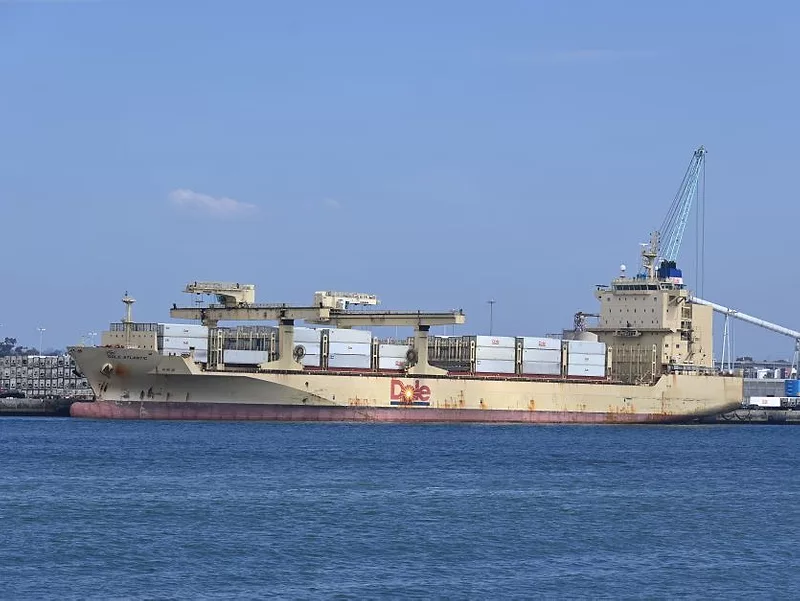
The Trump administration is considering easing a century-old law requiring U.S. vessels to carry goods between U.S. ports in an attempt to address prices for energy and "agricultural necessities."
The Merchant Marine Act, better known as “The Jones Act,” was signed in 1920 and requires goods shipped between U.S. ports to move on U.S.-built, flagged, owned and staffed vessels. It was intended to ensure the U.S. maintained a domestic supply of ships and crew that would be available in times of war, according to analysis from the Cato Institute.
White House Press Secretary Karoline Leavitt said Thursday that officials are weighing suspending the law to facilitate trade.
“In the interest of national defense, the White House is considering waiving the Jones Act for a limited period of time to ensure vital energy products and agricultural necessities are flowing freely to U.S. ports,” Leavitt said in a statement shared with Agri-Pulse. But she stressed that the action “has not been finalized.”
A White House official could not provide additional details on which “agricultural necessities” might be affected.
Fertilizer supply chains have been roiled by the conflict. Shipping in the Strait of Hormuz has fallen sharply. With production and trade disruptions affecting countries that supply almost half of global urea exports and almost a third of global ammonia exports, according to the American Farm Bureau Federation, prices have soared.
Global supplies of sulfur, a key component in phosphate fertilizers, are also constrained.
Interested in more news on farm programs, trade and rural issues? Sign up for a four-week free trial to Agri-Pulse. You’ll receive our content - absolutely free - during the trial period.
“The tail to this situation continues to grow,” Douglas Wright, a Kansas-based fertilizer consultant, told Agri-Pulse Thursday.
Iran's new supreme leader on Thursday vowed to keep the Strait of Hormuz closed in a statement broadcast on Iranian state television. The country mounted fresh attacks on ships in and around the strait on Wednesday, sending oil prices higher on Thursday.
Unlike the aftermath of Russia’s invasion of Ukraine when input prices jumped, the Middle East is not a major producer of agricultural commodities. Accordingly, commodity prices have not increased alongside input costs, putting an even tighter squeeze on U.S. farmers, researchers at North Dakota State University noted on Thursday in their monthly ag trade monitor report.
“The key uncertainty in 2026 is how long the Strait will remain closed,” they wrote. “A prolonged closure could push fertilizer prices toward or beyond 2022 peaks, compressing farm income margins in ways that 2022 did not.”
Former USDA Chief Economist Joe Glauber told Agri-Pulse Thursday that the price in the spike of oil could also lead to higher food prices for U.S. consumers.
“Energy is a big portion of retail food prices,” he said, adding that sustained higher oil prices will soon show up in grocery story price tags.
“These are early days,” Glauber said. “There's a lot of wild cards.”
Easing shipping rules on trips between U.S. ports will provide some relief, but economists warn that the price benefits could be limited.
Alex Jacquez, chief of policy and advocacy at Groundwork Collaborative and a former economic official in the Biden White House, told reporters in a statement that a waiver could shave just a few cents off gasoline prices.
“Think whatever you want about the Jones Act, the impact on retail gas prices will be less than 2 cents a gallon. Negligible,” he said.
The benefits for U.S. fertilizer prices could be equally negligible, Josh Linville, StoneX's vice president of fertilizer, told Agri-Pulse. Some buyers on the East and West coasts could see some benefits, but the Corn Belt, which receives it fertilzer by rail or barge.
"It is the tiniest of band aids on a gaping wound right now," Linville said.
Scott Lincicome, vice president of economics at Cato’s center for trade policy studies, also cast doubt on the impacts of the policy on U.S. prices.
“It certainly won't get prices back to pre-war levels,” he said in a post to social media. But he argued that doesn’t mean the administration shouldn’t waive the act, adding that any supply chain efficiencies could help.
For more news, go to Agri-Pulse.com.

